09/25/2026 - Articles

Create Quotes from Project Data: How to Automate Complex Quotes

Creating quotes from project data means using existing customer, project, product, and technical data automatically in the quote creation process. Instead of manually gathering information from different systems, structured data can flow directly into quote templates, calculations, and customized documents. This saves time, reduces data transfer errors, and enables a high degree of automation even for complex technical quotes.

Key Takeaways: Creating Quotes from Project Data

Structured data provides the foundation: Customer, project, product, pricing, and technical data can be reused directly for quotes.

Automation goes beyond templates: Calculations, components, images, technical details, and custom parameters can also be incorporated based on structured data.

Customized quotes can be automated: The key is whether differences can be described using structured data, parameters, and rules.

Less duplicate data entry and fewer errors: Data does not have to be copied repeatedly or transferred manually between CRM, ERP, project management, and documents.

ADLER Solar best-practice example: Using BCS and BIRT, the company creates customized quotes for photovoltaic systems from customer, project, and system data, including technical information and financial calculations.

The benefits extend beyond the quote: Once entered, data can also be reused for project execution, documentation, service, and invoicing.

Customer data in the CRM, prices in the ERP system, technical details in the project, calculations in spreadsheets, and product information in other applications: With complex quotes in particular, a substantial part of the effort often goes not into writing the quote itself, but into gathering, checking, and transferring the required information. If customer, project, product, and technical data are maintained in a structured way, however, this information can be reused for quote creation. This allows companies to create quotes from project data instead of having to bring existing information together again for every new document.

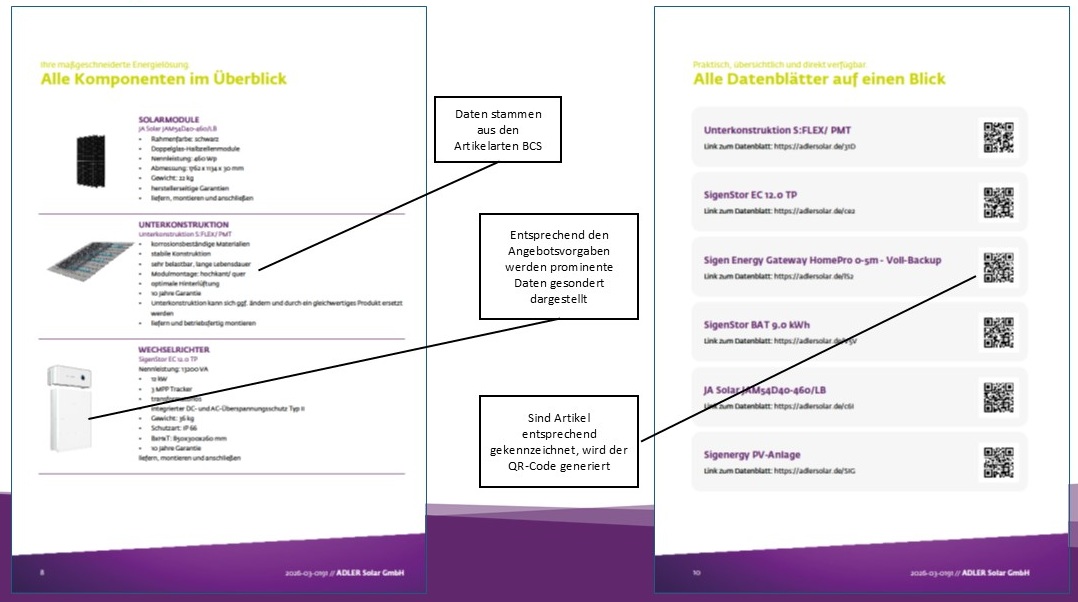
This goes far beyond simply filling a quote template with a name and address. Technical information, custom parameters, components, images, and calculation results can also be incorporated into a quote automatically or based on predefined rules. ADLER Solar shows how far this approach can go: Using BCS and BIRT, the company creates customized quotes for photovoltaic systems based on structured customer, project, and system data. Technical components, data sheets, and financial calculations are also integrated into the quote documents.

Why Manual Quote Creation Reaches Its Limits in Complex Projects

For simple standard quotes, an existing document template may be sufficient. In project-based business, however, information from different departments and systems often has to be brought together in a single quote.

Typical quote data includes:

  • Customer and contact data
  • Services and products
  • Quantities and prices
  • Project requirements
  • Technical specifications
  • Custom configurations
  • Schedules and conditions
  • Calculations
  • Consumption or measurement data
  • Financial analyses
  • Images and documents
  • Contract and payment terms

If this information is stored across different applications, files, or emails, disconnected workflows arise. Employees have to search for data, transfer it, check whether it is up to date, and then consolidate it in the quote document.

This leads to several problems:

  • Duplicate data entry: Existing customer data, technical parameters, or service descriptions have to be entered again.

  • Inconsistent data versions: When information is stored in multiple locations, it is not always clear which version is the most up to date.

  • Data transfer errors: When data is copied manually, values may be omitted, mixed up, or carried over from an earlier quote.

  • Additional effort when changes occur: If a price or technical component changes, employees have to check where that information has already been used.

  • Limited data reuse: Information available only in Word files or PDFs is more difficult to process automatically in subsequent workflows.

This effort increases particularly for technical quotes, because commercial, technical, and project-specific information has to be brought together in a single document.

What Data-Driven Quote Creation Means

Data-driven quote creation refers to creating quotes based on existing structured data. This data can come from CRM, ERP, project management, or specialized systems, for example.

Customer data does not have to be entered again if it is already stored in a structured format in the CRM. The same applies to products, services, prices, project information, technical specifications, or calculation results. Quote creation software can transfer this data into defined document structures. Customer data appears in predefined locations, quote line items are generated from existing records, tables are created, and project-specific information is automatically inserted into the document.

The key difference from a conventional document template therefore lies in the data source.

Comparison of Quote Templates and Data-Driven Quote Creation

Quote TemplateStructured Data
DesignWhich customer is being addressed
StructureWhich products or services are being offered
Recurring textWhich technical specifications apply
HeadingsWhich prices are used
Legal noticesWhich parameters are included in calculations
Page structureWhich results are generated

Both approaches can be combined: The template determines what the quote looks like. The data determines what appears in it for the specific customer case.

What Data Can Be Used for Quotes?

Which information is included in a quote depends on the business model and the specific project. For quote creation in project-based business, the following data sources are particularly relevant:

Data SourceTypical DataUse in the Quote
CRM Company, contact person, address, contact details Cover letter, header, and customer data
Project Requirements, parameters, schedules, project information Service description and individual project conditions
Product master data Products, services, prices, units Quote line items and components
Cost calculation Effort, quantities, costs, hourly rates Price and effort calculations
Technical data Capacity, dimensions, properties, configurations Technical specifications
Consumption and measurement data Consumption, demand, actual values Customized calculations and analyses
Resources Roles, planned effort, capacities Effort estimates and cost calculations
Documents and media Images, graphics, data sheets Product information and attachments
Calculation results Financial viability, key figures, scenarios Basis for decision-making and customer consultation
Contract data Terms, deadlines, payment terms Commercial and legal sections

Information is particularly well suited for automated quote creation when it is stored in a structured format and clearly assigned to a customer, project, product, or component. A value stored in a dedicated data field can be retrieved and processed more effectively than information that exists only in free text or in a finalized PDF.

How Quotes Are Created from Project Data in 6 Steps

  1. 1

    Capture Data

    The process starts with customer, project, service, and technical data.

    The information that will later be needed for a quote should ideally be taken into account where it is first created. If a technical detail has to be researched again for every quote, it may make sense to store that value in a structured format in the project, product data, or another suitable data source.

  2. 2

    Structure Data

    Recurring information that will be processed further should be stored in a structured format whenever possible.

    • Customer information
    • Products
    • Services
    • Technical parameters
    • Quantities
    • Prices
    • Consumption data
    • Project characteristics

    This allows systems to retrieve this information specifically and use it in subsequent processes.

  3. 3

    Apply Rules and Calculations

    Not every element of a quote comes directly from a single data field.

    For example, key figures can be calculated from multiple values. Depending on the products, services, or project types involved, different text modules, line items, tables, or document components may also be required.

    This turns simple data transfer into a rule-based quoting process.

  4. 4

    Generate the Quote Document

    The structured data is then combined in a predefined layout.

    • Tables
    • Images
    • Technical information
    • Calculation results
    • Charts
    • Data sheets
    • Supplementary documents
  5. 5

    Review and Approve the Quote

    Automated data transfer does not replace expert review.

    For complex quotes, it should be clearly defined who reviews prices, technical details, special terms, or other sensitive content before the quote is sent.

    Automation can support the review process, but it does not replace professional responsibilities.

  6. 6

    Reuse Data After the Order Is Placed

    Ideally, the data-driven process does not end with the quote.

    After an order is placed, information from sales and quote creation can be reused for project execution, documentation, service, or invoicing.

    This creates an end-to-end process chain:

    Customer contact → Quote → Order → Project execution → Documentation → Service → Invoice

Best-Practice Example ADLER Solar: Creating Quotes with BCS and BIRT

ADLER Solar GmbH in Bremen shows how data-driven quote creation works in practice. The company plans and installs photovoltaic systems, battery storage systems, charging infrastructure, and heat pumps, among other solutions.

Particularly in the B2C business, quotes need to communicate much more than just a total price. Customers need a clear and understandable presentation of the planned energy solution. This includes technical components as well as individual consumption data and information on financial viability.

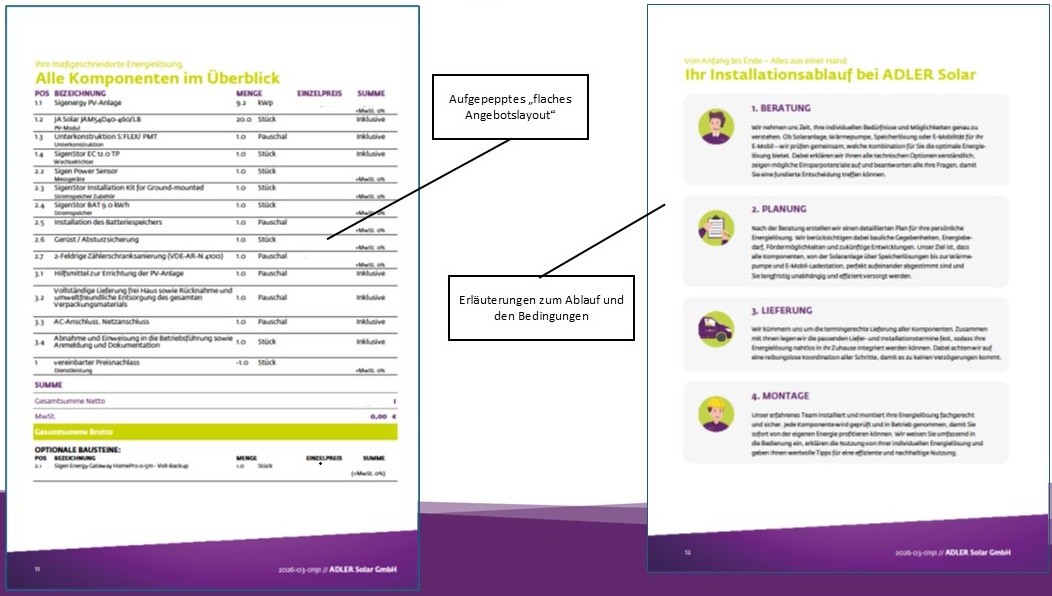
ADLER Solar uses BCS as the central platform for customer, project, and system data. To prepare the quote documents, the BIRT report designer integrated into BCS is used. This allows existing data to be used directly for customized quotes and brings together commercial, technical, and consulting-related information in a single document.

Johannes Korte

Head of Central Services and Authorized Signatory, ADLER Solar GmbH

Quotes are not created separately from project data, but directly from the structured data available. Quote design with BIRT is particularly important to us: We can create customer-specific, professionally sound, and visually appealing quotes directly from project data.

What Data ADLER Solar Uses and What BIRT Generates from It

Data in BCSQuote Content Generated from This Data
  • Customer data
  • System parameters
  • Technical data
  • Consumption data
  • Roof layout
  • Components
  • Product data
  • Images
  • Calculation and simulation data
  • Project-specific information
  • Cover pages and introductions
  • Customer data
  • Technical information about the planned system
  • Component overviews
  • Financial calculations
  • Energy analyses
  • Technical data sheets
  • QR codes
  • Contract terms
  • Customer-specific closing information

Financial Calculations as Part of the Quote

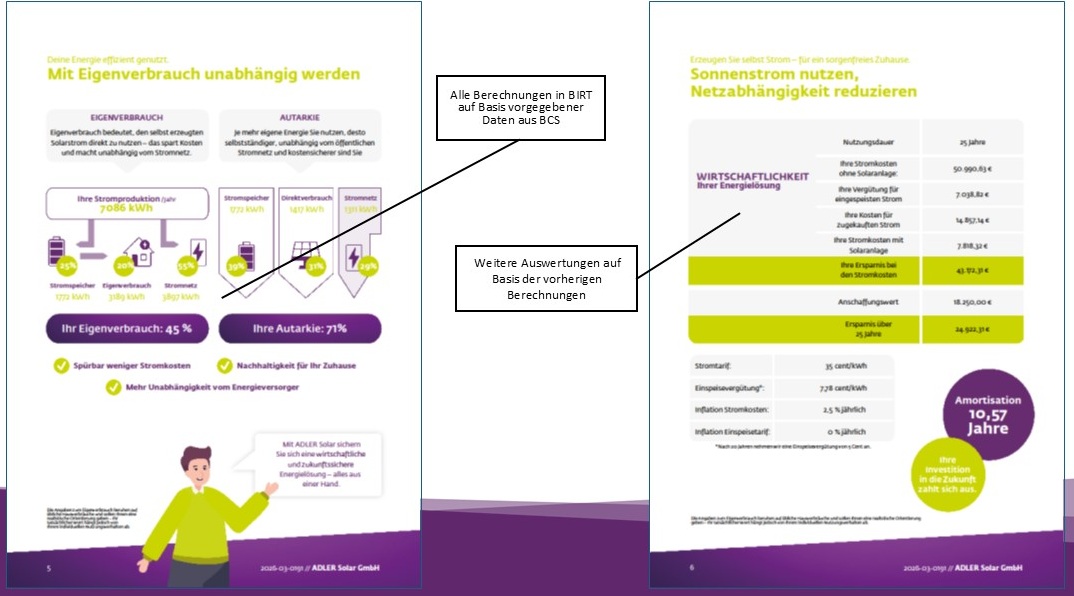
A distinctive feature of quote creation at ADLER Solar is the inclusion of financial analyses. For this purpose, customer data from BCS is combined with technical assumptions, calculations, and simulation data.

The quote documents can therefore include analyses of topics such as:

Self-consumption

Energy self-sufficiency

Grid dependency

Financial viability

As a result, the quote serves not only as an overview of prices and services, but also as a basis for customer consultation on the planned energy solution.

Can Customized Quotes Be Automated?

Customization and automation are not mutually exclusive. Customized quotes can be automated at least in part if their differences can be described using structured data, parameters, and rules. The key question is what causes these differences. If employees have to develop entirely new content and make individual expert decisions for every quote, the possibilities for automation are limited. The situation is different when customization results from variable data.

For a photovoltaic system, for example, parameters such as electricity consumption, the size and characteristics of the building, roof layout, system capacity, components used, battery storage, technical conditions, or calculation results may vary.

The result is a customized quote. The underlying document and calculation logic can still be repeatable. For complex quotes, a combination of the following is therefore often suitable:

standardized structure

automatic data transfer

rule-based content

individual expert input

personal consultation

What Are the Benefits of Data-Driven Quote Creation?

  • Less duplicate data entry: Data-driven quote creation reduces effort because data that already exists in the CRM, project, product master data, or a specialized application does not have to be entered again.

  • Fewer data transfer errors: Using values directly from the underlying data source reduces manual transfers between systems and documents.

  • More consistent information: When the same structured data is used across multiple process steps, it becomes easier to avoid inconsistent versions of information.

  • Faster quote creation: Recurring document components do not have to be rebuilt manually for every new quote.

  • Better handling of complex information: Technical data, components, calculations, and other project-specific details can be brought together in a structured document.

  • Quotes as a basis for customer consultation: Technical explanations, calculations, and individually prepared key figures can help customers better understand the proposed solution. At ADLER Solar, the quote therefore combines pricing and service information with the technical and financial aspects of the planned energy solution.

Why Data Quality Is Critical for Automated Quotes

Automation does not improve the quality of the underlying information. Successful automation of quote creation therefore starts with the questions: What data is required, where is it maintained, and who is responsible for keeping it up to date?

At ADLER Solar, the greater structuring of processes therefore also led to clearer responsibilities and higher requirements for data maintenance.

The additional maintenance effort is particularly worthwhile when the same information is used multiple times. A technical value, for example, can first be entered when setting up a project and later reused in the quote, documentation, and subsequent process steps. Data that is maintained once becomes a reusable information foundation, turning the initially higher maintenance effort into significant time savings.

Reuse Quote Data Throughout the Entire Process

At ADLER Solar, the use of structured data does not end once the quote has been completed. The same information flows into subsequent order processing steps and remains available there without having to be entered again for each process.

BCS serves as the central platform for different tasks. Its use can be broadly grouped into three areas:

Sales and order processing: Contact management, quote creation, and invoicing

Project and resource management: Project planning, project controlling, resource management, time tracking, and tickets

Documentation and administration: Document management as well as other operational and administrative processes

ADLER Solar's internally developed Service Center plays a special role in this process. Sales employees use this web application to enter new customer orders for photovoltaic systems. The information entered is then transferred to BCS through an interface.

Based on this information, customers, external organizations or individuals, and projects can be created using predefined templates. Information captured during the initial customer contact or order entry is therefore immediately available for subsequent processing.

Document creation also benefits from this shared data foundation. For example, mandatory applications to grid operators are populated with data from BCS. This means that information from order processing does not have to be researched or transferred again for each document.

Which Software Is Suitable for Data-Driven Quote Creation?

Which software is suitable for quote creation depends on the complexity of the quotes, the existing system landscape, and the desired level of process integration.

Solution ApproachTypical UseLimitations
Word or Excel A small number of simple or highly customized quotes Extensive manual data transfer and limited process integration
Quoting software Standardized quotes and commercial documents Depending on the solution, limited integration of project or technical data
CRM with quoting functionality Sales-focused quotes based on customer data Technical project data may only be available through integrations
ERP system Product-, price-, and order-based quote creation Support for project-specific requirements depends on the available functionality
Project Management and ERP Solution Project-based quotes with subsequent reuse of the data Implementation requires structured processes and data
Reporting or Document Generator Customized documents based on structured data and calculations Requires suitable data sources and defined reporting logic

For complex project quotes, the following points are therefore critical:

Can the software access existing customer and project data? 

Can custom data fields and structures be used? 

Can products and services be integrated? 

Can calculations be integrated? 

Can complex document layouts be generated? 

Can the data be reused after the order is placed? 

Can CRM, ERP, and specialized systems be integrated? 

At ADLER Solar, the solution combines BCS as the central data and process platform with BIRT for the customized preparation of quote documents.

Checklist: Requirements for Creating Quotes from Project Data

0 of 8 items checked

FAQ on Data-Driven Quote Creation

What Is Data-Driven Quote Creation?

Data-driven quote creation generates quote content from structured information that already exists in CRM, ERP, project management, or other systems. This can include customer data, products, prices, technical parameters, and calculation results.

What Project Data Can Be Used for Quotes?

Typical data includes customer information, requirements, services, technical specifications, quantities, resources, calculation data, schedules, measurement data, images, and documents. Which information is relevant depends on the business model, the product or service being offered, and the individual project.

Can Quotes Be Created Automatically from Project Data?

Many parts of a quote can be transferred or generated automatically if the underlying information is available in a structured format. The degree of automation depends on how well recurring content, calculations, and variations can be described using data and rules.

What Is the Difference Between a Quote Template and Data-Driven Quote Creation?

A quote template primarily standardizes the structure, design, and recurring text of a quote. Data-driven quote creation also pulls specific content from existing data sources, calculates or selects information based on predefined rules, and automatically integrates it into the relevant document.

Can Customized Technical Quotes Be Automated?

Yes, at least partially. If customer-specific variations can be described using structured parameters and transparent rules, customized technical quotes can also be generated from data. ADLER Solar, for example, uses this principle to create quotes for photovoltaic systems.

What Software Is Suitable for Automated Quote Creation?

Specialized quoting software may be sufficient for simple quotes. If quotes are closely connected to project data, technical information, and downstream business processes, an integrated project management and ERP solution may be more appropriate. The key factors are data access, processing, and reuse.

How Can Quote Data Be Reused After an Order Is Placed?

Structured quote data can be reused for project planning, project execution, documentation, service, and invoicing. This means customer, project, service, and technical information does not have to be entered again for every process step and remains consistent throughout order execution.

What Role Does Data Quality Play in Automated Quotes?

For automated quotes, the data used should be structured, up to date, unambiguous, and as complete as possible. Clear responsibilities for data maintenance and approval are equally important. The more reliable the data foundation, the more consistently quote content can be generated and reused.

Conclusion: Great Quotes Start with Structured Data

If you want to create quotes from project data, you should not start with the PDF, but with the data foundation. Customer information, project parameters, products, technical data, and calculation results should be stored in a way that allows them to be reused specifically for quotes and other business processes.

Based on this foundation, quote templates can be populated automatically, calculations can be integrated, and even extensive custom documents can be generated. Customized quotes can also be automated if their individual characteristics are based on structured data and transparent rules.

ADLER Solar shows how this approach can be implemented in practice: BCS provides the customer, project, and system data, while BIRT turns it into customized quote documents. Technical information, components, images, and financial analyses are automatically combined in a single document.

The data then remains available for subsequent process steps, from project execution and documentation to service and invoicing.

This makes quote creation in project-based business part of an end-to-end data and process chain.

About the Author

Kai Sulkowski is an editor and in-house SEO specialist in the Marketing Department at Projektron GmbH in Berlin. As an IPMA-certified project management professional, he focuses on project management and ERP software as well as the digitalization and automation of project-related business processes. He draws on his many years of experience in editorial work, SEO, and digital communications to explain topics such as data-driven quote creation, structured project data, and end-to-end process chains in a clear and accessible way and to put them into context using real-world examples.

More Interesting Articles from the Projektron Blog

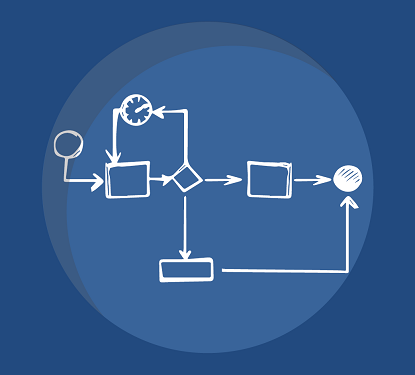
Structured customer, project, and service data come together to provide the basis for automated quote creation with BCS.

Structured customer, project, and service data come together to provide the basis for automated quote creation with BCS.