With BCS to Structured Proposals and Seamless Order Processing
User Report by ADLER Solar GmbH
At ADLER Solar, we do not use BCS as a traditional project management tool, but rather as a central platform for our order processing. From the first customer contact to proposals, project creation, documentation, and later invoicing, a great deal of information comes together in BCS. Proposal design with BIRT is especially important to us: We can generate customer-specific, technically sound, and visually high-quality proposals directly from project data. This creates structure, transparency, and a reliable basis for advising our customers.
ADLER Solar at a Glance
ADLER Solar GmbH, headquartered in Bremen, is a specialist company for sustainable energy solutions. We plan and install photovoltaic systems, heat pumps, battery storage systems, and charging infrastructure, positioning ourselves as a single-source provider. ADLER Solar has been in business since 2008 and, with around 65 employees at its Bremen location, is one of the leading specialist companies for sustainable energy solutions in northwestern Germany.

In the early years, our focus was strongly on services related to photovoltaic systems: dismantling and reinstallation, inspections, expert assessments, repairs, quality control, and other services. Our customers included system operators, investors, insurance companies, and manufacturers of modules and inverters. We carried out assignments throughout Europe and, in some cases, also in the United States and Japan.
Starting in 2018, and increasingly from 2020 onward, we changed our business model. Our focus shifted more and more toward planning and building new systems. At the same time, we expanded our offering toward the B2C market and focused more regionally on Bremen, northern Germany, and the respective branch regions. Energy storage systems, energy management, charging infrastructure, and, since 2025, heat pumps through ADLER Haustechnik, known as ADLER Wärme, were added to our portfolio.
Why We Introduced BCS
The trigger for using BCS was the replacement of Sugar CRM, which we had been using up to that point. We were looking for a solution that would allow us to map order management, project execution, and related processes in a more flexible, structured, and transparent way.
An important factor for us was the acquisition of BEC Solar in 2015. BEC was similarly structured, served a comparable portfolio, and had already been using BCS for years. As a result, expertise, experience, and licenses were already available. The implementation could begin more quickly because former BEC employees were already familiar with BCS.
Our objective was clear: We wanted to create end-to-end processes from sales, proposal, and order through to execution, documentation, service, and invoicing. BCS was not only intended to manage individual projects, but to serve as a central work platform for sales-related and operational workflows.
Implementation with a Learning Curve
BCS was introduced at our company in 2015. The first few years were heavily characterized by “learning by doing”—and, as we put it internally, sometimes also by “learning the hard way.”
At first, we underestimated the challenge of change management. Many employees were used to Sugar CRM. BCS introduced more structured processes, clearer responsibilities, and higher requirements for data maintenance. This initially led to acceptance issues.
Starting in 2018, we set up training, external consulting, and internal support in a much more structured way. As a result, usage improved noticeably. Over time, the initial resistance turned into a high level of acceptance. Today, BCS is widely used throughout our company because the value of well-maintained data becomes more visible with every subsequent process step.
BCS as a Central Platform for Order Processing
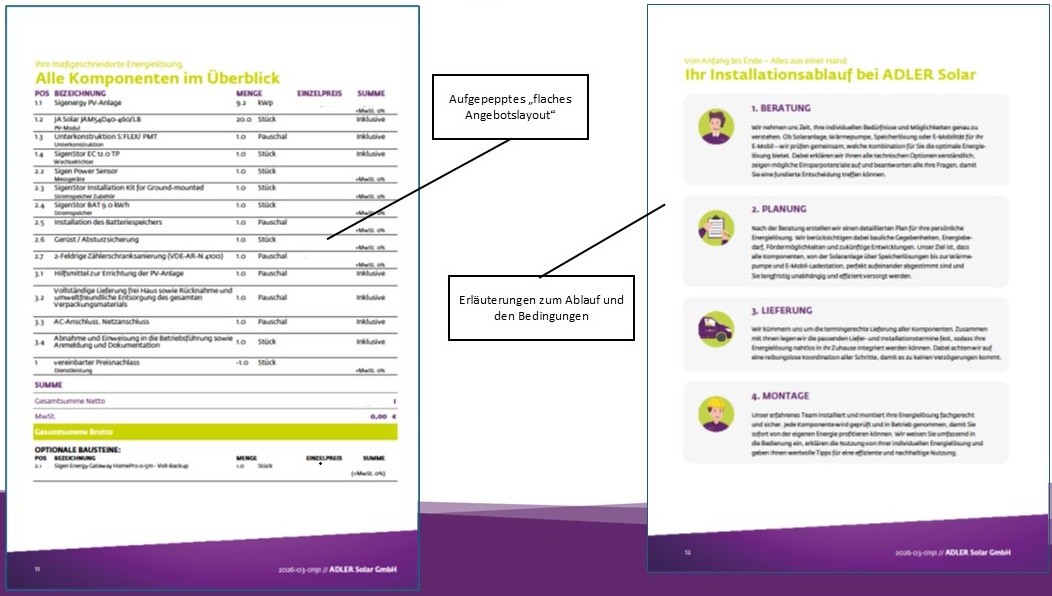
Today, we primarily use BCS for order processing. The focus is on mapping the entire process from proposal creation through to invoicing.
Among other things, we use proposal creation, contact management, project planning, project controlling, invoicing, resource management, ticketing, time tracking, vacation management, expense management, and HR management.
We do not work with a traditional project management methodology. Instead, BCS is used as an ERP platform. For us, projects represent customer orders, systems, service cases, and operational execution processes.
A central element is our self-developed “Service Center.” Through this web application, our sales employees can enter new customer orders for photovoltaic systems. Via an interface, customers, external organizations or individuals, and projects based on defined templates are created in BCS.
Single Point of Truth for PV Systems
For us, BCS is the central data repository for documenting a photovoltaic system. Master data such as system parameters, technical component data, and other information is stored in dedicated fields.
In addition, transactional data is captured, such as consumption figures, roof layout, or special considerations in the process flow. Every process step is documented and can later become part of the system documentation.
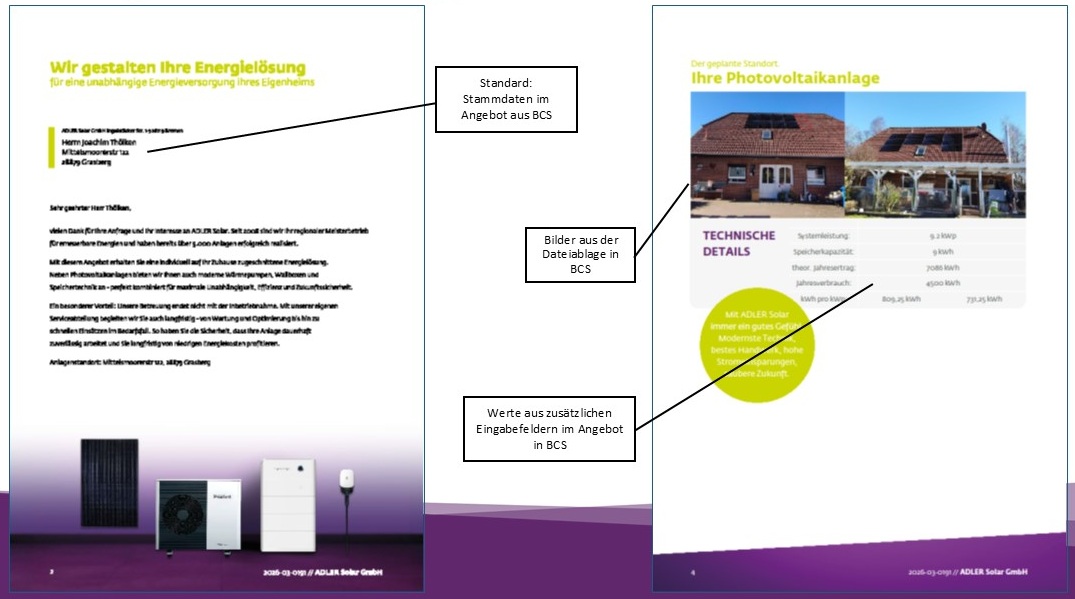
The file repository is used, among other things, for images. Technical datasheets, project data, system information, and process documentation are connected in this way. As a result, the operational data becomes structured documentation that is maintained close to the project.
Proposal Design with BIRT
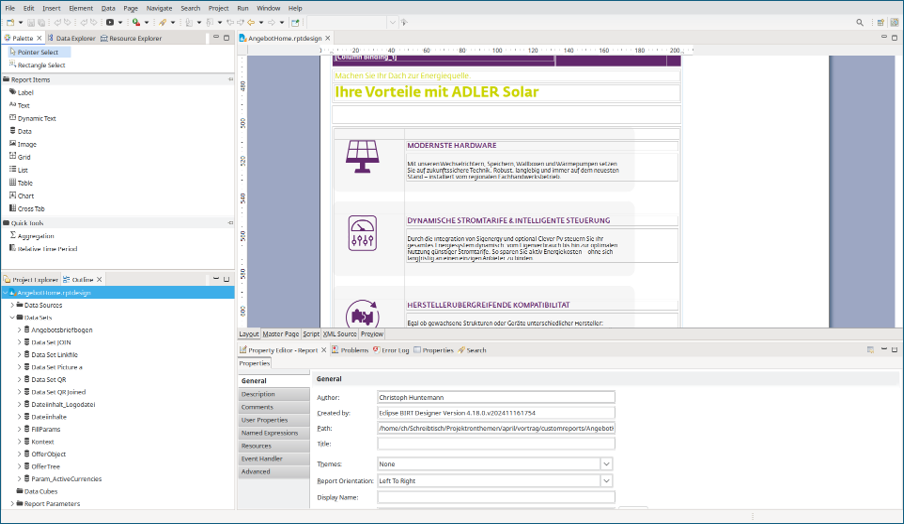
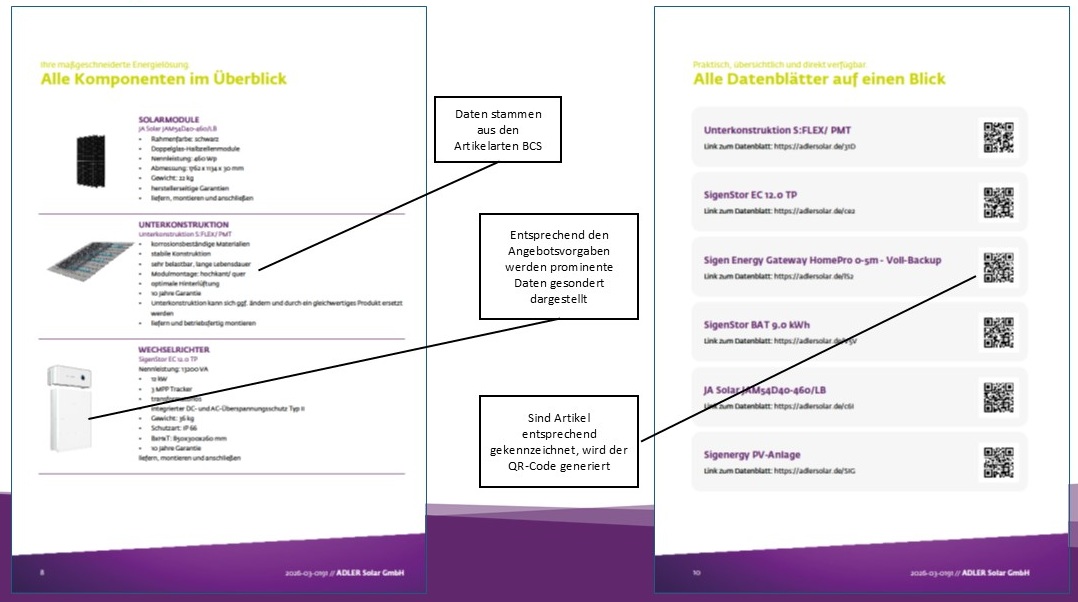
A particularly important use case for us is proposal design with BIRT. Especially in the B2C business, an appealing, informative, and technically sound proposal is crucial. Our customers expect not only pricing information, but also a clear presentation of the planned system, its economic viability, and the relevant technical specifications.
For this, we use BIRT as a report designer with direct integration into BCS. BIRT enables the creation of customized reports and layouts based on the data maintained in BCS.
For us, this means that quotations are not generated in isolation from the project data, but directly from the structured database. Customer data, technical plant information, consumption data and other parameters are incorporated into the report.
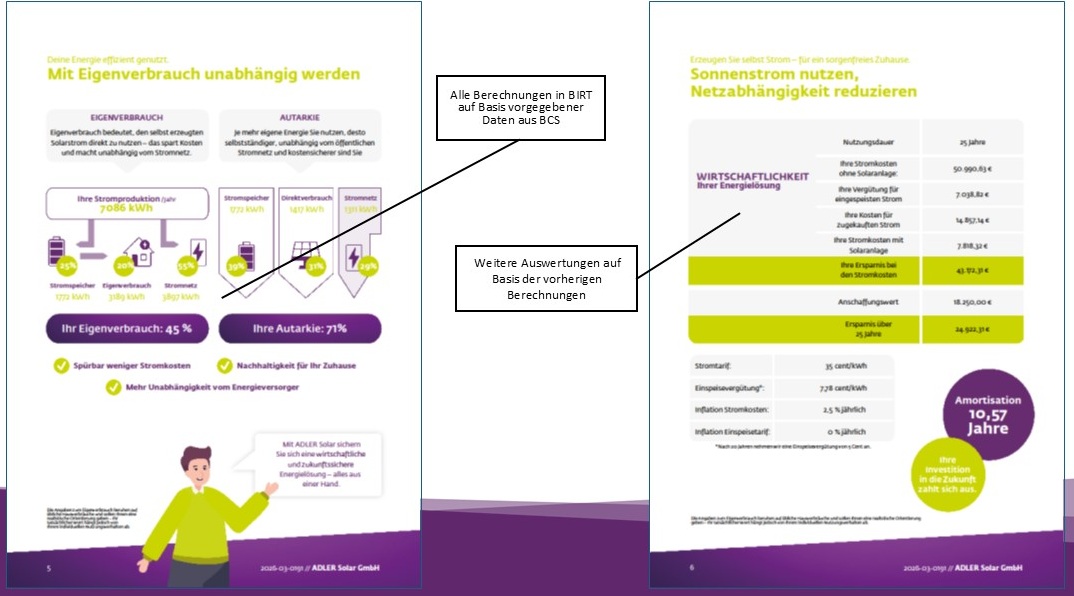
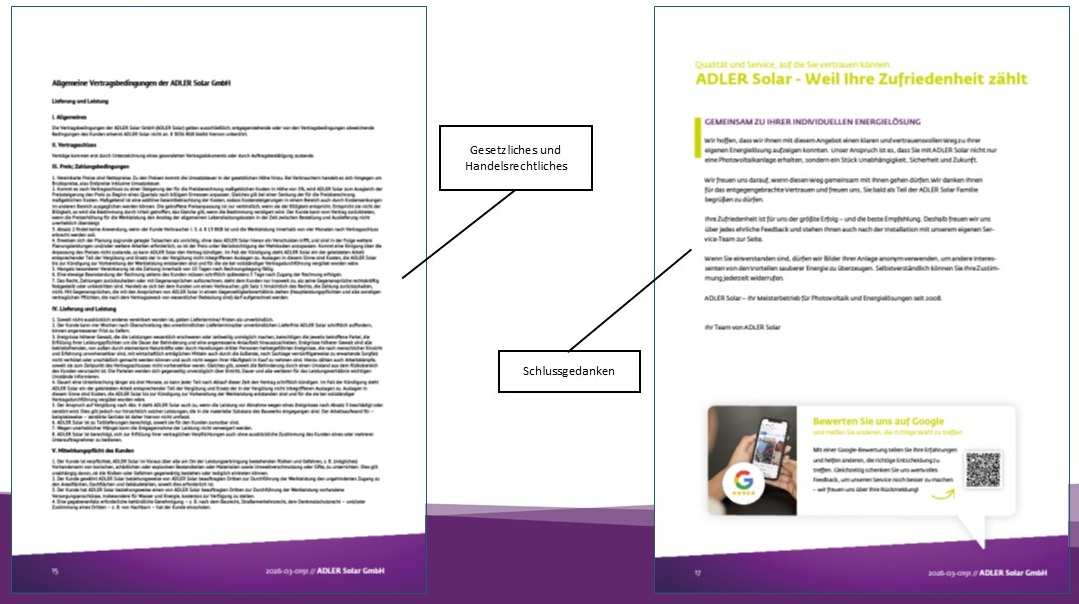
In BIRT, this information is used to generate proposal pages with a cover page, introduction, customer data, technical information, and economic efficiency calculations. We also perform our own calculations regarding the economic viability of a photovoltaic system. These are based on customer data from BCS, technical assumptions, scientifically grounded calculations, and simulation data.
This provides the customer with a proposal that is not only professionally designed in formal terms, but also offers the best possible insight into the planned energy solution.
Automated Documents and Applications
In addition to proposals, we also use BCS data for other documents in the process. Mandatory applications to grid operators are automatically populated with BCS data.
This reduces manual data transfer and ensures that information is used more consistently. At the same time, data maintenance in the system becomes more valuable: Information that has been entered accurately once can be reused in later process steps.
Looking ahead, we want to expand the process further. We are planning an interface that will automatically create proposals and populate them with the types of items required for the respective customer.
At our company, BCS is connected to several systems and embedded in an evolved system landscape. Among other things, we use Microsoft Active Directory for authentication, Microsoft 365 for calendars, contact data, and email import, as well as CSV imports and exports.
A central element is our own web application, “Service Center.” Through it, our sales employees enter new customer orders for photovoltaic systems. The data entered there is transferred to BCS via an interface. On this basis, customers, external organizations or individuals, and projects are created in BCS using defined templates.
In addition, we use BCS data for various dashboards and analyses. These include overviews of systems built based on open tasks and proposal data, an invoice report, and sales performance dashboards with information on appointments, orders, and cancellations. This makes it easier to track operational processes and sales developments transparently.
A DATEV interface is available, but it is currently used very little or not actively used, since DATEV is only used indirectly at our company. Instead, an indirect connection via document export reduces the workload.
Another special feature is an interface from our access control system to BCS for transferring attendance data.
BCS has replaced, among other things, Sugar CRM and Open Time Tool.
What Works Better Today
BCS brings more structure to our order processing. Processes are guided more clearly, data is stored centrally, and information can be reused. The use of multiple clients with their own projects and processes is possible without switching applications.
The involvement of external employees and project managers makes data maintenance easier. At the same time, the interface to our in-house sales development provides a high level of flexibility.
The benefits are particularly evident in proposals: Instead of manually compiling information, customer-oriented, project-specific, and technically complex proposals can be generated directly from BCS.
Changes in Day-to-Day Work
For us, the introduction of BCS was also an organizational change. BCS requires structured data maintenance, clear responsibilities, and a willingness to consistently map processes in the system.
Initially, many users viewed this critically. Today, acceptance clearly prevails. Processes and structures reduce workload because maintained data can be reused in later process steps.
Our Conclusion
We use BCS far beyond traditional project management. For us, the system has become the central platform for order processing, documentation, proposal design, and related business processes.
The greatest benefit for us lies in connecting structured project data with operational process steps. Proposal design with BIRT in particular demonstrates how customer-focused BCS can be: From maintained master data, transactional data, and technical information, meaningful, project-specific proposals are created.
In this way, BCS helps us present complex energy solutions in an understandable way, document processes cleanly, and make information usable throughout the entire order lifecycle.
Our most important lesson is this: BCS delivers its value where processes are clearly defined and data is maintained consistently. The effort involved in data maintenance pays off as soon as information can be reused in proposals, documentation, project execution, and invoicing.