AI Help
Answers specific questions about using BCS and its features based on the documentation and displays relevant sources.
The AI features in BCS support your employees wherever information is created and used: in the software help, tickets, tasks, projects, requirements, and contact histories. Instead of copying content into a separate AI tool, users receive summaries and context-aware answers directly within their project management and ERP processes. This reduces the time spent searching and reading, simplifies handovers, and makes existing knowledge available faster.



An overview of which AI features are already available, which are currently being tested, and which Projektron is developing.
Answers specific questions about using BCS and its features based on the documentation and displays relevant sources.
Summarize the subject, description, and comments to provide a concise overview of the issue, processing status, and previous history.
Condense task descriptions, checklists, comments, and history information to simplify onboarding and handovers.
Answers questions about an individual task and takes the designated task information into account.
Present selected project information in a concise format, including history logs, project manager notes, and project-related contact histories.
Condense extensive requirements and provide faster access to the subject matter documented in user stories.
Summarizes relevant customer contacts from the past twelve months and identifies the filters used.
Translates user interface text from German into supported languages and simplifies the provision of international work environments.
Searches for similar tickets that have already been processed, generates an initial response suggestion, and allows users to refine it in the chat.
Multiple tasks will be selectable for joint analysis of dependencies, similarities, and open points affecting several tasks.
Answers will reference the underlying checklists, comments, history log entries, and other BCS information.
Adds targeted questions about agreements, discussed topics, developments, and outstanding feedback to the existing summary.
Will enable targeted follow-up questions about a ticket and the information documented within it.
Extend AI-generated summaries to additional lists, history information, and other work areas in BCS.
The operation and presentation of chats are being further improved. Planned enhancements also include support for voice input.
A central AI agent will answer documentation questions and retrieve specific information from BCS.
AI agents will support selected processes in BCS, such as submitting leave requests, creating risks, or reviewing bookings.
An installable package with local AI components, documentation, and training options will support additional deployment models.
The plans, scope, and availability of features that have not yet been released may change during development.
AI Help provides conversational access to the extensive BCS documentation. Users ask a specific question and receive an immediately usable answer with source references.
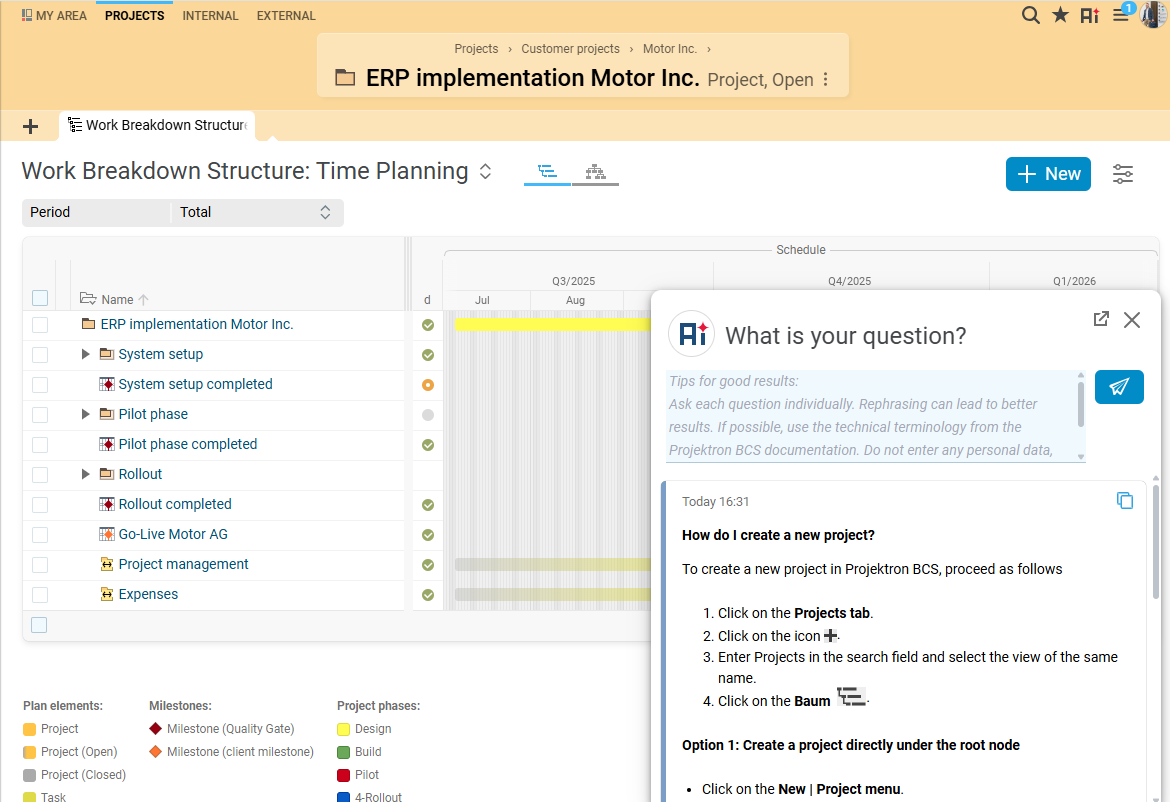
Users open AI Help with a single click. The question is processed using a RAG approach: First, BCS performs a semantic search for relevant documentation content. The language model then generates an answer based on this content.
Answers to specific questions about using BCS and its features
Illustrated step-by-step instructions provided as an answer
Source references with links to the online help
Answers generated in real time
Option to rate the answer as helpful or not helpful
Easy copying of the question-and-answer pair, including sources
Easy creation of a support ticket if the answer is not sufficient
Option to open AI Help in a separate window for parallel work
AI Help is not a general-purpose knowledge AI. It answers questions covered by the available BCS documentation. This keeps the support focused on BCS-specific topics and allows users to verify the answer using the cited sources.
AI summaries condense existing information into an overview that is quick to understand. The original content remains fully intact and can be opened at any time for professional review.
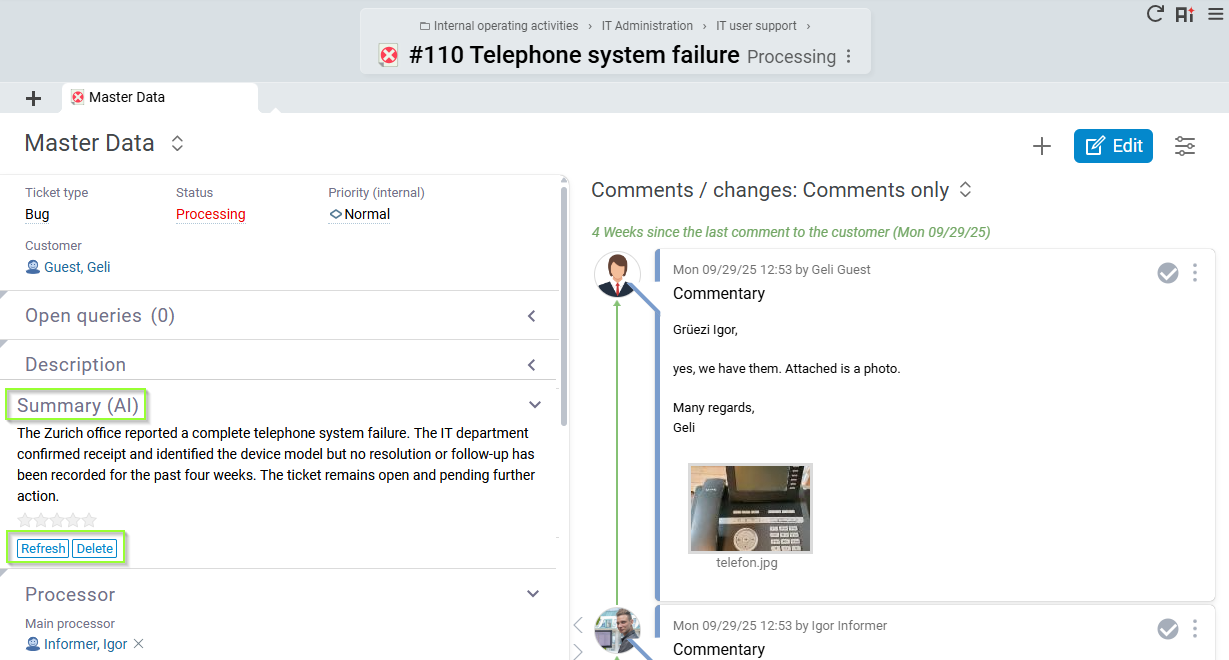
The ticket summary condenses the subject, description, and potentially numerous comments from different participants. This makes it easier to understand lengthy support and service histories and enables smooth handovers.
Overview of the issue, processing status, and key history
Notification when a summary may no longer be up to date
Update, delete, and regenerate summaries
Rating from “Very good” to “Very poor”
Optional comment on the rating
Support for handovers, escalations, and reopened tickets
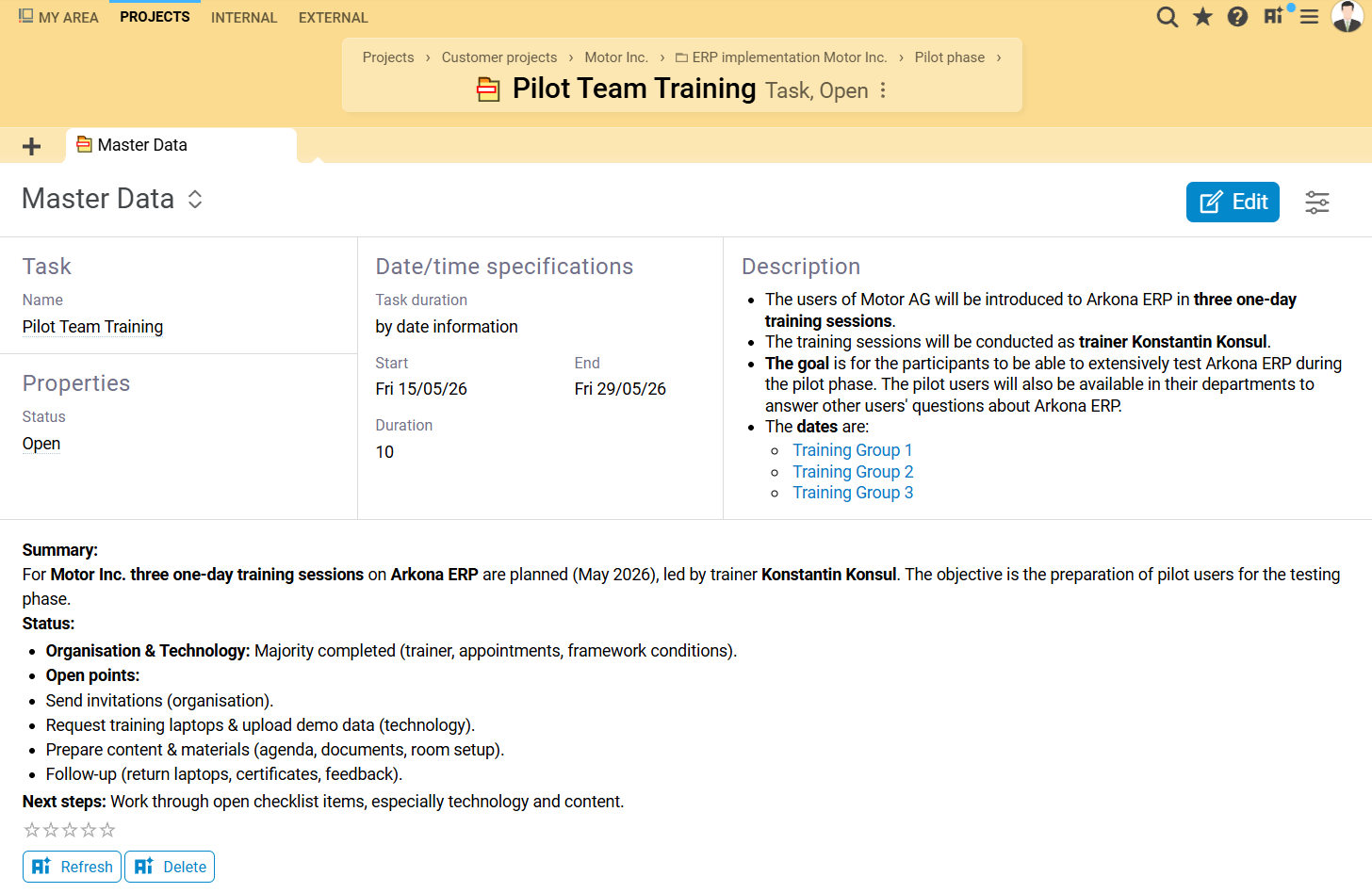
In complex tasks and projects, relevant information is often distributed across different areas. Summaries generated by BCS AI combine master data, descriptions, checklists, comments, and history information into a concise overall view.
Faster onboarding for new or reassigned tasks
Overview of open items and documented progress
Summaries of selected project-related information areas
Analysis of project notes and history logs
Update, delete, and rate generated content
Even extensive Scrum requirements in the Products workspace can be condensed using an AI-generated summary. This helps users understand the subject matter more quickly and provides easier access to the documented content.
Concise overview of extensive requirements
Faster onboarding for new or reassigned user stories
Support for review, coordination, and further processing
The AI-generated summary condenses the customer contact history from the past twelve months. This enables account managers to identify documented conversations, feedback, and developments more quickly.
Summary of customer contacts from the past year
Meaningful filtering of contact history entries
Display of the filters used in the result
Replacement of the existing summary when it is regenerated
BCS can use AI to translate user interface text from German into supported languages. This simplifies the creation of international work environments and accelerates the translation of new or modified content.
Context-aware assistants combine selected BCS data with a conversational interface. Instead of receiving only a static summary, users can ask specific follow-up questions about the documented information.
Already available: The Task Assistant answers questions about a task and takes the relevant task information into account.
In development: Users will be able to select multiple tasks together to examine dependencies, similarities, and open items.
In development: In addition to the summary, a chat will allow users to ask specific questions about previous customer communications.
Roadmap plans, schedules, and feature details may change during development.
For new tickets, BCS is intended not only to summarize existing information, but also to actively support users in finding a solution. The feature currently being tested searches for similar tickets and uses them to generate an initial response suggestion.
The AI features reduce the time spent searching and reading, simplify handovers, and provide information directly within the relevant work context.
AI Help answers specific questions based on the BCS documentation and displays the sources used.
Summaries make it easier to understand the status of tickets, tasks, and project histories, even when responsibilities change.
Important content, open items, and developments are condensed for meetings, reviews, and further processing.
The AI features are integrated directly into BCS objects. There is no need to copy content into a separate tool.
Source references, the underlying original content, and feedback features make professional review easier.
AI components can be provided in line with the edition, license, processes, and internal company requirements.
BCS connects AI with the information designated for the relevant work process.
The AI features use the relevant BCS content, such as tickets, tasks, requirements, comments, checklists, and contact histories.
Summaries condense information, assistants answer follow-up questions, and AI Help provides access to the BCS documentation. This keeps the support within the relevant work context.
AI provides an additional way to access information that already exists. Complex processes can be reviewed more quickly and prepared for handovers, meetings, or further processing.
Well-maintained descriptions, checklists, and comments remain the basis for helpful answers and summaries.
The AI features deliver value wherever employees receive, share, and evaluate information in their daily work.
Review project notes, contact histories, and history logs more quickly, prepare task handovers, and identify open items for status meetings. Summaries help users classify extensive project information more quickly.
Review task content, understand checklists, comments, and history logs, and ask specific questions about the processing status. The Task Assistant provides answers directly within the context of the relevant task.
Take over lengthy tickets more quickly, understand their previous history, and generate an updated summary after relevant changes. This makes complex support processes and handovers easier to understand.
Condense the contact histories of external organizations and use the Contact History Chat to ask specific questions about agreements, discussed topics, or outstanding feedback. This feature is expected to be available with BCS 26.3.
Activate AI components as needed and adapt their use to the edition, license, user roles, processes, and internal security, compliance, and governance requirements.
Obtain an initial overview of extensive project, task, and communication histories more quickly. Key figures, original data, and the professional assessment of those responsible remain decisive for business decisions.



Projektron develops the AI applications and their integration into BCS in-house. The modular framework connects selected BCS data sources with suitable AI components and provides a reliable foundation for high-quality responses, controlled processing, and the needs-based development of the features.
Each AI feature uses the BCS content designated for the relevant use case. This provides the language model with the appropriate subject-matter context for answers, summaries, and follow-up questions.
AI Help performs a semantic search for relevant content in the BCS documentation. The documents found are provided together with the question as the basis for the answer.
Summaries take into account the content designated for the relevant process, such as the subject, description, comments, checklists, or history logs.
Chats refer to selected tasks, contact histories, or other designated BCS content. This allows users to ask questions directly about the relevant work process.
The quality of an AI-generated answer depends both on the language model and on the selection and preparation of the content provided. The decisive factor is whether relevant information is found and processed within its subject-matter context.
Projektron develops and tests various methods for this purpose. They support features that perform semantic searches across extensive content and compile the information needed for a suitable answer.
Users deliberately initiate answers, summaries, and chats within the relevant work process. AI support is therefore incorporated into existing processes in a controlled manner and provides results for further processing and review.
The information processed depends on the AI feature being used. Companies can also govern its use through their own rules for roles, permitted inputs, review processes, and responsibilities.
BCS has been developed in Berlin since 2001. The software can be operated within a company’s own infrastructure or in German data centers.
Projektron operates an information security management system in accordance with ISO/IEC 27001 and is TISAX-assessed. These structures provide the organizational framework for information security, clearly defined responsibilities, and reliable processes.
The AI applications described currently use a language model from Mistral AI that is operated on a server of Projektron GmbH.
BCS can be operated within the customer’s infrastructure. The AI applications currently described use a language model operated on the infrastructure of Projektron GmbH.The framework separates the applications, BCS data sources, and technical AI components. This allows the language model, embedding model, and vector database to be developed, supplemented, or replaced independently.
The architecture provides the foundation for integrating additional models and operating models when they offer advantages in terms of quality, data protection, security, or cost-effectiveness.
A fully locally deployable AI solution forms part of the long-term development of the AI features in BCS.The articles follow the development of the AI features in BCS and explain both specific applications and the underlying technology.
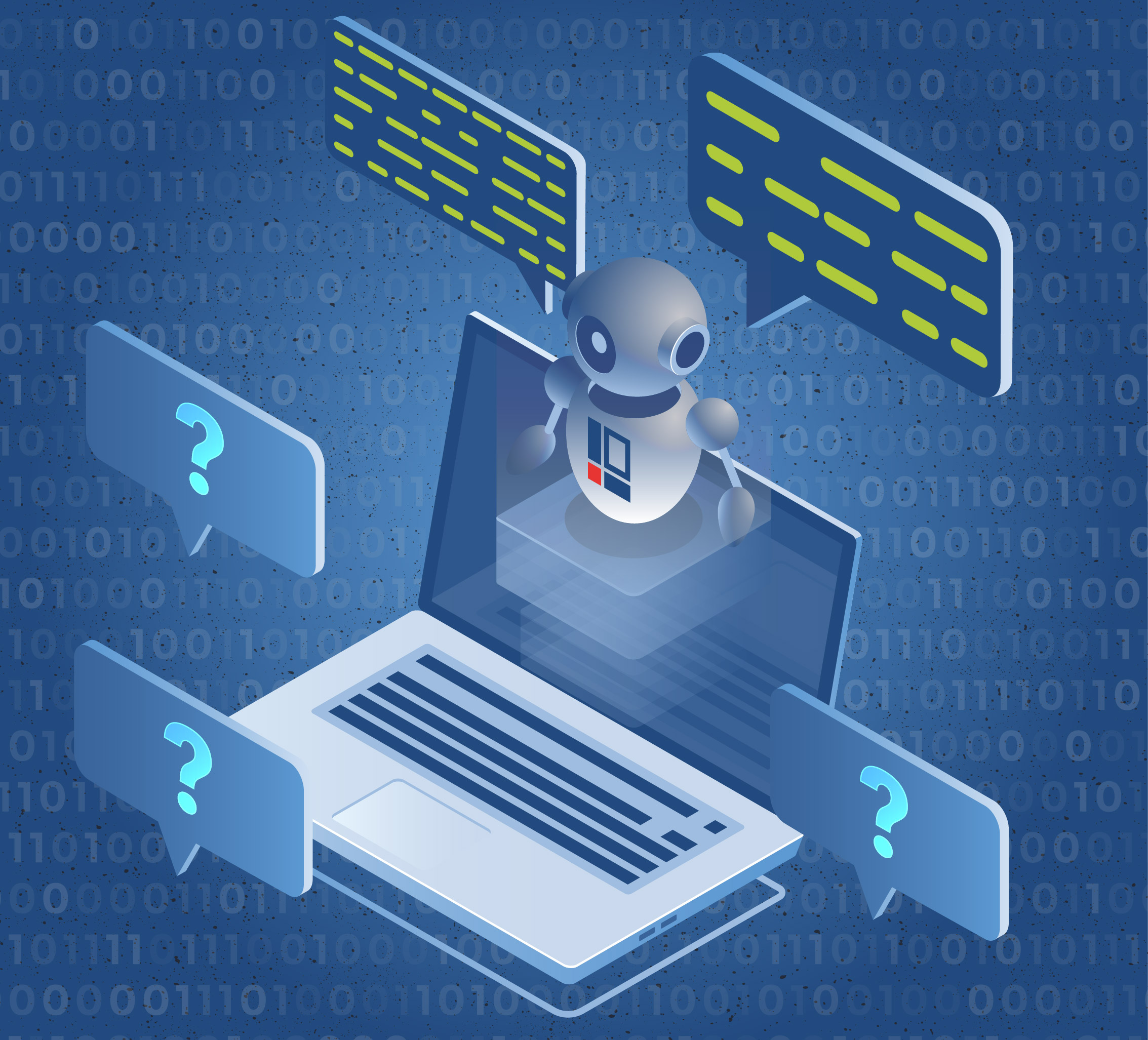
An introduction to the development project: initial technical foundations, potential use cases, and objectives for integrating AI into BCS.
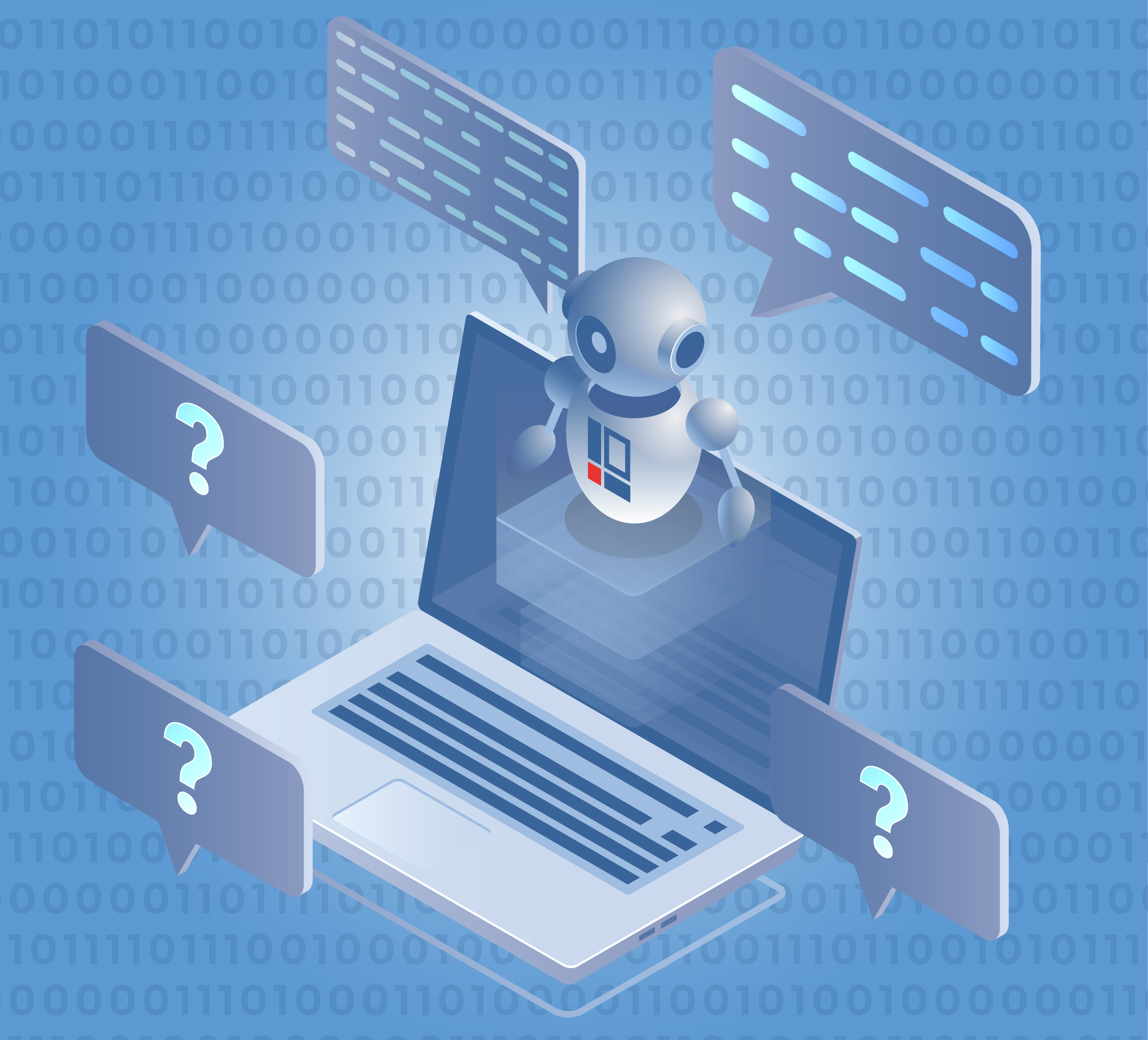
The article explains the requirements, modular architecture, and interchangeable components behind the AI applications.

How AI Help answers questions about the BCS documentation and how it was improved through retrieval, testing, and feedback loops.
An overview of specific applications for AI support and the gradual expansion of the features in BCS.
How text is divided into smaller units and why this segmentation affects how language models process it.
How words and content are converted into numerical vectors, making them comparable for semantic searches.

How language models identify and weight relevant terms and relationships within a text.
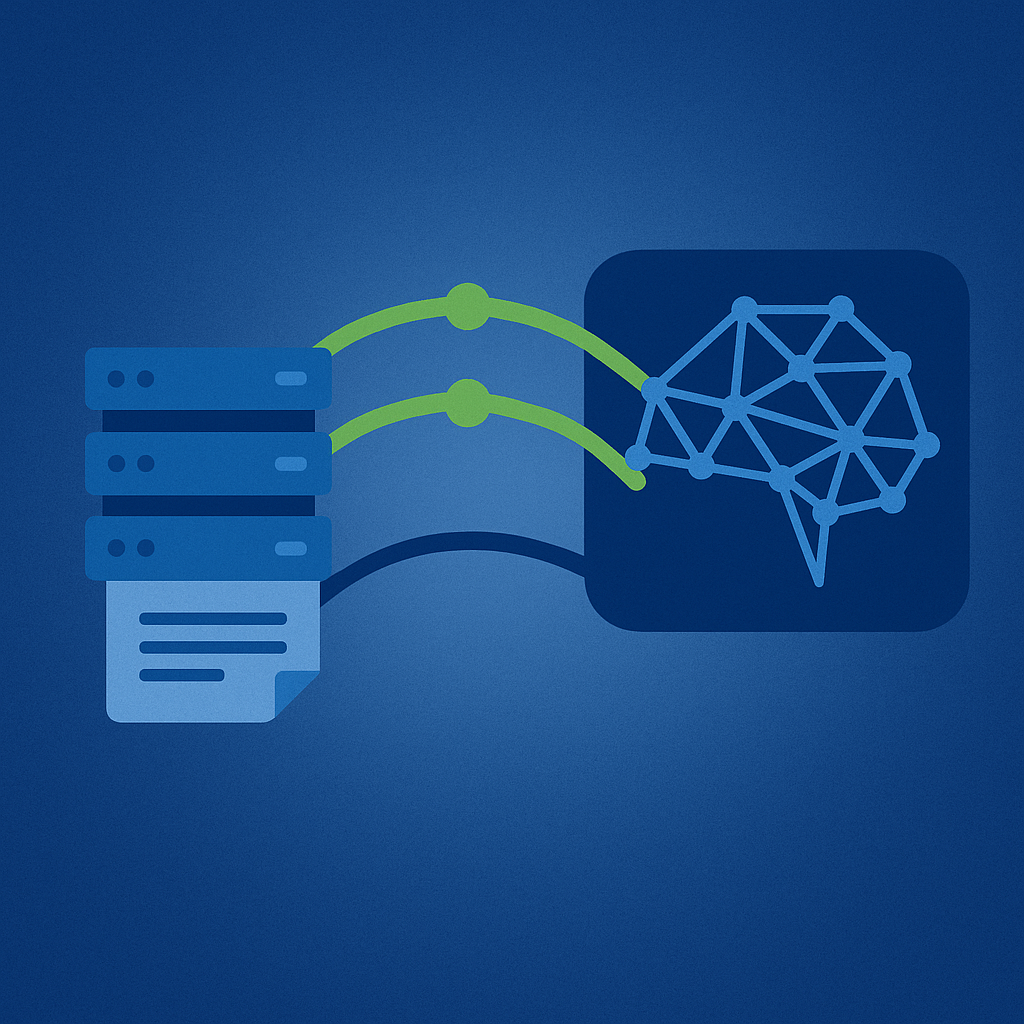
How language models are connected to defined knowledge sources to provide subject-matter context and make answers more traceable.
Source references, notices about whether content is current, and integrated rating features help users trace, assess, and purposefully reuse AI-generated results.
AI Help identifies the documentation pages that contributed to an answer. Users can move directly from the generated answer to the original source, review the details, and verify the information.
When relevant information in a ticket changes, BCS can indicate that the saved summary may no longer be current. The user decides whether to generate a new one.
AI Help answers can be rated as helpful or not helpful. Summaries can be rated on a scale from “Very good” to “Very poor” and supplemented with a comment.
A generated summary does not replace comments, history logs, or checklists. The underlying content remains fully available and continues to serve as the authoritative reference.
Answers and summaries are generated on request. The features described do not analyze all company data unnoticed and do not make automatic changes to projects or master data.
AI Help was tested iteratively using realistic support questions that had already been resolved. Weaknesses identified in retrieval and data preparation were incorporated into the technical optimization.
Answers about the features, use cases, technical foundations, data protection, and availability of AI support in BCS.
AI Help uses the RAG approach – retrieval-augmented generation. The user’s question is first analyzed semantically. Relevant content is then identified in the BCS documentation.
The relevant documents are provided to the language model together with the question as context. This is intended to ensure that the answer is specifically based on documented information about BCS.
The sources used are displayed and can be opened directly in the online help for professional review.
AI Help is designed for questions about using BCS and its features. It does not replace a general-purpose chat or knowledge search.
Context-aware assistants process the BCS content designated for the relevant process. For example, the Task Assistant refers to the selected tasks and the information documented within them.
No. Errors, omissions, or incomplete interpretations can occur even when documentation- and source-based methods are used.
Answers, summaries, and suggestions should therefore be reviewed carefully. This is particularly important when they are used as the basis for decisions with professional, financial, contractual, or legal relevance.
Answers, chats, and summaries are deliberately initiated by the user. The user decides when a summary is generated, updated, or deleted and when a question is submitted to an assistant.
BCS can indicate that a previously saved summary may no longer be current because of new or modified content.
The AI features use defined data sources and activatable BCS components. The content processed depends on the feature being used.
The language model used is provided by Mistral AI. Companies can manage its use through components, licenses, roles, and organizational requirements.
Passwords, trade secrets, or personal and sensitive data that is not required should not be entered into free-text questions.
No, the AI does not currently run entirely on-premises. AI Help uses the RAG approach and accesses a language model from Mistral AI that is hosted on a server operated by Projektron GmbH.
In the long term, Projektron intends to offer a fully local solution in which no data is transferred to language models hosted by third parties.
Operating BCS on-premises does not currently mean that all AI components are automatically operated within the customer’s infrastructure.For a ticket summary, BCS primarily processes the ticket’s subject, description, and comments.
The summary is displayed and saved directly in the ticket under “Summary (AI).” It can be updated, rated, or deleted.
For tickets, BCS can display a notice when professionally relevant content has changed since the summary was created.
This includes changes to the ticket type or ticket status, as well as new external comments or team comments. The user can then update the summary.
AI Help answers questions about using BCS and its features based on the BCS documentation.
The Task Assistant, by contrast, refers to information from specific tasks. It supports context-aware follow-up questions and can consider multiple selected tasks together.
Yes. AI summaries can be rated on a five-point scale from “Very good” to “Very poor.”
A comment can also be added to explain the rating. AI Help answers can likewise be rated as helpful or not helpful.
Availability may vary by feature. The relevant factors are the BCS version, edition, license, activated components, and system configuration in use.
The current release information and individual licensing should be reviewed to determine which features can be used in BCS or BCS.light.
Projektron Customer Service is your point of contact for all matters relating to BCS and is available to answer your questions or provide further information about the AI features.