DATEV
Accounting simplified
Transfer outgoing invoices, incoming invoices, e-invoices, expense reports, and accounting data from BCS to your DATEV environment. With BCS, you can implement DATEV integrations for invoice, expense, and accounting data—tailored to your specific needs. The interfaces are based on the DATEV XML interface online as well as the current Ledger version for transferring structured invoice and document data. This allows structured data and associated document images to be consistently transferred to DATEV Unternehmen online. For payroll accounting and bookkeeping, use the flexible CSV export of all attendance and transaction data for further processing with DATEV.
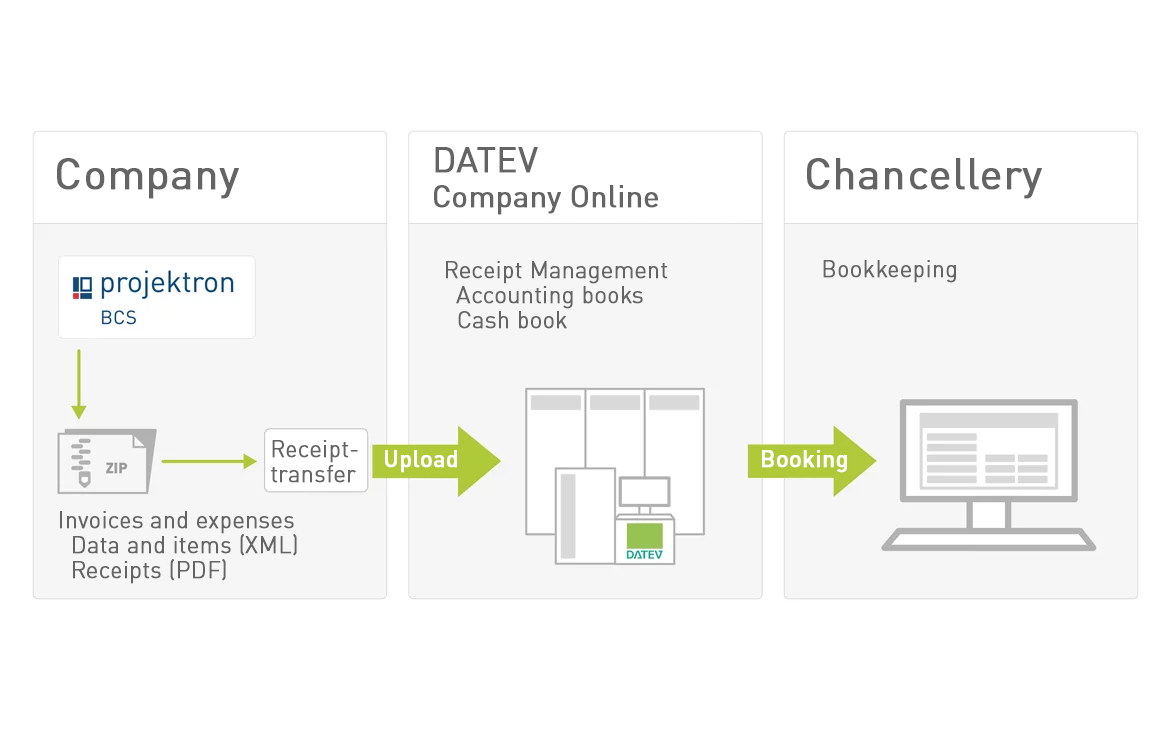
Interface Examples
In collaboration with customers, we have already implemented various DATEV interfaces for BCS. These include the transfer of outgoing invoices and credit notes, incoming invoices and e-invoices, as well as expense data including related document images.
The integration is typically implemented with DATEV Unternehmen online and is based on the DATEV XML interface online as well as the current Ledger version. This enables structured invoice, expense, and accounting data to be transferred consistently from BCS to DATEV.
In addition to accounting data, document images such as PDF invoices, incoming invoices, or expense receipts can also be transferred automatically. Required classifier fields and mappings are configured on a project-specific basis and aligned with the respective accounting processes.
For additional use cases, such as payroll accounting, attendance, booking, and accounting data can be exported flexibly in CSV format.
How the DATEV Integration Works
The integration with DATEV is based on proven scenarios and is individually tailored to your system landscape and processes.
Depending on the use case, structured outgoing invoices, incoming invoices, expense data, or accounting data are exported from BCS and transferred to DATEV Unternehmen online using DATEV-compatible interface formats. Depending on the target system, XML, CSV, or other DATEV-compatible formats may be used.
In addition, document images such as PDF invoices or expense receipts can be transferred automatically. Data transfer is typically handled via the DATEV Belegtransfer application.
Typical components of the integration include:
Transfer of structured invoice data
Transfer of PDF documents and document images
Configuration of classifer fields, such as revenue accounts and cost centers
Export of booking and accounting data
CSV export for payroll and payroll accounting
The exact setup of the integration depends on your DATEV environment, the required data flows, and your business requirements.
Requirements & Notes
Successful integration with DATEV requires certain technical and organizational prerequisites. These typically include:
DATEV Unternehmen online
the DATEV Belegtransfer
appropriate permissions for online document management and invoice ledgers
maintained debtor and creditor master data in BCS
provision of the required export files
Within BCS, the required modules and master data must also be configured correctly. Depending on the scenario, this may include VAT IDs, invoice data, incoming invoices, expense data, and individual field mappings.
For hosted BCS systems, booked file access may be required because export files are stored on the BCS server. For on-premise installations, an appropriate transfer method between the BCS server and the locally installed DATEV Belegtransfer must be established.
Specific requirements vary depending on the integration scenario and are defined jointly during the project.
Flexible CSV Export: Payroll Accounting with Accurate BCS Data
To support reliable data transfer into your DATEV accounting environment, attendance and booking data can be exported flexibly from BCS in CSV format.
This allows time, attendance, and booking data to be used for further processing in payroll processing and payroll accounting. The CSV export is particularly suitable for custom DATEV processes where BCS data needs to be integrated into existing workflows.

Stefan Popp
Managing Director | Flexus AG
Accounting continues to be handled in DATEV. BCS prepares the relevant data and exports it to DATEV.

Johannes Korte
Head of Central Services and Authorized Signatory | ADLER Solar GmbH
With clear processes and structures, BCS provides lasting relief, maximizes the benefits of data maintenance across all process steps, and enables the simultaneous management of multiple clients without switching systems. The integration of external project stakeholders, as well as flexible interfaces—such as those with in-house systems and DATEV—further enhance efficiency and adaptability.

Tanja Maier
Controlling, SSC-Services GmbH
All in all, we were able to achieve enormous time savings by invoicing through BCS in conjunction with the DATEV export.

Ursula Meyer
Delivery Manager, Be Shaping The Future - Performance, Transformation, Digital GmbH, Munich
We also use the BCS-DATEV interface for the integration between “Projektron BCS” and “DATEV Unternehmen Online”.

Thomas Hackenbuchner
Head of Finance & Administration | MicroNova AG
MicroNova also uses BCS for the actual invoicing, as enormous time savings can be achieved in connection with the DATEV export. Not only outgoing invoices to customers are processed, but also "intercompany invoices" within the group.
Customized DATEV Integration
The DATEV integration is not a preconfigured standard interface, but is implemented on a project-specific basis. Due to the specific requirements of DATEV, the appropriate integration solution is developed together with you במסגרת a workshop.
In doing so, we define data flows, formats, and processes ranging from outgoing and incoming invoices to expense reports and payroll accounting.
Using our web service or the import-export module, we implement a solution that is precisely tailored to your requirements.