06/19/2026 - Articles
E-invoicing mandate 2026: What companies need to know now
Less red tape, lower costs, and faster payment processing: Germany’s e-invoicing mandate is driving the digitalization of accounting and invoicing. Since January 1, 2025, companies in Germany have been required to receive electronic invoices in B2B transactions. E-invoicing is therefore no longer a future topic, but part of everyday business. Companies should now check whether their software supports current requirements and formats such as XRechnung 4.0 and ZUGFeRD 2.5.
Germany’s E-Invoicing Mandate: Key Deadlines
Germany’s e-invoicing mandate is being introduced in stages. It is important to distinguish between the obligation to receive e-invoices and the obligation to issue them.
-
Since January 1, 2025Requirement to receive e-invoices: Businesses based in Germany must be able to receive electronic invoices. In principle, a standard email inbox is sufficient. A basic PDF file does not qualify as an e-invoice.
-
Through December 31, 2026General transition period: All invoice issuers may continue to send paper invoices. Other electronic invoice formats, such as PDF files, may also still be used with the recipient’s consent.
-
Beginning January 1, 2027Businesses with prior-year revenue exceeding €800,000 must generally issue e-invoices for qualifying domestic B2B transactions. The transition period continues for businesses with prior-year revenue of €800,000 or less.
-
Through December 31, 2027Businesses with prior-year revenue of €800,000 or less may continue to use other invoice formats. Certain EDI procedures may also remain eligible under the transition rules.
-
Beginning January 1, 2028General requirement to issue e-invoices: Once the transition periods have ended, e-invoices for qualifying transactions between businesses based in Germany must be issued electronically in a structured data format.

Key takeaways: E-invoicing mandate 2026
Since January 1, 2025, companies in Germany have been required to be able to receive e-invoices in the B2B sector. Transition periods apply to the issuing of e-invoices until the end of 2026 or, in some cases, 2027.
A simple PDF invoice is no longer considered an e-invoice. Permitted formats are structured, machine-readable formats such as XRechnung or ZUGFeRD.
The e-invoicing mandate affects many companies, freelancers, and small businesses. Clean master data, suitable formats, and legally compliant archiving are essential.
E-invoices reduce manual work, improve data quality, and accelerate review, approval, and payment processes.
Software is key to successful implementation. Solutions such as BCS support the creation, receipt, validation, processing, and archiving of electronic invoices.
Inhalt
E-invoicing mandate since 2025: What currently applies?
Since January 1, 2025, Germany’s e-invoicing mandate has applied to transactions between domestic companies. Since then, companies have generally been required to be able to receive electronic invoices. However, transition rules apply to the issuing of structured e-invoices, allowing companies to adapt their processes step by step.
It is important to distinguish between receiving and issuing invoices: the obligation to receive e-invoices has already applied since January 1, 2025. For issuing invoices, companies may still use other invoice types under certain conditions until the end of 2026. For companies with prior-year revenue of no more than EUR 800,000, this transition period is extended until the end of 2027.
Since 2025, a simple PDF invoice has no longer been considered an e-invoice under German law; instead, it is classified as another type of invoice. Permitted e-invoices must be issued, transmitted, and received in a structured electronic format and must allow electronic processing. In Germany, XRechnung and ZUGFeRD are particularly relevant formats for this purpose.
What has been decided regarding electronic invoicing?
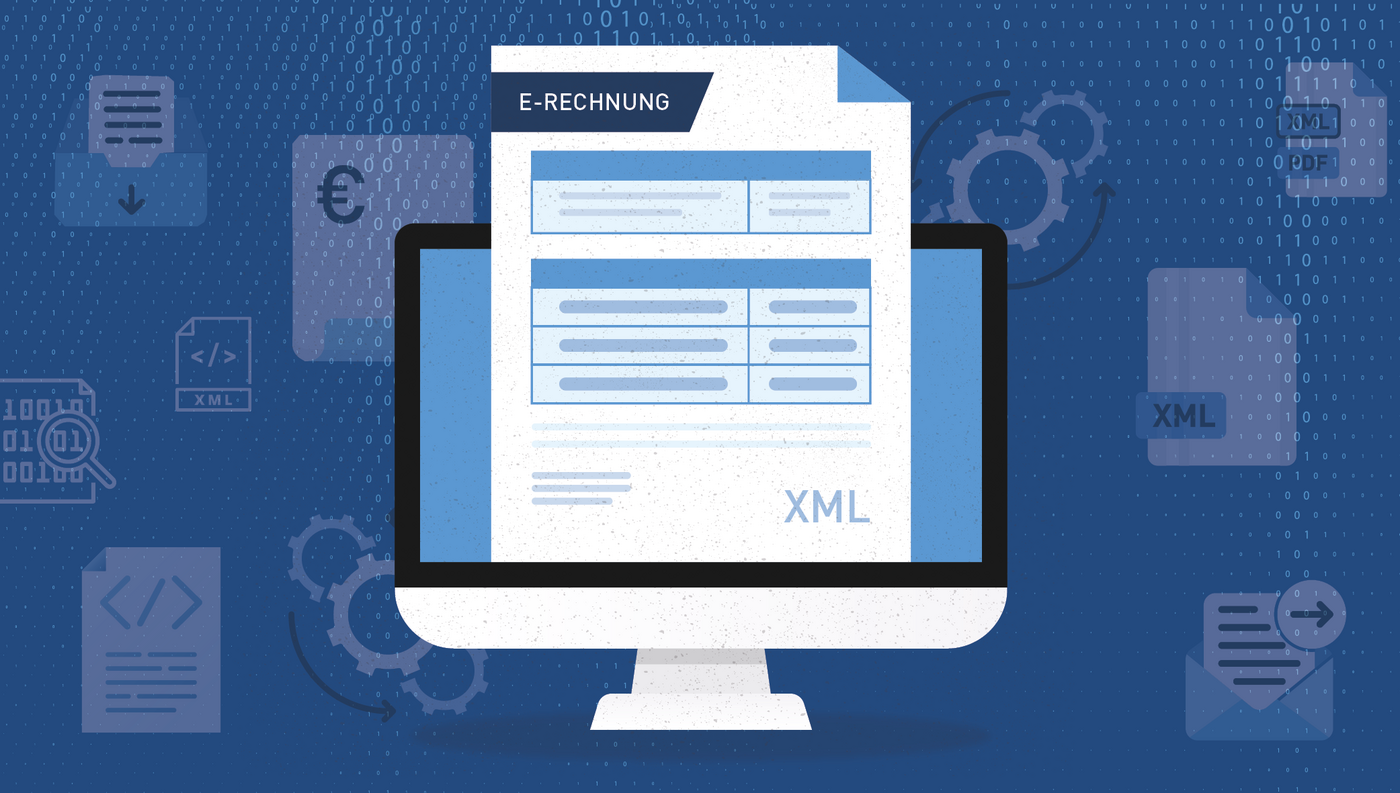
Germany’s Growth Opportunities Act, published in the Federal Law Gazette on March 27, 2024, paved the way for mandatory electronic invoicing for domestic B2B transactions in Germany. Since January 1, 2025, an e-invoice must generally be used for transactions between domestic companies. However, transition rules apply to the issuing of e-invoices, allowing companies to adapt their processes step by step.
At the European level, the digitalization of VAT is also moving forward. The “VAT in the Digital Age” package, known as ViDA, was adopted in 2025 and is intended to modernize the EU VAT system. One of its central elements is the introduction of digital reporting obligations based on electronic invoices. These will initially affect primarily cross-border B2B transactions and will be introduced gradually at EU level.
For Germany, the Federal Ministry of Finance first clarified the legal and practical requirements in its letter dated October 15, 2024. A further update followed with the ministry’s letter dated October 15, 2025. In addition, the Federal Ministry of Finance provides an FAQ catalog that is updated regularly and supports companies in implementing the e-invoicing mandate.

Note
This article was updated in June 2026. It reflects the status of the Federal Ministry of Finance FAQ on e-invoicing as of March 2026, as well as the ministry’s letters dated October 15, 2024, and October 15, 2025, on the introduction of mandatory electronic invoicing for transactions between domestic businesses. The e-invoicing mandate has applied since January 1, 2025, with transition rules in place for the issuing of e-invoices.
The article also takes into account current developments relating to XRechnung 4.0 and ZUGFeRD 2.5. The upcoming XRechnung 4.0 is connected to the revision of the European standard EN 16931-1. The first part of ZUGFeRD 2.5, or Factur-X 1.09, was published on June 10, 2026. It includes only mandatory updates to the code lists and smaller preparatory changes. The majority of the version, including the more critical update with the announced functions for gross invoices, will follow in a second release after the revision of EN 16931-1:2026 has been adopted.
Germany’s E-Invoicing Mandate: 10-Step Implementation Checklist
Use this e-invoicing checklist to assess, step by step, how well your organization is prepared to receive, process, issue, and retain electronic invoices. Check each step your organization has already completed.
-
Identify Covered Transactions and Exceptions
Identify which domestic B2B transactions are subject to Germany’s e-invoicing mandate. Document exceptions, including B2C transactions, certain tax-exempt supplies, low-value invoices of up to €250, and invoices issued by businesses using Germany’s small-business VAT exemption. Note that those small businesses must still be able to receive e-invoices.
Open -
Determine Your Deadline and Prior-Year Revenue
Review the relevant prior-year revenue and determine when your organization must begin issuing outbound e-invoices. Do not wait until the end of the statutory transition period. Build in enough time for preparation, testing, and rollout.
Open -
Assign Ownership and Build the Project Team
Appoint a responsible owner and involve at least accounting, IT, procurement, sales, and, where appropriate, tax advisors or legal counsel. Clearly define decision rights, responsibilities, backup coverage, and internal deadlines.
Open -
Set Up a Central Receiving Channel
Set up a central email inbox or another suitable digital delivery channel. Share the address with suppliers and define backup coverage, access rights, forwarding rules, and business continuity procedures.
Open -
Define Formats and Delivery Methods
Decide which structured formats your organization will receive and issue, such as XRechnung or ZUGFeRD. Also confirm which formats, portals, or interfaces are required by key customers, suppliers, and public-sector contracting authorities.
Open -
Prepare Software, Interfaces, and Master Data
Verify that your invoicing, ERP, and accounting systems can create, import, and process structured invoices. Update customer and vendor master data, tax details, payment information, recipient addresses, and required reference numbers.
Open -
Provide Visualization and Validation
Provide a viewer that allows employees to display XML invoices in a readable format. Automatically validate incoming and outgoing files for format errors, required information, and technical processability. For hybrid formats, the structured data component is authoritative.
Open -
Define Invoice Workflows and Error Handling
Document the process from receipt through review, approval, posting, and payment. Also define how outbound e-invoices are created, sent, corrected, and canceled. Establish procedures for invalid, incomplete, or duplicate invoices.
Open -
Update Retention and Process Documentation
Ensure that the original structured component of incoming and outgoing e-invoices is retained unchanged for eight years. Document storage, access rights, processing, backups, restoration, and data access in a clear and auditable manner.
Open -
Run a Pilot, Train Employees, and Roll Out
Test the full process with selected customers and suppliers: creation, transmission, receipt, review, posting, and archiving. Train the employees involved and, after rollout, regularly monitor error rates, processing times, and unresolved format issues.
Open
What is an electronic invoice, or e-invoice?
An e-invoice, or electronic invoice, is a digitally issued document that contains the same information as a traditional paper invoice, but is:
issued in a structured electronic format,
transmitted and received electronically,
and enables automatic electronic processing of the invoice data.
The structured electronic format must comply with the European standard for electronic invoicing and the list of corresponding syntaxes under Directive 2014/55/EU, and therefore with the CEN standard EN 16931.
Examples of e-invoicing formats commonly used in Germany include:
XRechnung
ZUGFeRD from Version 2.0.1 onward, with the exception of the MINIMUM and BASIC-WL profiles
Factur-X
certain EDI procedures, provided they meet the legal requirements

Is a PDF an electronic invoice?
Since January 1, 2025, a simple PDF has no longer been considered an e-invoice under German law. Under the new legal definition, it is not classified as an e-invoice, but as another type of invoice, because the invoice data is not available in a structured format and cannot be readily processed automatically.
The situation is different for hybrid formats such as ZUGFeRD or Factur-X. These combine a readable PDF/A-3 document with an embedded XML data set. The decisive element is the structured XML part. If the PDF view and the structured XML data set differ, the structured part takes precedence.
Hybrid formats
Hybrid formats that contain both a structured part and a visual part are permitted. The best-known example is ZUGFeRD, or Factur-X.
For hybrid e-invoices, the structured part takes precedence. This means that if the PDF representation and the XML data set differ, the information in the structured part is authoritative. Companies should therefore ensure that the PDF and XML content match and use appropriate validation mechanisms.
Benefits of e-invoicing
An e-invoice contains the invoice information in a structured, machine-readable data set and offers numerous advantages over a traditional paper invoice, both for invoice issuers and invoice recipients.
| For invoice recipients | For invoice issuers |
|---|---|
| Optimized and automated invoice processing without manual entry | Simplified and faster invoice creation |
| Higher data quality due to fewer errors | Shorter processing times and more punctual payments |
| Cost savings through automated processing | Cost savings by eliminating paper and postage |
| Decentralized and flexible processing | Higher process quality through automatic creation and validation |
| End-to-end electronic processing without media breaks | Less manual rework |
| Better auditability and validation | Location-independent work |
| Faster approval and payment processes | Better traceability throughout the invoicing process |
| Easier integration into ERP, accounting, and document management systems | Structured digital processes from invoice creation to tracking |
E-invoices compared with other invoice types
Since 2025, German VAT law has distinguished between e-invoices and other types of invoices.
An e-invoice exists when the invoice is issued, transmitted, and received in a structured electronic format and can be processed electronically. Other invoice types include paper invoices, simple PDF invoices, image files, or scanned paper invoices.
During the transition periods, other invoice types may still be used under certain conditions. In the long term, however, they will generally be replaced by structured e-invoices for domestic B2B transactions.
What does the electronic invoicing mandate mean for invoice issuers and recipients?
Overall, the introduction of the e-invoicing mandate means a modernization and simplification of accounting and invoicing processes. At the same time, it requires companies to adapt their software, master data, and internal processes carefully and in good time.
| For invoice recipients | For invoice issuers | For both parties |
|---|---|---|
|
Readiness to receive e-invoices
Since January 1, 2025, companies have had to ensure that they can receive e-invoices in the required structured format. In principle, an email inbox is sufficient for receiving e-invoices. In practice, however, suitable software solutions are required to review, process, and archive e-invoices efficiently. Process adjustments
Existing business processes must be adapted to make the receipt, processing, approval, and archiving of e-invoices efficient. Electronic invoices offer significant potential for automated accounting and faster processing. Archiving
E-invoices must be stored electronically. For e-invoices, at least the structured part must be retained intact in its original form. |
Issuing obligation with transition periods
Since 2025, the e-invoicing mandate has generally applied to domestic B2B transactions. However, transition rules apply to the actual obligation to issue structured e-invoices until the end of 2026 or, in certain cases, until the end of 2027. Sending without consent
For an e-invoice that meets the new legal requirements, the invoice recipient’s consent is generally no longer required. Consent remains relevant, however, if another type of invoice is used in a different electronic format, such as a simple PDF invoice. Competitive advantage
Companies that switch to e-invoicing early can benefit from more efficient processes, reduce errors, and better prepare for upcoming legal requirements. |
Coordination and communication
Companies should coordinate with business partners regarding formats, transmission channels, and internal processing steps. Especially with hybrid formats such as ZUGFeRD, it is important that the structured part can be processed correctly. Data quality
E-invoices require clean master data. Incorrect addresses, tax details, references, or payment data can result in invoices not being processed correctly. Transition phase
The years 2025 to 2027 are a transition phase. Companies should use this time to establish stable processes before e-invoicing becomes fully mandatory after the transition periods expire. |

Legal basis of the e-invoicing mandate in Germany
Important legal foundations and key development steps include:
EU Directive 2010/45/EU amending invoicing rules
Germany’s 2011 Tax Simplification Act
EU Directive 2014/55/EU on electronic invoicing in public procurement
The German act implementing Directive 2014/55/EU
The German E-Invoicing Ordinance on electronic invoicing in federal public procurement
The Growth Opportunities Act, which revised the e-invoicing rules in the German VAT Act
Federal Ministry of Finance letter dated October 15, 2024
Federal Ministry of Finance letter dated October 15, 2025
Federal Ministry of Finance FAQ on e-invoicing, as of March 2026
ViDA, the European “VAT in the Digital Age” package
Since when has e-invoicing been mandatory? Rules and deadlines
In the Business-to-Government sector, or B2G, the e-invoicing mandate has applied in Germany to federal government suppliers since November 27, 2020, based on the federal E-Invoicing Ordinance. Since then, suppliers to the federal government have generally been required to issue electronic invoices for public contracts, unless an exception applies.
At the level of Germany’s federal states, deadlines, portals, and specific requirements have in some cases been defined individually. Many federal states have also introduced mandatory rules in the B2G sector. Invoice issuers should therefore always check which requirements apply to the relevant public contracting authority.
In the Business-to-Business sector, or B2B, the e-invoicing mandate has applied since January 1, 2025, to transactions between domestic companies. However, transition rules apply to the issuing of e-invoices, making it easier for companies to move to e-invoicing step by step.
Transition rules and deadlines for the e-invoicing mandate
The basic obligation to use e-invoices has applied since January 1, 2025. However, transition rules are provided for the period from 2025 to 2027 under Section 27(39) of the German VAT Act.
Issuing and receiving invoices until the end of 2026
For domestic B2B transactions, companies may continue to issue other types of invoices until the end of 2026. These include paper invoices and, with the recipient’s consent, simple PDF invoices or other electronic formats that do not meet the requirements for an e-invoice.
Nevertheless, the obligation to receive e-invoices has already applied since January 1, 2025. This means that companies must be able to receive e-invoices, even if they themselves may still issue other types of invoices during the transition phase.
Smaller companies
For companies with total revenue of up to EUR 800,000 in the previous year, the transition period for issuing other types of invoices is extended until the end of 2027. This is intended to give smaller companies more time for the technical and organizational transition.
Use of EDI procedures until the end of 2027
Until the end of 2027, invoices may be issued and transmitted in another electronic format if this is done using an EDI procedure, or electronic data interchange, provided they are compatible with the CEN standard EN 16931 and the recipient consents. In addition, EDI procedures may also be used in the long term if they allow the accurate and complete extraction of the invoice information required for VAT purposes.
Obligations after the transition periods expire
After the transition rules expire, companies must generally use e-invoices for domestic B2B transactions, unless a statutory exception applies. Unstructured formats such as simple PDF invoices or paper invoices will then no longer be sufficient.
An electronic reporting system for the timely, transaction-based reporting of certain invoice information to the tax authorities is planned for a later date. The e-invoicing mandate provides the technical and organizational foundation for this reporting system. However, the necessary statutory rules have not yet been enacted.
Receiving and archiving e-invoices since 2025
Even though companies have not yet been required to issue all of their invoices in the new structured format since January 1, 2025, domestic business customers have had to be able to receive e-invoices since that date.
In principle, an email inbox is sufficient for receiving an e-invoice. In day-to-day business practice, however, this is usually not enough. What matters is that e-invoices can be visualized, validated, processed, and archived.
For retention, German VAT law provides for an eight-year period under Section 14b(1) of the German VAT Act. For an e-invoice, at least the structured part must be retained intact in its original form. A printout alone is not sufficient.
Who is affected by the e-invoicing mandate?
The obligation to issue e-invoices generally applies to business transactions between companies within Germany or in certain territories as defined in Section 1(3) of the German VAT Act.
Both parties, meaning the invoice issuer and the invoice recipient, must be established in Germany. Relevant factors include, in particular, the registered office, place of management, or a permanent establishment in Germany involved in the transaction. If there is no registered office in Germany, the place of residence or habitual residence may also be relevant. A VAT registration in Germany alone, without actual establishment in Germany, does not automatically trigger the obligation to issue e-invoices.
Entrepreneurs include commercial companies, freelancers, landlords, doctors, and small businesses, provided they are acting in a business capacity.
In which cases does the e-invoicing mandate apply?
The e-invoicing mandate also applies to:
self-billing invoices, known in German VAT law as “Gutschriften” under Section 14(2), sentence 5 of the German VAT Act
transactions in which the recipient of the service owes the tax, known as the reverse-charge procedure under Section 13b of the German VAT Act
invoices issued by small businesses under Section 19 of the German VAT Act
transactions subject to average-rate taxation for agricultural and forestry businesses under Section 24 of the German VAT Act
travel services under Section 25 of the German VAT Act
transactions subject to margin scheme taxation under Section 25a of the German VAT Act
The e-invoicing mandate also applies if the invoice recipient is a small business or someone who only carries out tax-exempt transactions, such as a residential landlord.
What exceptions are there?
The rules on mandatory e-invoicing only apply if there is a VAT obligation to issue an invoice in the first place. They therefore do not apply to invoices issued to private end consumers and not to many tax-exempt transactions where issuing an invoice is generally voluntary under VAT law.
Even where there is a VAT obligation to issue an invoice, an e-invoice does not necessarily have to be issued for:
low-value invoices up to a gross amount of EUR 250
tickets that qualify as invoices
services provided by small businesses
services provided to legal entities that are not entrepreneurs
certain services provided to end consumers in connection with real estate
In these cases, another type of invoice may also be issued. However, it is important to note that although small businesses are exempt from issuing e-invoices, they must still be able to receive e-invoices.
What applies to invoice recipients?
Since January 1, 2025, domestic business customers have had to be able to receive electronic invoices. The invoice recipient’s consent is not required for receiving a legally compliant e-invoice.
Consent is only still required if an invoice does not meet the new requirements, or if there is no e-invoicing mandate and an electronic invoice in another format is nevertheless to be used.
Rules for B2C invoices
There is no general obligation to issue electronic invoices for invoices to end consumers, meaning B2C invoices. The recipient’s consent to electronic invoicing is still required in this case.
How must the e-invoice be transmitted and received?
The new rule does not specify any particular transmission channel for electronic invoices. In principle, an email inbox is sufficient for receiving them.
Alternatively, electronic interfaces, portals, or other transmission channels may also be used. In the B2G sector, however, specific portals or platforms may be mandatory, such as the federal invoice submission platforms in Germany.
Electronic invoice formats: XRechnung and ZUGFeRD
To meet the legal requirements of the e-invoicing mandate, companies must ensure that their invoices are transmitted in a suitable structured format. Two key formats that are relevant in Germany are XRechnung and ZUGFeRD.
According to the current position of the Federal Ministry of Finance, the formats commonly used in Germany, in particular XRechnung and ZUGFeRD from Version 2.0.1 onward, meet the VAT requirements for an e-invoice. For ZUGFeRD, the MINIMUM and BASIC-WL profiles are excluded. Other formats or EDI procedures may also continue to be used, provided they allow the accurate and complete extraction of the invoice information required for VAT purposes.
What is XRechnung?
XRechnung is the German application specification of the European standard EN 16931. It was developed by the Coordination Office for IT Standards, or KoSIT, and is continuously maintained and further developed.
In Germany, XRechnung is considered the central standard for electronic invoices issued to public contracting authorities. It is especially well established in the B2G sector, but it can also be used as an e-invoicing format in the B2B sector.
Unlike ZUGFeRD, XRechnung is a pure XML format. It contains all necessary invoice information in structured form, but does not include an embedded PDF or a traditional visual invoice image. For visual review, companies therefore need a visualization tool or viewer.
Not every XML invoice is automatically an XRechnung. An invoice only complies with the XRechnung standard if it meets the permitted syntaxes, business rules, and requirements of the specification.
XRechnung 4.0: What should companies expect?
An important next development step is XRechnung 4.0. The background is the revision of the European standard EN 16931-1, on which XRechnung is based as the German standard for electronic invoices.
The next revision shifts the focus from a standard that was originally strongly shaped by B2G requirements toward data structures that are suitable for B2B use and robust from a compliance perspective. These structures are intended to form an important basis for national e-invoicing mandates and European initiatives such as ViDA.
The European Committee for Standardization approved the update to the semantic model in February 2026. The formal publication of the revised EN 16931-1 is expected around mid-2026. A preliminary version of XRechnung 4.0 is also expected to be made available shortly after the new EU standard. This preliminary version is not yet intended for productive use, but is designed to provide early guidance on the new functionality. The productive version of XRechnung 4.0 is expected to follow between mid- and late 2026.
The transition to XRechnung 4.0 and the underlying revision of EN 16931-1 will undoubtedly involve significant effort for public administration, businesses, and software providers. The large number of changes, new data fields, and structural adjustments will affect existing processes in many areas. At the same time, this change opens up considerable potential: especially in the B2B environment and in individual industries, new opportunities are emerging to automate electronic invoicing processes more extensively and to better reflect industry-specific requirements.
XRechnung in BCS
The invoicing module in BCS has long offered full support for XRechnung, including visualization of the invoice information. A digital invoice view is created within invoicing in BCS, making it easier for users to review the included information in the familiar way. Only the XML file is then sent to the invoice recipient. Learn more about XRechnung in this blog article.
What is ZUGFeRD?
ZUGFeRD stands for “Zentraler User Guide des Forums elektronische Rechnung Deutschland,” or Central User Guide of the German Electronic Invoice Forum, and was introduced in Germany in 2014. The standard was developed to create a uniform, easy-to-integrate format for electronic invoices that is suitable for small and medium-sized businesses as well as large companies.
ZUGFeRD is a hybrid format. It embeds structured invoice data in XML format into a PDF/A-3 document. The invoice is therefore sent as a PDF file, but also contains an embedded XML version of the same invoice.
The PDF component enables familiar visual review. The XML component enables automated processing of the invoice data in suitable software systems.
Since Version 2.1, ZUGFeRD has been technically identical to the French format Factur-X. This is why the term ZUGFeRD/Factur-X is often used.
ZUGFeRD 2.5: Publication in two steps
With ZUGFeRD 2.5, or Factur-X 1.09, the next version of the hybrid e-invoicing format was published in June 2026. The release is taking place in two steps.
Step 1: Release on June 10, 2026
The first part of the release took place on June 10, 2026. This update primarily includes the mandatory update of the code lists and validation artifacts in line with the latest publications on the European standard EN 16931.
In addition, special requirements were integrated that are relevant to the upcoming French B2B mandate. These include new elements in the EXTENDED profile that support interoperability with electronic invoicing in France.
Step 2: Functionality for gross invoices to follow soon
A subsequent second release is expected to implement the announced functionality for gross invoices. This is particularly relevant for industries in which gross invoices play an important role, such as bookselling, publishing, and the mineral oil industry.
The exact publication date for this second step has not yet been set. FeRD is expected to announce it in good time.
For companies, this means that anyone using ZUGFeRD should not only check the version currently in use, but also make sure that the software they use reliably supports future updates.
ZUGFeRD in BCS
With the invoicing module in BCS, you can create an e-invoice in ZUGFeRD format in no time. In the master data of an invoice in the invoice generator, simply select ZUGFeRD from the drop-down menu under the “Delivery” category in the “Invoice format” field. BCS automatically generates the invoice in PDF/A-3 format with embedded XML data.
Learn more about the benefits of the ZUGFeRD data format for e-invoicing in our expert article.
XRechnung or ZUGFeRD: Which format makes sense?
XRechnung and ZUGFeRD meet different practical requirements.
XRechnung is a pure XML format and is especially well established in the B2G sector. It is well suited for fully structured, automated processes, but requires visualization for human review.
ZUGFeRD combines a readable PDF invoice with structured XML data. The format is particularly attractive in the B2B environment because it combines familiar review based on a visual invoice image with machine-readable data.
Which format makes sense depends on the invoice recipient, the process, and the technical requirements. For public contracting authorities, the decisive factor remains which formats are permitted under the relevant specifications, platform requirements, and legal rules.
E-invoicing software is essential
Without suitable software, it is practically impossible to meet the requirements for receiving, processing, and archiving e-invoices efficiently and in a legally compliant way.
A suitable software solution must be able to create, send, receive, visualize, validate, process, and archive invoice data in structured formats. In addition, it must ensure that invoices comply with legal and standards-based requirements.
Key functions of a suitable software solution include:
automatic creation of e-invoices
support for relevant formats such as XRechnung and ZUGFeRD
validation against standards, profiles, and business rules
visualization of structured XML data
integration into ERP, accounting, and document management systems
secure electronic archiving for the legally required retention period
support for approval and review processes
data transfer to accounting programs such as DATEV
Various viewer solutions are now available for visual review alone. Through the ELSTER portal, the German tax administration also provides an e-invoice viewer that can display e-invoices in XRechnung or ZUGFeRD format in a human-readable form.
For efficient processing in day-to-day business, however, a viewer alone is usually not enough. What matters is a software solution that can not only display e-invoices, but also validate, process, archive, and integrate them into existing accounting or ERP processes.
All e-invoicing features in one software solution: BCS
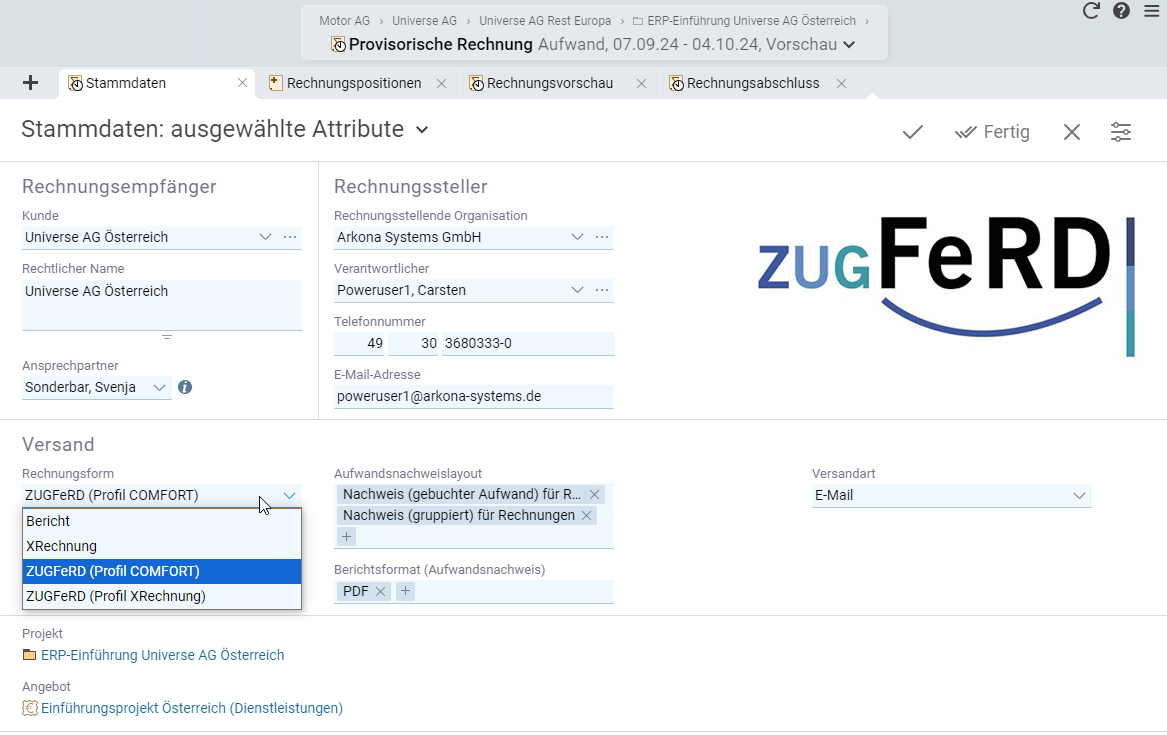
BCS supports the creation and delivery of the relevant formats for electronic invoicing, especially XRechnung and ZUGFeRD.
With the invoicing module in BCS, you can, among other things:
create and send e-invoices
upload incoming XML invoices from a DMS or file server
validate invoices according to EN 16931
automatically create incoming invoices
store documents securely
visualize XML files for review
transfer data seamlessly to accounting programs such as DATEV
support approval processes in the future through BPMN-based workflows
With BCS, you will therefore not only be able to receive, process, and archive e-invoices, but also create and send them. BCS provides the tools you need to meet the e-invoicing mandate while also optimizing your internal processes.
Projektron continuously monitors legal and technical developments related to e-invoicing and takes relevant changes into account in product development. The BCS invoicing module is being developed accordingly so that companies can continue to map their invoicing processes reliably and in compliance with the rules.
Electronic invoicing and previous electronic invoice formats
The history of electronic invoicing is closely linked to the development of information technology and the digitalization of business processes. Here is an overview of the most important milestones:
History of electronic invoice formats
The first computers are used to process invoices and financial data. These early systems are mostly mainframes used primarily by large companies and banks.
The development of databases and the introduction of batch processing enable more efficient management and processing of invoices.
The first generation of ERP systems emerges. These systems integrate various business processes, including accounting and invoicing, into a shared system.
The introduction of EDI, or electronic data interchange, revolutionizes electronic invoicing. Standardized formats make it possible to exchange business data between companies. As a result, invoices and other documents can be transmitted electronically.
The rise of the internet enables new forms of electronic communication. XML is developed to exchange structured data between different systems. As a result, XML quickly becomes an important foundation for electronic invoicing because it enables flexibility and interoperability.
Digital signatures and the growing recognition of the legal validity of electronic documents contribute to the spread of electronic invoicing. The EU creates additional frameworks to promote the use of electronic invoices.
Numerous countries introduce legal requirements mandating the use of electronic invoices, especially in the public sector. EU Directive 2014/55/EU on electronic invoicing in public procurement enters into force in 2014 and establishes an important standard for electronic invoicing in the public sector.
ZUGFeRD is introduced in 2014. XRechnung is developed and established from 2017 onward as the German standard for electronic invoices in public procurement.
The digital transformation of accounting and invoicing accelerates significantly. Since November 27, 2020, suppliers to the German federal government have generally been required to issue invoices electronically. Since January 1, 2025, the e-invoicing mandate has also been introduced step by step in the domestic B2B sector.
With ViDA, electronic invoices and digital reporting obligations are also being advanced at European level. At the same time, the formats continue to evolve: XRechnung 4.0 is expected as a comprehensive further development in connection with the new EN 16931-1. ZUGFeRD 2.5, or Factur-X 1.09, was published in 2026 and takes into account, among other things, new code lists as well as requirements from the French B2B mandate.
Conclusion: Strategic preparation for e-invoicing secures competitiveness
The e-invoicing mandate is no longer a future topic. Since January 1, 2025, companies in Germany have been required to be able to receive electronic invoices. Although transition rules apply to the issuing of e-invoices, the direction is clear: structured electronic invoices are becoming the standard in B2B business.
For companies, this is therefore no longer just about being prepared in time. What matters now is establishing invoicing processes that are stable, efficient, and future-proof. This includes suitable formats such as XRechnung and ZUGFeRD, secure archiving, reliable validation, and integration into existing ERP and accounting systems.
Current developments show that e-invoicing continues to evolve. XRechnung 4.0 will shape the German implementation of the new EN 16931-1:2026 and align the standard more strongly with data structures that are suitable for B2B use and robust from a compliance perspective. ZUGFeRD 2.5, or Factur-X 1.09, brings updated code lists, new requirements from France, and, in a further step, the announced support for gross invoices.
BCS supports companies in creating, sending, receiving, processing, and archiving electronic invoices. This not only helps you meet legal requirements, but also enables you to use e-invoicing as an opportunity to automate and sustainably optimize your commercial processes.
Projektron continuously monitors legal and technical developments related to e-invoicing and takes relevant changes into account in product development. The BCS invoicing module is being developed accordingly so that companies can continue to map their invoicing processes reliably and in compliance with the rules.
FAQ on the e-invoicing mandate
What is an e-invoice?
An e-invoice is an electronic invoice in a structured format. It can be received, processed, validated, and archived digitally.
Since when has the e-invoicing mandate applied?
The e-invoicing mandate has applied to domestic B2B transactions since January 1, 2025. Since then, companies have had to be able to receive e-invoices.
Are PDF invoices still permitted?
A simple PDF invoice is not considered an e-invoice under German law. It counts as another type of invoice because it does not contain structured invoice data.
Which e-invoicing formats are important?
In Germany, XRechnung and ZUGFeRD are particularly relevant. Both support structured data and meet key e-invoicing requirements.
What is the difference between XRechnung and ZUGFeRD?
XRechnung is a pure XML format. ZUGFeRD combines a readable PDF/A-3 document with embedded XML data.
Who is affected by the e-invoicing mandate?
In principle, domestic companies are affected in B2B transactions. Small businesses must also be able to receive e-invoices.
Which transition periods apply to e-invoicing?
Transition rules for issuing e-invoices apply until the end of 2026. For smaller companies and certain EDI procedures, deadlines may apply until the end of 2027.
Why is e-invoicing software important?
E-invoicing software supports the creation, receipt, validation, visualization, processing, and archiving of electronic invoices.
What are the benefits of electronic invoices?
Electronic invoices reduce manual work, lower costs, improve data quality, and accelerate approval and payment processes.

About the author
Daniel Kreher is a controller in the finance department and has been involved in the development of e-invoicing in BCS from the very beginning. Projektron GmbH’s accounting department creates around 3,000 invoices per year. The share of XRechnung invoices and invoices in ZUGFeRD format has grown steadily over the past few years.
Additional reading & sources on e-invoicing
- Federal Ministry of Finance: FAQ on mandatory e-invoicingAs of March 2026; definition of an e-invoice, PDF as another type of invoice, transition periods, exceptions, XRechnung, and ZUGFeRD.https://www.bundesfinanzministerium.de/Content/DE/FAQ/e-rechnung.html
- Federal Ministry of Finance letter dated October 15, 2025: Introduction of mandatory electronic invoicingUpdate and adjustment of the German VAT Application Decree.https://www.bundesfinanzministerium.de/Content/DE/Downloads/BMF_Schreiben/Steuerarten/Umsatzsteuer/Umsatzsteuer-Anwendungserlass/2025-10-15-einfuehrung-obligatorische-e-rechnung.html
- Federal Ministry of Finance letter dated October 15, 2025 as PDFhttps://www.bundesfinanzministerium.de/Content/DE/Downloads/BMF_Schreiben/Steuerarten/Umsatzsteuer/Umsatzsteuer-Anwendungserlass/2025-10-15-einfuehrung-obligatorische-e-rechnung.pdf?__blob=publicationFile&v=5
- E-Rechnung BundB2G mandate for federal government suppliers since November 27, 2020, including exceptions and platform information.https://e-rechnung-bund.de/
- E-Rechnung Bund: FAQhttps://e-rechnung-bund.de/faq/
- KoSIT / XStandards Einkauf: XRechnungOverview of the XRechnung standard.https://xeinkauf.de/xrechnung/
- KoSIT / XStandards Einkauf: Versions and bundles of XRechnungCurrent versions, bundles, and technical components.https://xeinkauf.de/xrechnung/versionen-und-bundles/
- KoSIT / XStandards Einkauf: XRechnung 4.0 — what should we expect?Outlook on EN 16931-1:2026, the preliminary version, and XRechnung 4.0.https://xeinkauf.de/aktuelles/xrechnung/xrechnung-4-umsetzung/
- German Electronic Invoice Forum / FeRDOfficial FeRD page on ZUGFeRD/Factur-X.https://www.ferd-net.de/
- FeRD: ZUGFeRD 2.5 / Factur-X 1.09Official source via FeRD; if the specific news page is not permanently accessible, it can be found through the publications page.https://www.ferd-net.de/
- European Commission: VAT in the Digital Age / ViDAOverview of ViDA, adoption on March 11, 2025, and rollout through January 2035.https://taxation-customs.ec.europa.eu/taxation/vat/vat-digital-age-vida_en
- European Commission: Adoption of the VAT in the Digital Age packageNews on the adoption of the ViDA package.https://taxation-customs.ec.europa.eu/news/adoption-vat-digital-age-package-2025-03-11_en
- German VAT Act, Section 14 — Issuing invoiceshttps://www.gesetze-im-internet.de/ustg_1980/__14.html
- German VAT Act, Section 14b — Retention of invoiceshttps://www.gesetze-im-internet.de/ustg_1980/__14b.html
- German VAT Act, Section 27 — Transitional provisionsRelevant in particular: Section 27(39) of the German VAT Act.https://www.gesetze-im-internet.de/ustg_1980/__27.html
- Federal E-Invoicing Ordinance, ERechVhttps://www.gesetze-im-internet.de/erechv/
- GoBD — Federal Ministry of Finance letter on bookkeeping and the retention of electronic recordshttps://www.bundesfinanzministerium.de/Content/DE/Downloads/BMF_Schreiben/Weitere_Steuerthemen/Abgabenordnung/2019-11-28-GoBD.html
- Dresden Chamber of Commerce and Industry: E-invoicing from 2025 — mandate, deadlines, exceptionsClear practical overview, updated in 2026.https://www.ihk.de/dresden/hauptnavigation/recht-steuern/erechnung-6232764
- Hanover Chamber of Commerce and Industry: Electronic invoicesPractical information on the obligation to receive e-invoices, the obligation to issue them, and applicable deadlines.https://www.ihk.de/hannover/hauptnavigation/recht/steuerrecht/umsatzsteuer/elektronische-rechnungen-pflicht-ab-2025-6168870
More interesting articles on the Projektron blog
QR-bill
The QR-bill has been part of Swiss payment transactions since 2020, replacing old payment slips for faster, secure, and standardized payments. From November 21, 2025, only structured addresses will be permitted. Companies with unstructured addresses must make the switch.
Scrum in software development
When it comes to agile methods in software development, there is one term you cannot avoid: Scrum. But what exactly is Scrum, and how does it unfold its strengths in software development?
Process modeling with BPMN
BPMN is the standard for process modeling. BPMN stands for Business Process Model and Notation and is an international modeling language for business processes. Learn everything about BPMN and how to use it here.

Comparison: ERP for service providers
For service providers, the choice of ERP solution determines efficiency, transparency, and revenue. Our comparison presents the 10 best systems, explains which features really matter, and provides valuable tips for selecting the right solution. Find the ERP system that truly moves your company forward.

Since 2025, e-invoicing has become increasingly important in B2B transactions: structured electronic invoices enable automated processing, less manual work and greater legal certainty.