1
Established Standard Throughout Germany
XRechnung is a central standard for electronic invoices issued to public-sector clients in Germany. It creates a uniform basis for digital invoice exchange in the public sector.
06/18/2026 - Articles
XRechnung, Germany’s standard for electronic invoices issued to public-sector clients, has long been mandatory for suppliers and service providers working with the public sector. Since November 27, 2020, incoming invoices have only been accepted in electronic invoice format. This means that paper invoices and PDF invoices are accepted only in exceptional cases. The introduction of XRechnung was certainly a milestone — but was it a step forward or a step back?

XRechnung is the German standard for electronic invoices issued to public-sector clients. It consists of a structured, machine-readable XML data set and enables invoice information to be processed digitally.
Since November 27, 2020, XRechnung has been mandatory in the B2G sector for many invoices issued to public-sector clients.
Since January 1, 2025, e-invoicing has also become increasingly important in the B2B sector. Companies must generally be able to receive electronic invoices; transitional periods for issuing them apply depending on company size.
XRechnung reduces manual steps in invoice processing. Structured data can be automatically checked, routed, processed, and archived.
XRechnung and ZUGFeRD differ in format. While XRechnung is a pure XML data set, ZUGFeRD combines a PDF/A-3 invoice image with embedded XML data.
With XRechnung 4.0, the standard continues to evolve. New requirements from EN 16931, mandatory B2B e-invoicing, and European initiatives such as ViDA make XRechnung an important building block for future-ready invoice processes.
Software solutions such as BCS make it easier to create and validate XRechnungen. They generate valid XML data and internally visualize invoices as digital invoice images for review and approval processes.
Directive 2014/55/EU of the European Parliament and of the Council of April 16, 2014 requires public-sector contracting authorities involved in Europe-wide procurement procedures to be able to receive and process the resulting invoices electronically. An image file, a simple PDF, or a scanned paper invoice does not qualify as an electronic invoice within the meaning of the Directive.
The Directive laid the foundation for more standardized electronic invoicing across Europe. The European standard EN 16931 provides the functional and technical basis. Building on this standard, Germany developed XRechnung as its national standard. The Coordination Office for IT Standards, known as KoSIT, is responsible for providing, maintaining, and further developing XRechnung as part of XStandards Einkauf.
XRechnung is therefore Germany’s national application specification for electronic invoices and plays a central role, especially in invoice exchanges with public-sector clients.

An XRechnung is a structured, machine-readable XML document. It contains invoice information in a standardized data format so that the information can be read electronically and processed further.
In general, an XRechnung must meet the following requirements:
The invoice itself is not an embedded object. However, it may contain embedded objects, such as supporting documents that substantiate the invoice.
It is a valid instance in accordance with the XML schema definitions specified in the CEN standard EN 16931-2.
It complies with the business rules of the XRechnung standard.
It contains only the information elements provided for in the standard.
Not every XML invoice is automatically an XRechnung. An invoice qualifies as an XRechnung only if it meets the requirements of the standard. These include, in particular, the permitted syntaxes, the specified business rules, and the information elements defined in the standard.
Because XRechnung consists of a structured data set, no additional readable invoice document in image or PDF format is required. Standardization reduces manual steps, can help minimize sources of error, and can shorten invoice processing times.
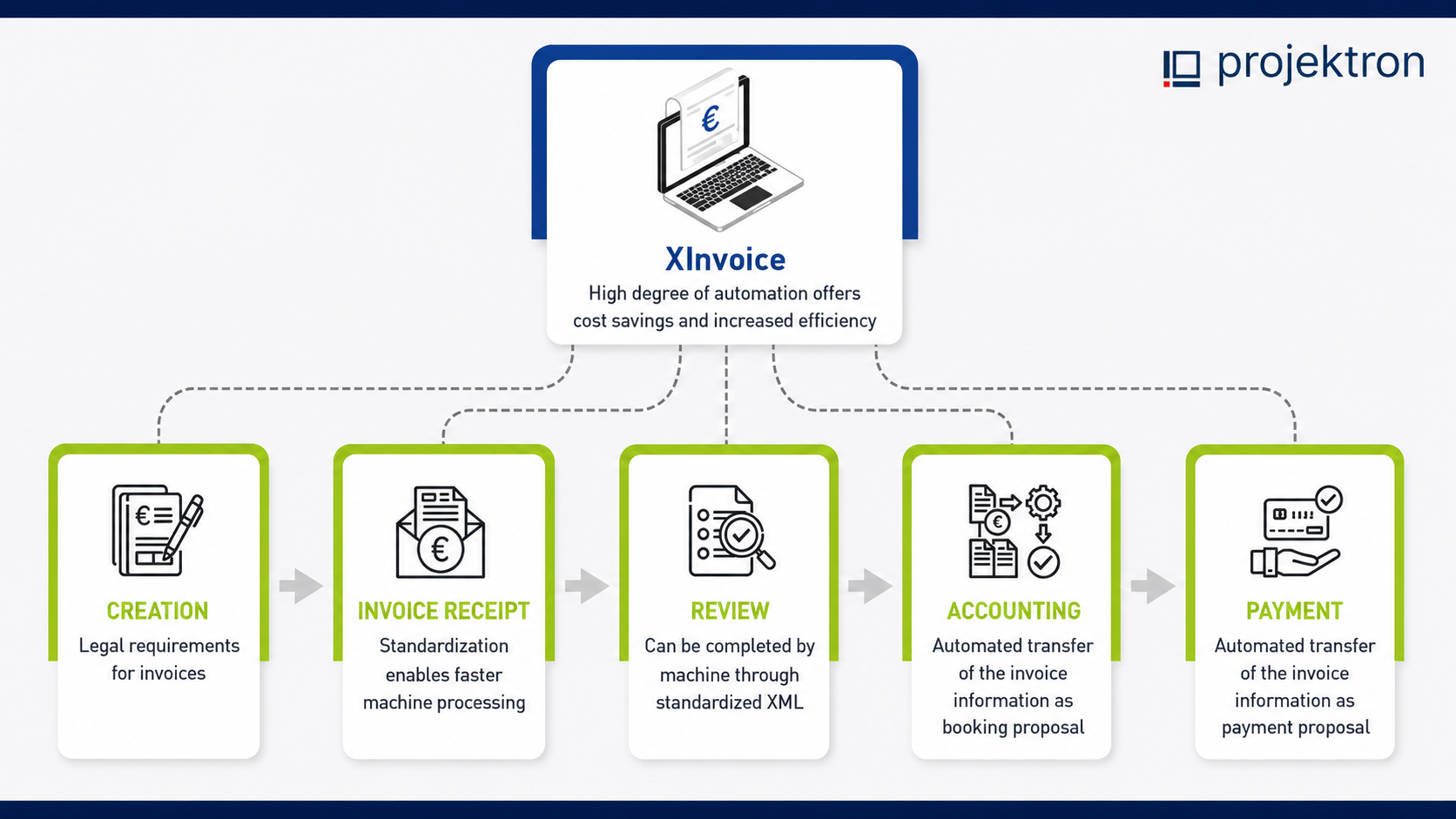
An e-invoice does not present invoice content on paper or merely as an image file. Instead, it represents that content in a structured data set. This allows information to be transmitted, received, and processed electronically without media breaks.
XRechnung is a specific form of e-invoice. Technically, it is based on an XML-based semantic data model and implements the European CEN data model for the German context. This makes it the central standard for electronic invoices submitted to public administration in Germany.
For many invoice issuers, the transition was initially a challenge. Since November 27, 2020, federal government suppliers have generally been required to submit electronic invoices in the prescribed format, unless an exception applies. While the rules have been implemented uniformly at the federal level, requirements, portals, and transmission channels may still differ at the state level.
Depending on the invoice context, an XRechnung contains information such as the following:
Which information is mandatory depends on the specific invoice context, the legal requirements, and the specifications of the respective invoice recipient.
The XRechnung requirement primarily applies to invoice issuers that work with public-sector clients. Depending on the contracting authority, different requirements may apply regarding format, portal, and transmission channel.
Exceptions may apply, for example, to payment requests or direct orders up to a certain value threshold. Certain confidential invoice data, such as data related to foreign service matters or other procurement activities abroad, may also be exempt from the e-invoicing requirement.
Because the detailed rules may differ between the federal government and the German states, invoice issuers should check which requirements apply to the respective public-sector client before submitting an invoice.
In the B2G sector, electronic invoicing has been mandatory since November 27, 2020, particularly for invoices issued to federal public-sector clients.
Since January 1, 2025, e-invoicing has also become significantly more important in the B2B sector. For transactions between domestic companies, a legal definition has applied since then: an e-invoice must be issued, transmitted, and received in a structured electronic format and must allow for electronic processing. A simple PDF does not meet these requirements and is therefore considered another type of invoice.
The key distinction is between receiving and issuing invoices. Since January 1, 2025, companies must generally be able to receive e-invoices. Transitional periods apply to issuing them: in 2025 and 2026, other types of invoices may still be used under certain conditions. For companies with prior-year revenue of up to 800,000 euros, this option is extended until the end of 2027.
In the B2C context, there is still no general requirement for electronic invoicing.
By the time XRechnung became mandatory in November 2020, at the latest, it was clear that invoice issuers, public-sector contracting authorities, and software providers would need to work with XRechnung on an ongoing basis. The standard is not a static format; it is regularly developed further and adapted to new legal, technical, and functional requirements.
Several versions of XRechnung have since been published and replaced by updated versions. The Coordination Office for IT Standards, known as KoSIT, remains responsible for the current status of the standard. It provides the valid versions, specifications, and rules for XRechnung and publishes regular updates.
One particularly important next step is the upcoming XRechnung 4.0. This development is driven by the revision of the European standard EN 16931-1, on which XRechnung is based as the German standard for electronic invoices. The revision shifts the focus from a standard originally shaped primarily by invoice exchanges with public-sector clients toward data structures that are also relevant for the B2B sector, national e-invoicing requirements, and the European ViDA initiative.
The update to the semantic model has already been adopted at the European level. The formal publication of the revised standard is expected in the course of 2026. A preliminary version of XRechnung 4.0 is expected to be made available shortly after the new EU standard. The final version is expected to follow between mid- and late 2026.
For public administration, businesses, and software providers, the transition to XRechnung 4.0 is likely to involve considerable effort. New data fields, revised business rules, and structural changes may have a significant impact on existing invoice processes and software solutions. At the same time, the further development offers considerable potential: especially in B2B environments and industry-specific scenarios, it creates new opportunities to further automate electronic invoicing processes and make them more future-ready.
For Projektron, this development is an important part of ongoing product development. Our goal remains the same: BCS is aligned with the latest legal and technical requirements. Companies that use the invoicing module in BCS can rely on us to monitor relevant changes, such as the upcoming XRechnung 4.0, at an early stage and continue developing our solution accordingly.
Key benefits of XRechnung include:
XRechnung is a central standard for electronic invoices issued to public-sector clients in Germany. It creates a uniform basis for digital invoice exchange in the public sector.
Electronic invoices reduce manual steps and shorten internal processing workflows. Invoices can be reviewed, forwarded, and approved for payment more quickly.
Structured invoice data can be read and processed automatically. This reduces the workload in accounting and helps prevent errors that can occur during manual data entry.
From creation and transmission to receipt and archiving, XRechnung supports digital workflows. Paper, printed PDFs, and manual intermediate steps can be significantly reduced.
XRechnungen can be integrated into software systems through intelligent interfaces, such as DMS, ERP, or accounting systems. This makes invoice data available where it is needed for further processing.
Because XRechnung is based on structured data, mandatory fields, formats, and content can be checked technically. This improves traceability and makes it easier to ensure the quality of invoice data.
XRechnung helps organizations and companies save both time and money. Expenses for paper, printers, toner, and postage are eliminated, while time-consuming tasks such as printing, stuffing envelopes, internal routing, and searching for documents are reduced.
XRechnung helps companies and organizations meet requirements in the B2G context and increasingly in the B2B context as well. It creates a structured basis for legally compliant electronic invoicing processes.
Because the statutory deadline was set for November 27, 2020, many companies in Germany only began to engage more deeply with the new invoice format relatively late. As a result, it was to be expected that the first hurdles of large-scale use would only become apparent after the requirement took effect.
Sending an XRechnung to public administration can differ significantly across Germany’s 16 federal states due to individual laws, regulations, portals, and transmission channels. Until greater standardization is achieved, implementation at the state level therefore remains something of a patchwork in some areas.
In practice, it has also become clear that while the XRechnung format offers many benefits, it can also come with disadvantages. The lack of a traditional invoice image makes invoice review less familiar, both internally within companies and for external parties such as auditors or tax auditors. Although the data set can be viewed, it does not provide the familiar overview of a traditional PDF.
This makes software solutions all the more important — solutions that not only generate XRechnungen technically, but also visualize them clearly for internal review and approval processes.
There are several basic ways to create an XRechnung:
The XRechnung is entered directly in a portal using a web form. This option is particularly suitable for individual invoices or smaller invoice volumes.
An external service provider handles the technical creation, validation, or transmission of the XRechnung. This can be useful if no suitable infrastructure is available internally.
The XRechnung is generated directly from the ERP system or BCS software. This solution is particularly efficient because invoice data can be processed without additional manual intermediate steps.
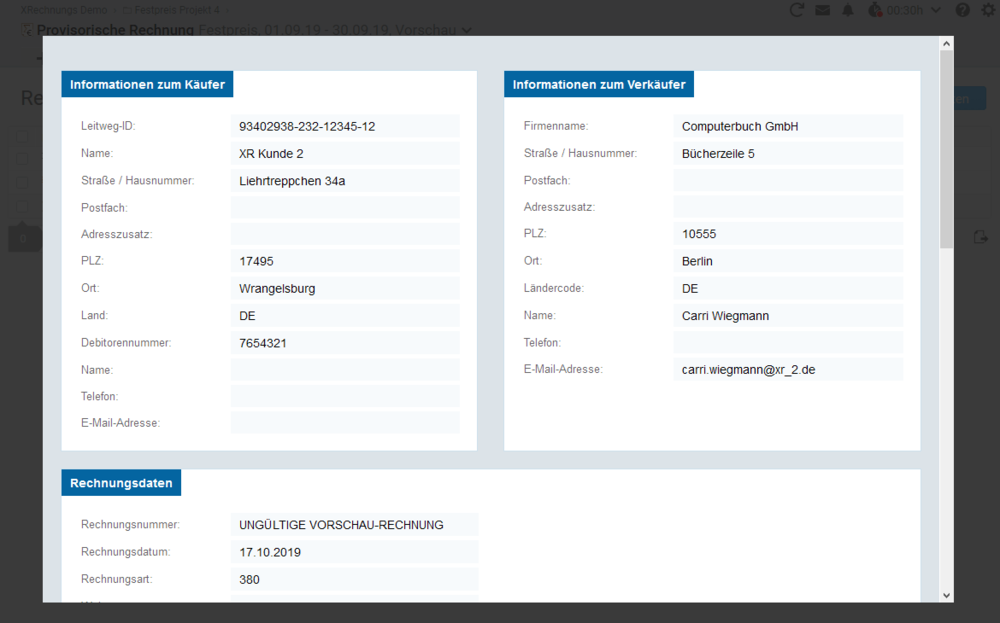
At Projektron, we are convinced that optimizing and reducing the effort involved in all commercial processes, especially invoicing, can deliver enormous benefits for companies. As a software developer, we therefore began working early on to enable XRechnung implementation in BCS. The topic first came up for us back in 2015, and we started looking into its potential implementation. Today, BCS offers a complete implementation of the format and is successfully used by many customers.
The invoicing module in BCS provides a generator tool for XRechnung. Our solution was to create a visualization: a digital invoice image is generated within invoicing in BCS and can be reviewed by the invoice issuer in the usual way. Only the XML is then sent to the invoice recipient. This means there is no need to additionally convert the XRechnung into a PDF.
Eine anwenderfreundliche Lösung mit Belegbild stellt ein anderes Format der elektronischen Rechnung dar: das ZUGFeRD-Format, international auch als Factur-X bekannt. Eine ZUGFeRD-Rechnung ist ein hybrides Format der E-Rechnung. Sie beinhaltet eine bildliche Darstellung der Rechnung in einer PDF/A-3-Datei. Zusätzlich enthält sie die Rechnungsinformationen als strukturierten und maschinell auswertbaren Datensatz im XML-Format.
Auch ZUGFeRD wird kontinuierlich weiterentwickelt. Mit ZUGFeRD 2.5 ist für 2026 ein weiteres Update vorgesehen. Dieses umfasst unter anderem die obligatorische Aktualisierung der Codelisten sowie Anforderungen, die für internationale B2B-E-Rechnungsszenarien relevant sind.
Damit zeigt sich: Sowohl XRechnung als auch ZUGFeRD entwickeln sich im Zuge der europäischen und nationalen E-Rechnungspflichten weiter — allerdings mit unterschiedlichem Ansatz. Während die XRechnung als rein strukturierter XML-Datensatz konzipiert ist, bleibt ZUGFeRD ein hybrides Format aus PDF/A-3-Belegbild und eingebettetem XML-Datensatz.
Welches Format im Einzelfall sinnvoll ist, hängt vom Rechnungsempfänger, vom Prozess und von den technischen Anforderungen ab. Für öffentliche Auftraggeber bleibt entscheidend, welche Formate nach den jeweiligen Vorgaben, Plattformbedingungen und gesetzlichen Regelungen zugelassen sind.
XRechnung was and remains an important step in the digitalization of invoicing in Germany. What was initially shaped primarily by invoice exchanges with public-sector clients is becoming increasingly relevant for the private sector as well due to mandatory B2B e-invoicing.
With the upcoming revision of EN 16931-1 and XRechnung 4.0, the standard will continue to evolve toward data structures that are suitable for B2B use and built for strong compliance. This transition will be challenging for public administration, businesses, and software providers. At the same time, it opens up new opportunities to further automate electronic invoicing processes, better reflect industry-specific requirements, and make invoicing as a whole more future-ready.
Projektron continuously monitors legal and technical developments related to e-invoicing and incorporates relevant changes into product development. The invoicing module in BCS is being developed accordingly so that companies can continue to manage their invoicing processes reliably and in compliance with applicable rules.

Daniel Kreher is a controller in the Finance department and has been involved in the development of e-invoicing in BCS from the very beginning. Projektron GmbH’s accounting department creates around 3,000 invoices per year. The share of XRechnungen and invoices in ZUGFeRD format has grown steadily over the past few years.
Choosing the right ERP system helps service providers manage projects efficiently, plan resources reliably, and streamline billing. Learn how to define requirements, compare providers, run practical tests, and prepare the implementation in a structured way.

Since 2020, the QR invoice has been part of Swiss payment transactions and has replaced old payment slips for faster, more secure, and standardized payments. As of November 21, 2025, only structured addresses will be permitted. Companies with unstructured addresses will need to switch.
The ZUGFeRD format is a cross-industry data format for electronic invoices. In our technical article, you can learn more about the benefits of the ZUGFeRD data format for e-invoicing.

Missed a notice period? Keep track of service, rental, leasing, cooperation, maintenance, purchase, and support contracts. Find out how to manage your contracts efficiently and effectively here.
XRechnung standardizes electronic invoicing, reduces manual work and helps companies build compliant digital invoice processes.