06/19/2026 - Articles
Swiss QR-Bill: Structured Addresses, Transition Period, and IG 2.4
Since November 2025, only structured addresses have been permitted on Swiss QR-bills. Anyone still using unstructured addresses should review their invoicing process now—as of September 30, 2026, the risk of payment rejections is expected to increase. In addition, the new QR-bill IG 2.4, which will take effect in November 2026, introduces further restrictions, particularly for invoices in euros.
Contents
What is the QR-bill?
The QR-bill (French: QR-facture, Italian: QR-fattura, English: QR-bill) was officially introduced in Switzerland and Liechtenstein on June 30, 2020. It replaced the previous red and orange payment slips as of October 1, 2022.
Its purpose is to:
replace the old payment slips,
digitalize payment transactions,
provide companies and private customers with an easier way to make electronic payments,
make payment information available in a standardized and machine-readable format.
The QR-bill can be issued either in printed or digital form. It consists of a payment part and a receipt. All payment information is contained digitally in the Swiss QR Code and is also printed in readable form on the payment part. This allows invoice recipients to review the payment data after scanning it and, if necessary, enter it manually.
Who developed the QR-bill?
The QR-bill was developed as part of the harmonization of Swiss payment transactions. The key standards are the Swiss Payment Standards and the Swiss Implementation Guidelines for the QR-bill issued by SIX Interbank Clearing. These specifications define the technical and layout-related requirements for the payment part with Swiss QR Code and receipt.
The QR-bill is therefore a standardized payment instrument for Switzerland and Liechtenstein. It is intended for invoice issuers, financial institutions, software providers, service providers, and all other market participants who create, process, or use QR-bills for payment processes.
The core element: the Swiss QR Code
Every QR-bill includes a Swiss QR Code containing all relevant payment information:
payee and IBAN
amount
reference number for clear payment allocation
address data of the invoice issuer and invoice recipient
The QR code can be scanned directly using a mobile banking app or scanner. This helps avoid typing errors, speeds up processing, and makes payments more secure.
How does the QR-bill differ from other e-invoicing formats?
Unlike e-invoicing formats used in large parts of the EU, such as PDF invoices or structured XML formats like ZUGFeRD, XRechnung, or Factur-X—which are primarily designed for digital data exchange between software solutions—the QR-bill combines both worlds: it can be used visually on paper and read digitally. This means that a customer can simply print and submit a QR-bill or scan and pay it directly in digital form.
The layout of the QR-bill is standardized: it presents the invoice information in an easily readable form, supplemented by the QR code in a clearly defined area. This enables banks and payment service providers to process the data automatically. The code itself contains everything required to post the payment correctly, including a structured reference number that clearly allocates payments.
Through this combination of standardization, automation, and user-friendliness, the QR-bill has become a key component of digital payment transactions in Switzerland and significantly simplifies payment processing for companies and private customers alike.
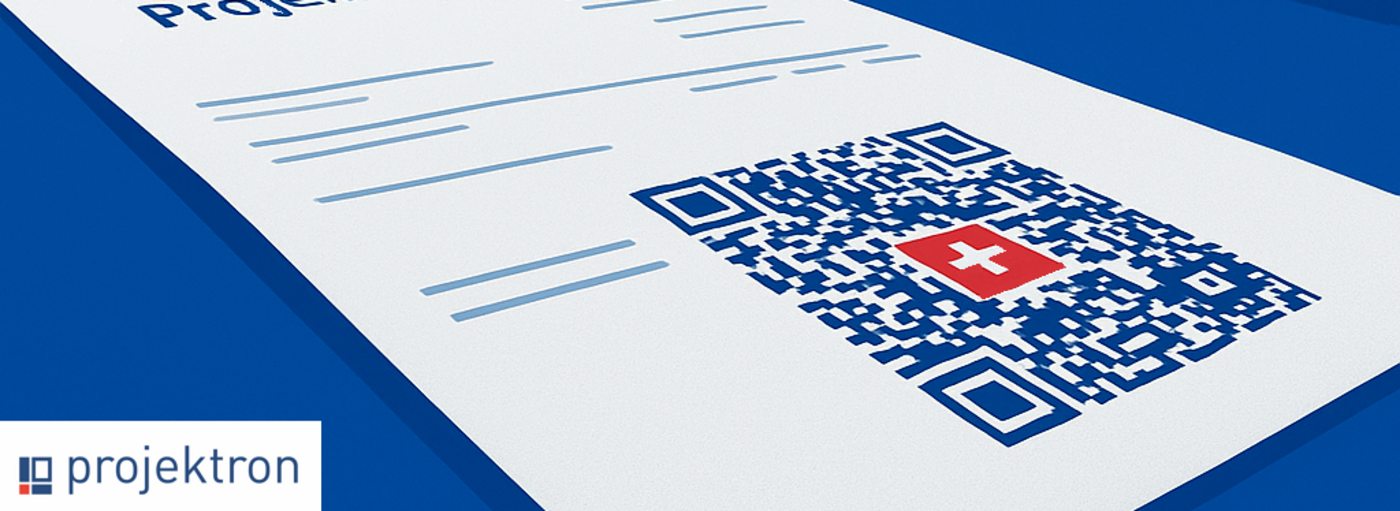
Who is affected by the QR-bill update?
The updates affect all companies and organizations that create or process QR-bills, or that use payment templates and standing orders based on QR-bills. This includes small and medium-sized enterprises, larger companies, law firms, associations, service providers, trade businesses, public administrations, as well as software providers and financial service providers.
Specifically, the following parties are affected:
Invoice issuers and payees: Their own address data must be stored correctly and in a structured format.
Invoice recipients and debtors: Their address data must also be available in a format that ensures smooth payment processing and handling.
Software providers and service providers: Invoicing software, ERP systems, and accounting solutions must be able to create and process QR-bills in accordance with the current Implementation Guidelines.
Financial institutions: Banks and payment service providers must process QR-bills in accordance with the applicable Swiss Payment Standards and take the relevant transition periods into account.
Is the QR-bill relevant for international invoicing?
The QR-bill is primarily relevant for payment transactions in Switzerland and Liechtenstein. It can be issued in Swiss francs or euros, but it is not an internationally mandatory invoicing format. The decisive factor is whether a payment is to be processed via a Swiss bank account or in accordance with Swiss payment standards.
German or other foreign companies sending invoices to Switzerland
These invoices only need to include a QR-bill if the recipient has a Swiss bank account and can use the QR code. Otherwise, a standard SEPA or international invoicing format can be used.
Swiss companies sending invoices to Germany, Austria, other EU countries, or countries outside the EU
In this case, the QR-bill is not mandatory. The respective country-specific payment formats apply, such as SEPA transfers, IBAN details, or reference numbers based on ISO standards. The QR-bill is therefore only relevant for domestic payments in Switzerland.
In short: The QR-bill is mandatory for Swiss domestic payment transactions. For international invoices, companies must comply with the local standards of the recipient country.

What has applied since November 2025, and what is the basis for it?
New requirements for the Swiss QR-bill have been in effect since November 2025. The key standards are the Swiss Implementation Guidelines for the QR-bill issued by SIX Interbank Clearing and the Swiss Payment Standards. The QR-bill must comply with the requirements of these Implementation Guidelines to ensure that it can be processed reliably and securely.
The most important change concerns the address structure in the Swiss QR Code. With the entry into force of QR-bill IG Version 2.3 on November 22, 2025, only structured addresses are permitted in QR-bills. Companies had to adapt their invoicing processes by November 21, 2025, at the latest, and ensure that QR-bills only contain structured addresses.
Structured addresses are mandatory
Since November 2025, only structured addresses have been supported in QR-bills. The address is no longer entered as a free-form address line, but is split into individual elements. Depending on the address, these include in particular the name, street, house number, postal code, city, and country.
At a minimum, the address information required for processing must be entered in the designated standardized fields. For fully structured addresses, the street, house number, postal code, city, and country are stored separately. Unstructured type K addresses are no longer permitted in newly created QR-bills.
More special characters and umlauts
Since November 2025, the extended character set in accordance with the Swiss Payment Standards has also applied to QR-bills. As a result, more special characters, umlauts, and diacritical marks can be displayed correctly in names and addresses.
This makes it easier to process personal names, company names, and international addresses in particular. At the same time, the QR-bill is being more closely aligned with the requirements of modern payment standards.
Transition period
There is a transition period for the changeover. Since November 2025, companies should create only QR-bills with structured addresses. During the transition period, payments based on QR-bills with unstructured addresses may still be processed in some cases.
However, as of September 30, 2026, banks are expected to reject payments with non-compliant addresses, especially payment orders or standing orders with an execution date after that date. Companies should therefore review and update their master data, templates, interfaces, and systems in good time.

2026: QR-bill IG Version 2.4
SIX has now published the next version of the Swiss Implementation Guidelines for the QR-bill. QR-bill IG Version 2.4 will be introduced with the SIC release on November 13, 2026, and will apply starting November 14, 2026. It replaces Version 2.3; however, Version 2.3 will remain valid until November 2027.
According to SIX, Version 2.4 does not require any technical adjustments for QR-bills in Swiss francs. The new version is particularly relevant for invoices in euros. For these invoices, the permitted combinations of IBAN, reference, and message are specified more precisely or restricted.
Companies that issue QR-bills in euros should therefore check whether their software will support the upcoming requirements in good time. Software providers, ERP vendors, and financial service providers should also take the changeover into account early on.
Why have only structured addresses been allowed since 2025?
Bisher konnten Unternehmen bei den Adressdaten in QR-Rechnungen zwischen zwei Formaten wählen:
Strukturierte Adresse (Typ S): Jede Komponente – Strasse, Hausnummer, PLZ, Ort, Land – wird in einem eigenen Feld angegeben.
Unstrukturierte Adresse (Typ K): Freitext, oft in einer oder zwei Adresszeilen, ähnlich wie auf dem alten Einzahlungsschein.
Diese Flexibilität führte in der Praxis immer wieder zu Schwierigkeiten. Banken und Zahlungsdienstleister mussten Daten teils manuell nachbearbeiten, automatisierte Systeme konnten Adressen nicht immer eindeutig erkennen, und Zahlungen konnten verzögert oder zurückgewiesen werden.
Mit der Umstellung auf IG QR-Rechnung Version 2.3 werden unstrukturierte Adressen in neu erstellten QR-Rechnungen nicht mehr unterstützt. Der Übergang zur verpflichtenden strukturierten Adresse sorgt für:
Der Übergang zum verpflichtenden strukturierten Adresse sorgt für:
mehr Einheitlichkeit im Zahlungsverkehr,
bessere Automatisierung,
weniger Fehler und Rückweisungen,
höhere Datenqualität,
bessere Zukunftsfähigkeit im digitalen Zahlungsverkehr.
What does the QR-bill changeover mean for companies?
The updates to the Swiss QR-bill affect companies that create, send, or process invoices. For SMEs as well as larger companies with complex financial processes, the changeover means that existing master data, templates, interfaces, and software processes must be reviewed and updated.
Update the software
To ensure that invoices can continue to be created in compliance with the standard, the invoicing software in use and all connected financial systems must be able to process structured address data correctly. This includes, for example, ERP systems, accounts payable and accounts receivable accounting, CRM systems, banking systems, and other interfaces.
Software update: Companies should make sure that their providers have fully implemented QR-bill IG Version 2.3 and will support the planned requirements from Version 2.4 in good time.
Check interfaces: Connections to third-party systems, such as ERP, CRM, or banking systems, must also be reviewed and updated where necessary.
Run test cases: Before going live, companies should perform internal tests to ensure that QR-bills with structured addresses are generated without errors.
Check EUR invoices: Companies that issue QR-bills in euros should also verify whether their software supports the restrictions for reference and message variants that will be introduced with QR-bill IG Version 2.4.
Clean up master data
One of the biggest challenges is updating existing master data records. Many companies still have unstructured, incomplete, or inconsistent addresses stored in their systems.
Review address data: All master data records for customers, suppliers, and other business partners should be checked for completeness and correct structure. This includes, in particular, name, street, house number, postal code, city, and country, where this information is relevant for the respective address.
Clean up and supplement data: Missing information should be added, unclear or incomplete address lines should be cleaned up, and addresses should be structured consistently.
Establish quality assurance: Companies should introduce processes that prevent incorrect or incomplete addresses from being entered into the system again.
Use automatic recognition and validation
To manage the changeover efficiently, it is advisable to use technical support.
Automatic checks: Many modern systems offer functions that can check addresses for structure and completeness. This makes it possible to identify sources of error at an early stage.
Error messages and workflows: Systems should issue warnings for incorrect or incomplete addresses and trigger automated workflows for correction.
QR code validation: Companies should check whether QR codes can be validated against the current SIX specifications. SIX provides a validation portal for Swiss QR Codes for this purpose.
Integration of validation services: External validation services that compare addresses with official postal databases can also help ensure clean data records.
Consistently avoid unstructured addresses
Since the changeover, companies should only enter new data records in structured format.
Avoid free-text entry: Input screens in the software should be adapted so that unstructured addresses can no longer be stored for QR-bills.
Train employees: Employees responsible for entering or maintaining address data should be informed about the new requirements and trained accordingly.
Create long-term reliability: Companies that consistently use structured addresses benefit from higher data quality and avoid rejections by banks after the transition period expires.

Time to act!
Companies that have previously used unstructured addresses should review their master data, templates, and software processes. Since November 2025, new QR-bills should only be created with structured addresses. During the transition period, non-compliant payment data may still be processed in some cases; however, as of September 30, 2026, companies may face payment rejections by financial institutions.
What does the QR-bill changeover mean for private individuals?
For private individuals, the introduction of the QR-bill changes very little. Payments can still be made as usual via e-banking on a computer or through mobile banking. The printed QR code can be scanned with a smartphone camera or directly in a banking app, allowing the payment data to be transferred automatically. In addition, QR-bills can be imported electronically as PDF files into payment software, which further simplifies data entry.
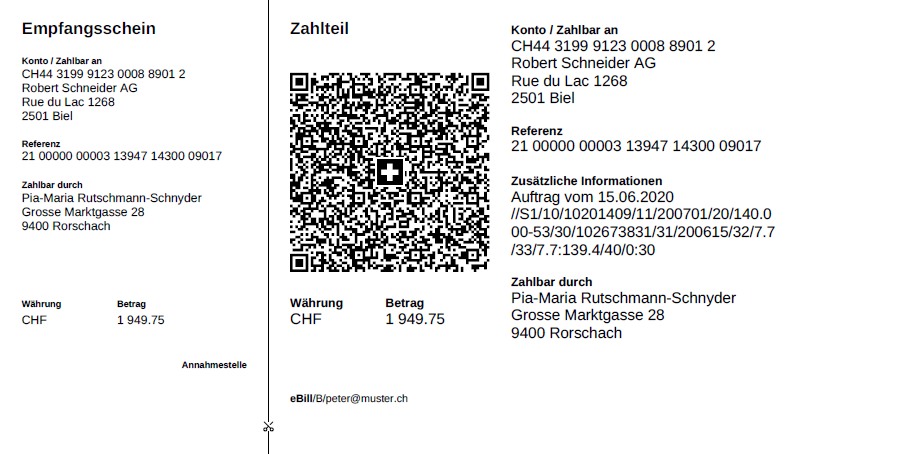
At the same time, using a smartphone is not required: All relevant information—such as the IBAN, reference number, and address data—is still printed on the payment part of the invoice and can be entered manually in e-banking if needed. Payment at the post office counter or by payment order through the bank also remains possible without any changes. Comprehensive information is available to users at qr-rechnung.net, including the option to scan QR-bills directly via webcam. The changeover therefore brings greater convenience and security to payment transactions without eliminating traditional payment methods.
Benefits of the new QR-bill regulation
Even though the changeover initially means additional work for most users, it offers clear benefits:
Legal compliance: Invoices comply with the applicable standard.
Payment security: Rejections by banks due to incomplete addresses are avoided.
Efficiency: Automated systems can process address data without manual rework.
Future readiness: All participants in Swiss payment transactions work with the same standards.
The changeover to structured addresses and the expanded approval of special characters promote consistency in Swiss payment transactions. At the same time, the QR-bill is more closely harmonized with the international ISO 20022 payment standard, which facilitates cross-border payments and the digital processing of invoices.
QR-bills in BCS: Support for the updates
BCS by Projektron has supported the QR-bill since its introduction. With BCS Release 20.3, the functionality for creating QR-bills was implemented in the BCS invoicing module: Since then, users have been able to specify in invoice templates and for individual invoices that the invoices created from them should include a payment part with a QR code. Since then, companies in Switzerland have been able to create invoices directly in the system and invoice securely and in compliance with the standard via the Swiss QR Code.
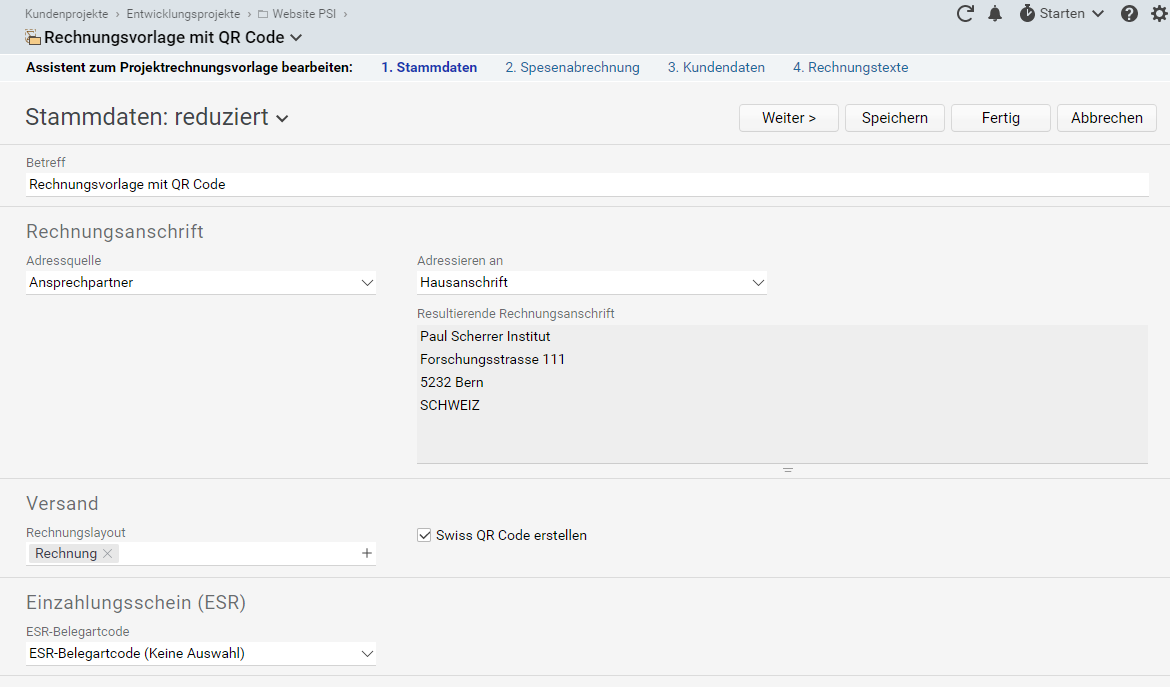
With the update to BCS Version 25.3, the new QR-bill requirements effective as of November 2025 were fully covered:
Only structured addresses are permitted.
Mandatory fields (street, house number, postal code, city, country) are integrated.
Master data is validated to avoid incorrect entries.
QR-bills comply with Implementation Guidelines 2.3.
Projektron is also monitoring the further development of the Swiss Payment Standards and QR-bill IG Version 2.4. The upcoming requirements have already been incorporated into product development at an early stage, ensuring that customers are well prepared for future developments.
Case Studies: QR-bills with BCS at Swiss Companies
Many Swiss companies rely on BCS to plan their projects efficiently, use resources optimally, and create invoices in compliance with legal requirements. The following case studies show how Deleproject AG and Stämpfli AG have mapped their entire invoicing processes—the receipt, processing, and creation of QR-bills—in BCS from the very beginning. With BCS, both companies were able to increase transparency and efficiency in project execution. These two use cases are just a selection from our many Swiss references—companies from various industries—that have been working successfully with BCS for years.
Case Study Deleproject AG: Successful Use of QR-bills with BCS
Deleproject AG, based in Uetendorf/Thun, is a Swiss engineering company specializing in industrial automation solutions. Since its founding in 1979, the company has developed and implemented software applications for process automation and production data management, and its customer base includes well-known companies from the food, chemical, and pharmaceutical industries as well as specialized machinery and plant engineering. To manage its complex projects professionally, Deleproject has relied on the BCS project management software since 2013, which is now actively used by around 30 employees.

The flexibility and breadth of BCS’s features are especially valued. The software is used for proposal creation, contact management (CRM), project planning, controlling, resource and expense management, as well as vacation and time tracking. The invoicing module, which Deleproject has expanded extensively over the years, plays a particularly important role. Invoices can be generated directly from project data, and both fixed-price and time-and-materials invoices can be created—a crucial step toward ensuring transparency and efficiency in project work.
With the introduction of the Swiss QR-bill, Deleproject was able to further modernize its billing processes. Thanks to direct support in BCS, Deleproject employees issue invoices in compliance with legal requirements while optimally taking customer needs into account.

Case Study Deleproject AG: Successful Use of QR-bills with BCS
The QR-bill in BCS makes invoicing much easier for us. We can not only bill our services correctly and transparently, but also comply with the current legal requirements in Switzerland.
Case Study Stämpfli AG: Smooth Introduction of QR-bills with BCS
Stämpfli AG, based in Bern, is a long-established Swiss family-owned company that has been providing communications services for six generations. With more than 300 specialists, Stämpfli offers a wide range of services—from brand consulting and digital media to print and specialist media. To manage complex customer projects efficiently across departments, the company has relied on BCS since 2016. Today, BCS is actively used by 149 users.

BCS plays a central role in Stämpfli’s day-to-day work: The software supports the company in proposal creation, project planning, project execution, controlling, reporting, as well as resource and absence management. Invoicing is also carried out directly from BCS and integrated via interfaces with ERP and financial accounting systems. This gives project managers and teams a clear overview of costs, expenses, and revenues at all times, allowing them to identify bottlenecks or overloads early on.
Resource planning is especially important at Stämpfli—for both project utilization and HR management. The introduction of the Swiss QR-bill was successfully implemented with Projektron before the end of the 2022 transition period and integrated into the invoicing processes with ease.

Martin Pfäffli, IT Services & Head of Applications at Stämpfli
Thanks to BCS, we have control over our resources and upcoming work. Today, invoicing, including QR-bills, also runs reliably and is fully integrated through BCS—making it an indispensable tool for our project execution.
FAQ on the QR-bill changeover
Efficient, legally compliant, and digital in Swiss payment transactions with the QR-bill
Since its introduction in June 2020, the QR-bill has been a central component of payment transactions in Switzerland and Liechtenstein. It replaced the previous payment slips and combines readable payment information with digitally readable data in the Swiss QR Code.
Since November 2025, QR-bill IG Version 2.3 has introduced an important update: QR-bills now support only structured addresses. This is intended to reduce sources of error, make payment orders more reliable to process, and avoid manual rework. At the same time, the permitted character set has been expanded so that more special characters, umlauts, and diacritical marks can be processed correctly.
For companies, this means that master data must be cleanly structured, software processes updated, and templates reviewed. During the transition period, certain non-compliant payment data may still be processed; however, as of September 30, 2026, rejections by financial institutions are to be expected.
With QR-bill IG Version 2.4, the next stage of development is already on the horizon. It will be introduced with the SIC release on November 13, 2026, and will apply starting November 14, 2026. According to SIX, no technical adjustments are required for QR-bills in Swiss francs. Companies issuing QR-bills in euros should check whether their software supports the upcoming requirements.
Thanks to continuous development, BCS supports the QR-bill requirements and helps companies map their invoicing processes in a standard-compliant, efficient, and digital way.

About the Author
Daniel Kreher is a controller in the finance department at Projektron GmbH and has been involved in the continued development of electronic invoicing processes in BCS for many years. In his role, he is also jointly responsible for implementing regulatory requirements in the areas of e-invoicing and QR-bills. Projektron GmbH’s accounting department creates around 3,000 invoices each year, including a growing number of e-invoices in XRechnung and ZUGFeRD format. Thanks to his practical experience, Daniel Kreher has first-hand knowledge of the challenges and opportunities that come with the digitalization and standardization of accounting.
More interesting articles on the Projektron blog

E-invoicing mandate
Since January 1, 2025, companies in Germany must be able to receive e-invoices in the B2B sector. Learn which transition periods apply, why simple PDF invoices are no longer sufficient, and how formats such as XRechnung and ZUGFeRD support digital invoice processing.
XRechnung
Long mandatory for suppliers and service providers working with the public sector: XRechnung. Since November 27, 2020, incoming invoices have only been accepted in electronic invoice format. Was XRechnung a positive milestone or a negative one?
ZUGFeRD format
The ZUGFeRD format is a cross-industry data format for electronic invoices. In our expert article, you can learn more about the benefits of the ZUGFeRD data format for e-invoicing.

HERMES PM Method
Learn all about HERMES project management, a method widely used in Switzerland that combines clear structures with flexibility. Find out why the method can also be a valuable asset outside Switzerland.

From November 21, 2025, only structured addresses will be permitted in QR invoices in Switzerland. Companies must adapt their master data and systems in good time.