05/13/2026 - Articles
Choosing an ERP System for Service Providers: A Guide to Comparison, Testing, and Implementation
Anyone looking to select an ERP system for service providers should not start with checklists or feature tables. For agencies, IT service providers, and consulting firms, it’s not just the range of features that matters, but the integration of project management, resource planning, CRM, time tracking, and billing. This guide shows you how to approach the selection of an ERP system for service providers in a structured way, avoid common pitfalls, and find a solution in 9 steps that truly fits your processes.
Contents
Choosing ERP for service providers: why standard solutions often fail
Selecting an ERP system for service providers is one of the most important strategic decisions for your company. After all, an ERP system isn’t just another tool; it forms the foundation of your entire value chain. In service companies, key processes are interlinked:
Sales generates projects
Projects allocate resources
Resources generate billable services
Services feed into billing and controlling
An ERP system connects precisely these processes. If this integration does not work, typical problems arise.

Four Reasons Why Many ERP Selection Projects Fail
1. Lack of transparency regarding project status and workload
2. Manual coordination between sales, project, and billing teams
3. Data silos between systems
4. Unclear or delayed billing
The most common misconception in ERP selection
Many companies begin their ERP selection process with a seemingly logical question:
What features do we need?
They create checklists, compare vendors, and evaluate features. The problem: This approach treats an ERP system as an isolated tool, not as an integrated system. An ERP system for service providers only realizes its full value when it maps out interconnections:
How does a quote turn into a project?
How do services become automatically billable?
How does project progress translate into a reliable analysis?
Those who do not clarify these questions first will not find a sustainable solution, even with the best software.
Why Standard Checklists Are Not Enough
Standard checklists work best in stable, clearly defined environments, such as retail or manufacturing. Service companies, however, operate differently:
Projects are individual and dynamic
Resources are the central bottleneck
Services are often difficult to standardize
Processes evolve along with the company
That is why it is not enough to simply check off functions. What matters is whether an ERP system supports your specific processes and integrates them effectively.

The crucial question
The key question is therefore not:
Which ERP system is the best?
But rather:
Which ERP system truly fits my service company and my processes?
This is exactly where this guide comes in.
It provides a step-by-step guide to selecting an ERP system for service providers that not only delivers on functionality but also truly improves your workflow—from the initial analysis through to a successful implementation.

Note on the selection project in the example
The project plan shown here is, of course, greatly simplified and stylized. It depicts an idealized ERP selection project for service providers. In practice, individual steps often run in parallel, and backtracking between phases and iterations is common. This overview is intended to provide guidance and illustrate the logic of the process, not a rigid sequence of steps.
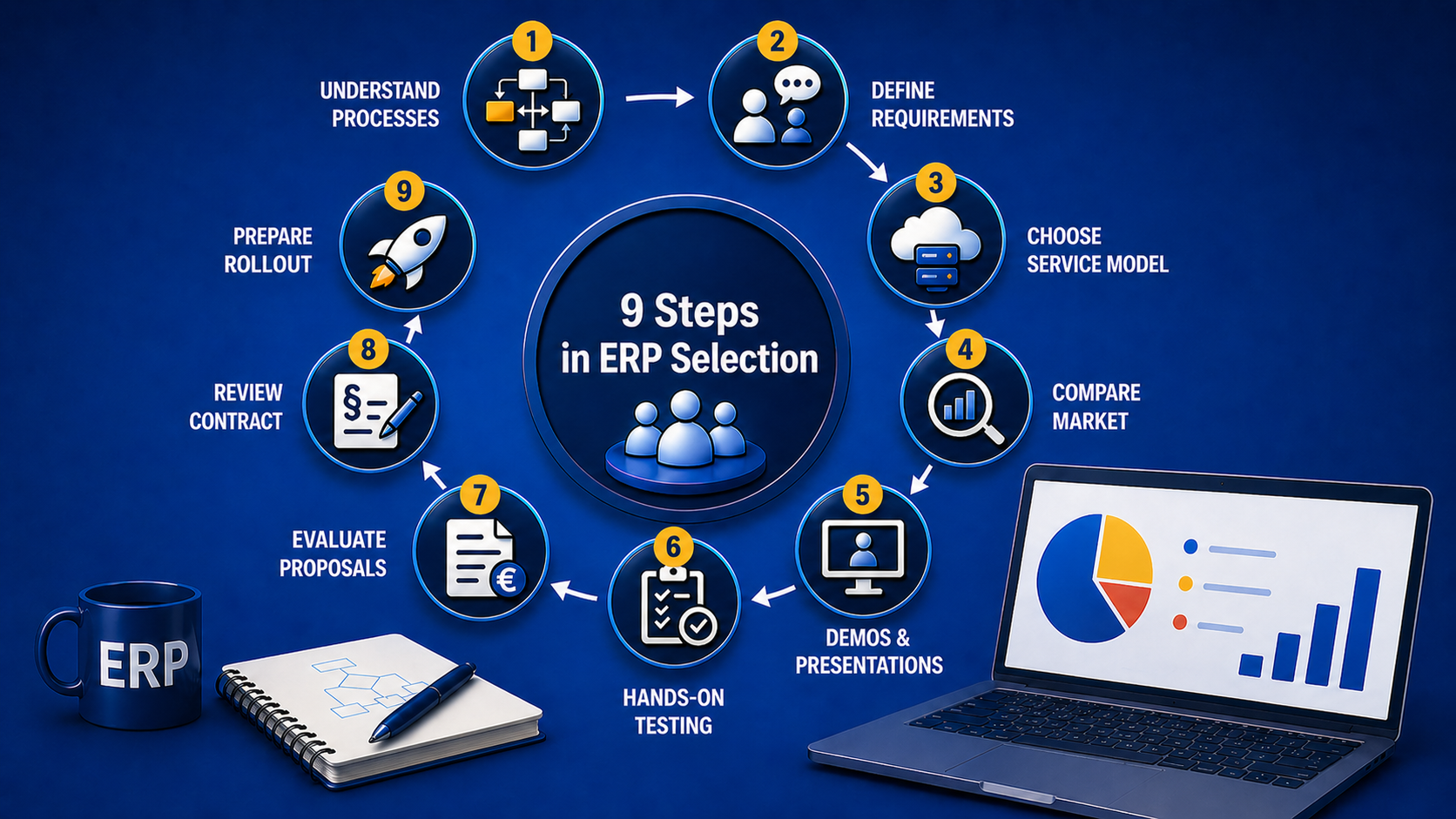
Step 1: ERP selection for service providers starts with processes, not software
Many companies begin selecting an ERP system for service providers by looking at features. Project management, time tracking, or CRM appear to be obvious starting points. This approach seems structured, but in practice it falls short. It reduces an ERP system to individual components instead of considering the system as a whole.
Especially for service providers, the real challenge does not lie in individual features, but in the interaction of processes. An ERP system must connect sales, projects, resources, and billing. If this integration does not work, inefficiencies arise that spread throughout the entire organization. This is exactly why selecting an ERP system for service providers is always also a process decision.
What an ERP system for service providers really needs to deliver
An ERP system for service providers maps the entire value chain, from the first customer contact to billing. Multiple processes are interconnected and must not be viewed in isolation. The quality of this integration plays a key role in determining efficiency and control within the company. This is where the so-called return on digital investment is created: the measurable economic benefit resulting from end-to-end, integrated processes. It is reflected not only in saved hours, but above all in better utilization, higher billing rates, and more informed decision-making.
Typically, this process chain includes:
sales turns into a project
projects allocate resources
resources generate billable services
services flow into billing and controlling
If an ERP system does not accurately represent these relationships, media disruptions and manual workarounds occur. This is exactly where it becomes clear whether a solution truly fits a service-based company.
Why needs analysis is the most important step in ERP selection
Before starting an ERP comparison for service providers, you should consistently look inward. A well-founded needs analysis forms the basis for every successful ERP selection. It ensures that not symptoms, but root causes are addressed.
In many companies, similar patterns emerge. Systems exist but do not work together. Data has to be transferred manually, and transparency regarding projects or utilization is lacking. Particularly critical are breaks between proposal, project, and billing, as these have direct financial impacts. These are exactly the gaps that limit a company’s digital return. A thorough needs analysis reveals where potential is lost and thus provides the foundation for systematically increasing digital return.
Common problems encountered in practice include
1. Standalone tools without integration
2. Manual data transfers
3. Lack of transparency regarding project status
4. Discontinuities between sales and billing
From the current state to the target vision for ERP selection
For a successful selection of an ERP system for service providers, it is not enough to analyze the current state. The key question is how your company wants to work in the future. Only this target vision makes requirements truly robust.
Several factors play a role here. Growth, increasing project complexity, and process integration are typical drivers. The automation of processes, for example in billing or reporting, is also becoming increasingly important. A modern ERP system should actively support these developments.
Companies that clearly define their target vision make significantly better decisions. They do not just select software, but actively shape their future way of working. This is where the strategic value of ERP selection lies.
The most common mistake when selecting ERP systems for service providers
A classic mistake is to formulate requirements as a pure list of features. Statements such as “We need time tracking” or “We need project management” are correct, but remain superficial. They describe functions, not how they interact.
What really matters, however, is how processes are connected within the ERP system. A good system shows its strength at the interfaces between sales, project execution, and billing. This is exactly where efficiency gains or friction losses occur.
Key questions therefore include:
How does a proposal turn into a project?
How do services automatically become billable?
How are reliable insights generated from project data?
Companies that adopt this perspective early make more informed decisions and choose an ERP system that truly works in everyday operations.
Step 2: Defining requirements: why user perspectives determine success or failure
Once the processes are understood, the next crucial step in ERP selection for service providers follows: defining concrete requirements. This is exactly where many wrong decisions are made. Requirements are often formulated from a high-level perspective and remain too abstract.
This leads to systems being selected that theoretically meet all requirements, but are not accepted in daily use. Complex interfaces, unclear workflows, or a lack of transparency cause employees to develop their own solutions. As a result, the ERP system quickly loses its relevance.
However, an ERP system for service providers only delivers value when it supports day-to-day work. Therefore, requirements must be defined much closer to real-world practice.
Why the user perspective is crucial in ERP
An ERP system is used by different roles, each with their own expectations. These perspectives must be brought together during ERP selection to create a system that truly works.
Typical requirements include:
project managers need transparency on progress and resource utilization
employees expect simple and fast time tracking
sales needs access to project data for proposals
controlling requires consistent and up-to-date figures
If these requirements are not considered, complex workflows and low user acceptance arise. This is exactly why the user perspective is a key success factor in ERP selection for service providers.
User stories as a foundation for practical ERP selection
A proven approach to defining requirements is the use of user stories. They describe requirements from the user’s perspective and focus on the specific benefit. This makes requirements more tangible and easier to compare.
Instead of listing functions in isolation, real-life situations are described. One example is the ability to view team utilization in real time in order to identify bottlenecks early. Such formulations help to evaluate the actual capabilities of a system.
The major advantage is that the focus is on the outcome. Requirements are not abstract, but formulated in the context of daily work. This significantly improves the quality of the entire ERP selection process.
Typical requirements for ERP systems for service providers
During the definition of requirements, it becomes clear which topics are particularly relevant for service providers. The focus is less on individual features and more on end-to-end processes. This is exactly where many systems on the market differ significantly.
Key requirements include:
integration of proposals, projects, and billing
transparent resource planning
end-to-end time tracking and service documentation
reliable reporting in controlling
It is crucial that these requirements are not considered in isolation. An ERP system for service providers must support them as an integrated process.
Why prioritization significantly improves ERP selection
A common mistake is creating a long and unstructured list of requirements. Without clear prioritization, the selection process quickly becomes confusing. Vendors are difficult to compare, and the focus is lost.
Therefore, requirements should be structured early on. It is useful to distinguish between mandatory and additional requirements. This classification simplifies evaluation and creates clarity throughout the process.
At the end of this step, there is a robust requirements catalog, often in the form of a specification document. This document forms the basis for all further steps in ERP selection for service providers. The clearer this foundation, the more reliable the final decision will be.
Step 3: Choosing the ERP service model: making the right decision between cloud and on-premise
In addition to functional requirements, the service model plays a central role in selecting an ERP system for service providers. The decision between cloud ERP and on-premise ERP affects not only the technical setup, but also costs, flexibility, and internal processes. Many companies underestimate this aspect and make decisions that are difficult to correct in the long term.
Especially for service providers with project-based workflows, the question of accessibility and scalability is particularly relevant. Teams often work in distributed setups, projects change dynamically, and requirements grow along with the company. The service model determines how well an ERP system can support this dynamic.
Cloud ERP vs. on-premise ERP: the key differences
A cloud ERP for service providers is delivered via the internet and used directly in the browser. Operation, maintenance, and updates are handled by the provider, significantly reducing internal IT effort. At the same time, access is location-independent, which is a major advantage for distributed teams.
An on-premise ERP system, on the other hand, is operated locally within the company. Control over data and infrastructure remains entirely internal, which may be desirable in certain scenarios. However, this model also comes with higher requirements for operation, maintenance, and IT resources.
Both approaches have their place; what matters is the fit with your own organization. Therefore, selecting an ERP system for service providers should always be done in the context of your company’s specific needs.
Why cloud ERP is often the better choice for service providers
For many service-based companies, cloud ERP offers clear advantages in day-to-day operations. Its strengths are particularly evident in dynamic project environments. Systems are available faster, easier to scale, and significantly more flexible to use.
Typical advantages of cloud ERP include:
fast implementation without the need for own infrastructure
location-independent access for teams and projects
automatic updates and continuous improvements
easy scalability as the company grows
Especially for agencies, IT service providers, and consultancies, this flexibility is often crucial. A cloud ERP supports modern ways of working far better than traditional systems.
When on-premise ERP can make sense
Despite the advantages of cloud solutions, there are scenarios in which an on-premise ERP can be the right choice. Companies with specific requirements regarding data control or customizations often deliberately choose this approach.
Typical reasons for on-premise ERP include:
high requirements for data sovereignty
existing IT infrastructure within the company
highly customized system environments
However, the increased effort for operation and maintenance should not be underestimated. Small and medium-sized service providers in particular often reach organizational limits here.
Evaluating data protection and costs correctly
Regardless of the service model, data protection and costs play a central role in ERP selection for service providers. Especially in Germany, topics such as GDPR compliance and data security are decisive when choosing a provider. Aspects of digital sovereignty are also becoming increasingly important, as they enable companies to maintain greater control over their data, systems, and dependencies on vendors.
Key aspects include:
clearly defined server location, ideally in Germany (Hosted in Germany)
transparent security standards
reliable data processing agreements
Costs should also be evaluated holistically. While cloud ERP typically operates on subscription models, on-premise systems incur additional costs for operation and maintenance. Therefore, it is not the initial price that matters, but the total cost over several years.
Step 4: Comparing ERP for service providers: how to properly evaluate the market
After the internal analysis, the market phase of ERP selection for service providers begins. The goal is to identify suitable vendors and compare them in a structured way. In practice, however, it quickly becomes clear that the ERP market is anything but transparent.
Why the ERP market is difficult to navigate for service providers
The term ERP system covers a wide range of very different solutions. Traditional ERP systems often originate from manufacturing or retail and are heavily focused on inventory management. For project-based service providers, these systems are often only partially suitable.
At the same time, there are numerous project management tools that support planning and collaboration but do not provide an end-to-end solution. This is exactly where the challenge arises when selecting an ERP system for service providers.
Why specialized ERP systems are crucial for service providers
For service-based companies, specialized ERP systems are often the better choice. They combine core functions such as project management, resource planning, CRM, and billing into one integrated system. This creates seamless processes without media disruptions.
The key difference lies in the process logic. While traditional systems often think in modules, specialized ERP solutions are oriented toward real workflows within the company. This is essential for service providers with project-based operations.
An ERP system for service providers should therefore not only cover functions, but also support the entire value creation process. This perspective is central to making a well-founded selection decision.
Which criteria really matter when comparing ERP systems
A common mistake in ERP selection is relying on Google rankings or well-known vendors. For a sound decision, however, what matters is how well a system supports your own processes. This is where the focus of the comparison should lie. Key evaluation criteria include:
mapping of project-based workflows
integration of proposals, projects, and billing
transparency in resource planning
quality of reporting in controlling
interfaces to existing systems
These criteria should be directly derived from your own requirements catalog. Only then does the comparison truly reflect your specific situation.
From longlist to shortlist in ERP selection
In practice, a two-step approach has proven effective. First, a longlist of potential vendors is created, for example through research, recommendations, or targeted searches for ERP systems for service providers. This phase is about gaining an overview of the market.
This is followed by an initial evaluation based on the defined requirements. Systems that do not meet key criteria are consistently excluded. The goal is a shortlist of a few vendors that are suitable for deeper evaluation.
This structured approach ensures that ERP selection for service providers remains efficient and transparent. At the same time, it prevents premature commitment to individual solutions.
Avoiding common mistakes in ERP comparison
It is precisely in this phase that decisions are often made that are difficult to reverse later. Many companies downplay missing features or assume that integrations can easily be implemented later. Relying on well-known vendors also often leads to suboptimal decisions.
Typical mistakes in comparison include:
underestimating missing features
assuming integrations are trivial
favoring systems based on brand recognition
A consistent evaluation based on your own requirements helps to avoid these mistakes. This is where the importance of the groundwork from previous steps becomes evident.
Step 5: Evaluating ERP demos: how to use presentations effectively
After preselecting suitable vendors, the next step in ERP selection for service providers follows: conducting presentations and demos. In this phase, companies get their first concrete look at the systems and gain an impression of features, interface, and usability. At the same time, however, this is where one of the biggest distortions in the entire selection process occurs.
ERP demos are almost always idealized scenarios. Vendors deliberately present prepared workflows with clean data and optimized processes. This creates a positive impression but says little about how the system actually performs in everyday use.
Anyone looking to select an ERP for service providers should therefore not see demos as a decision, but as a validation step. What matters is not what is shown, but how well your own requirements are reflected in it.
How to actively steer ERP demos
The biggest mistake in this phase is passive observation. Many companies let themselves be guided through presentations instead of actively controlling them. As a result, they end up comparing presentation quality rather than their actual requirements. It is far more effective to align the demo consistently with your own processes. This means defining concrete scenarios and evaluating the vendor based on how well these are supported. This creates a realistic picture of the system’s actual capabilities.
Typical scenarios for a well-founded evaluation include:
transition from proposal to project
planning and adjusting resources
time tracking and billing of services
analysis of project data in controlling
The closer these workflows are to your own reality, the more meaningful the demo becomes.
Which criteria really matter in evaluation
In addition to the features shown, the evaluation should focus more on actual usability. An ERP system for service providers only delivers value in daily use, not in a presentation. Key criteria include:
clarity and user guidance within the system
support for real processes instead of isolated features
flexibility for adjustments and changes
ability to integrate into the existing system landscape
The vendor itself should also be evaluated critically. Especially in complex projects, it is crucial whether a vendor understands the industry and can provide advice on equal footing.
Compare results in a structured way
After the presentations, it is advisable to document all impressions systematically. Without a clear structure, differences quickly blur, especially when multiple vendors present within a short period.
A simple evaluation framework helps make systems comparable and reduces subjective impressions. On this basis, the selection can be narrowed down in a targeted way, leaving only a few solutions for the next step.
Practical Tip: Make Good Use of the Demo
A good ERP demo isn't a sales pitch—it's a dialogue.
Make sure vendors address your specific needs rather than just presenting standard processes.
Step 6: ERP hands-on testing: evaluating systems under real conditions
After the presentations, the decisive moment in ERP selection for service providers follows: the hands-on test. Only in real use does it become clear whether a system truly meets your requirements. What seemed convincing in a demo can quickly reach its limits in everyday use.
Especially with complex aspects such as resource planning, project controlling, or billing, differences only become visible when real data and actual workflows are used. This is why hands-on testing is not an optional step, but the foundation for a well-informed decision.
Anyone selecting an ERP system for service providers should devote sufficient time and attention to this step.
What a good hands-on test must achieve
A structured hands-on test goes far beyond trying out individual features. The goal is to experience the actual way of working within the system and understand how well processes are supported.
In particular, it involves:
evaluating usability in everyday work
running through key workflows end-to-end
realistically testing integrations and interfaces
assessing user acceptance among future users
The hands-on test is therefore the first true reality check in the selection process.
How to set up an effective hands-on test
To produce reliable results, the test should be conducted as close as possible to your actual operations. Ideally, teams work with real or realistic project data and fully simulate typical workflows.
Key elements of a strong hands-on test include:
involving different roles such as project managers, employees, and controlling
executing complete processes from proposal to billing
using the system over several days or weeks
documenting experiences and issues
The more realistic the test, the clearer the strengths and weaknesses become.
What insights hands-on tests provide
In many ERP projects, the hands-on test reveals a very different picture compared to the demo. Systems that initially seem convincing often reach practical limits in everyday use. At the same time, less noticeable solutions may only reveal their strengths during real use.
Typical insights from hands-on tests include:
workflows are more complex than expected
certain features are difficult to use in practice
integrations do not function smoothly
differences in usability become apparent
These insights are crucial for the final selection of an ERP system for service providers.
Why user feedback is essential
In addition to structured evaluations, the feedback from users should be given particular importance. They work with the system daily and quickly recognize whether workflows are intuitive or unnecessarily complex. An ERP system will only succeed if it is accepted in everyday use. This is why involving future users is one of the most important success factors at this stage.
Step 7: Requesting and evaluating proposals: comparing costs and services correctly
After the hands-on test and narrowing down the shortlist, the proposal phase follows in the ERP selection process for service providers. In this step, the financial framework becomes concrete and, for the first time, truly comparable. However, many companies reduce this phase to a simple price comparison and underestimate the long-term implications.
An ERP system is not a short-term purchase, but a strategic investment over many years. Therefore, the decision should not be based on the lowest price, but on the best overall package of performance, cost structure, and future viability. This is where a well-founded ERP selection differs from a short-term decision.
Anyone selecting an ERP system for service providers should therefore always evaluate proposals in the context of their own processes and objectives.
How to obtain comparable proposals
One of the most important prerequisites for a sound evaluation is the comparability of proposals. This can only be achieved if all vendors are asked based on the same set of requirements. Ideally, the previously created requirements specification document serves as the common foundation.
A complete proposal should not only include pricing, but also clearly outline the full scope of services. This includes in particular:
license or subscription costs
implementation effort and project structure
training and onboarding services
support and maintenance costs
optional modules and extensions
Only when these elements are clearly defined can proposals be meaningfully compared.
Why total cost matters more than initial pricing
A common mistake in ERP selection for service providers is focusing on the initial price. Especially with cloud solutions, monthly fees may seem manageable, while on-premise systems may appear expensive due to high upfront investments. However, both perspectives are too narrow.
What truly matters is evaluating the total cost over several years. This includes not only direct expenses, but also internal efforts and future developments.
Key cost factors include:
ongoing license or usage fees
internal effort for operation and administration
costs for customization and extensions
training efforts for employees
This holistic perspective is often referred to as Total Cost of Ownership (TCO) and is crucial for a realistic evaluation.
Evaluating performance and added value correctly
In addition to costs, the actual value delivered by the system should also be assessed. A low-cost offer can become more expensive in the long run if key features are missing or processes are not optimally supported. Conversely, a higher price may be justified by better support and lower follow-up costs.
Important qualitative criteria include:
quality of implementation support
availability of training and documentation
response times and expertise in support
continuous development of the software
For service providers in particular, process support is critical. An ERP system should not only function properly, but also actively contribute to improving efficiency.
Comparing and evaluating proposals in a structured way
To make well-informed decisions, a structured comparison of all proposals is recommended. Both quantitative and qualitative factors should be taken into account. A simple price comparison is not sufficient to highlight differences.
A useful approach is to compare all relevant aspects side by side, considering not only costs, but also performance, support, and future viability. This creates a solid foundation for the final decision.
Step 8: Review the ERP contract: clarify legal and organizational conditions
After selecting a suitable system, the contract phase follows. In practice, this step is often rushed, even though it has a significant impact on future collaboration and long-term costs. Especially when selecting an ERP system for service providers, this is a critical point.
An ERP system accompanies a company for many years and becomes deeply integrated into core processes. It is therefore essential to carefully review the contractual framework. Mistakes at this stage are difficult or even impossible to correct later.
Anyone selecting an ERP system for service providers should therefore view the contract as a strategic part of the project.
Which contract components are particularly important
An ERP contract usually covers several areas that should be clearly defined. This includes not only the software itself, but also services, support, and future developments.
Key components include:
scope of the software, including modules
licensing or usage model (cloud or on-premise)
implementation services and project scope
support and maintenance agreements
contract terms and termination conditions
It is especially important to clearly distinguish between standard services and additional costs. Unclear definitions often lead to unexpected expenses later on.
Service Level Agreements and operational reliability
A central part of many ERP contracts is the Service Level Agreement (SLA). It defines the quality and availability of services during ongoing operation. For service providers whose business models depend heavily on functioning processes, these agreements are particularly important.
Typical SLA elements include:
guaranteed system availability
support response times
maintenance and update cycles
These factors determine how reliably the system operates in daily use and how quickly issues are resolved.
Data protection and data sovereignty in ERP systems
Especially in cloud ERP, data handling plays a central role. Companies should carefully review where their data is stored and which security standards are applied. For many service providers, this is not only a technical issue but also a legal requirement.
Key questions include:
Where are the server locations?
Which security measures are implemented?
How is access to data regulated?
Is data export possible when changing providers?
Careful evaluation is essential, especially with regard to GDPR requirements.
Hidden costs and long-term impact
In addition to obvious costs, potential follow-up costs should also be considered. These often arise during ongoing operations and are not always transparently presented in proposals or contracts.
Typical additional costs arise from:
additional users or modules
customizations
extended support
future system expansions
A transparent cost structure is therefore a key factor for planning reliability. Companies should consider all potential expenses at an early stage.
Step 9: Prepare ERP implementation: ensure adoption and successful execution
With the contract signed, the selection of an ERP system for service providers is complete. However, the real challenge only begins now: implementation. In this phase, it becomes clear whether the selected system will actually deliver the desired value in day-to-day operations.
Many ERP projects fail not because of the software itself, but due to poor implementation. Processes are not properly transferred, employees are not sufficiently involved, or expectations are not clearly defined. Anyone looking to select an ERP system for service providers should therefore consider implementation from the very beginning.
A successful implementation is not a technical project, but an organizational transformation process.
Understanding ERP implementation as an independent project
Implementing an ERP system affects nearly all areas of a company. Sales, project management, controlling, and administration are equally impacted. It is therefore essential to plan the implementation in a structured way and manage it clearly.
Typical tasks in this phase include:
System setup and configuration
Migration of existing data
Adjustment and optimization of processes
Employee training
A clear project structure helps to avoid delays and ensures that responsibilities are clearly defined.
Why employee adoption is critical
An ERP system only delivers value if it is actively used in daily work. That is why employee acceptance is one of the most important success factors in ERP implementation. If the system is perceived as complex or unnecessary, shadow processes outside the system will quickly emerge.
Companies should therefore communicate early on why the new system is being introduced and what benefits it provides. Transparency builds trust and reduces resistance. At the same time, training and hands-on onboarding help to eliminate uncertainties.
Implementing an ERP system for service providers is always a change process and should be treated as such.
Step-by-step implementation instead of a big bang
In many cases, a phased (iterative) implementation has proven effective. Instead of rolling out the system across the entire company at once, it is first introduced to a pilot group (project-oriented software implementation). This allows processes to be tested and adjusted if necessary.
Typical advantages of this approach include:
early identification of issues
targeted optimization of processes
higher acceptance through early success experiences
Only once the core processes are stable is the system rolled out across the entire company. This approach significantly reduces risks and increases the likelihood of success.
Change management as a key success factor
Implementing an ERP system changes working methods, responsibilities, and processes. It is therefore important to actively manage these changes. Without structured change management, uncertainty and resistance will arise.
Key elements include:
clear responsibilities within the project
continuous user feedback
adjustment of processes based on experience
A structured approach to change ensures that the ERP system is not only implemented, but also successfully used.
FAQ: Choosing an ERP System for Service Providers
What is an ERP system for service providers?
An integrated business software covering project management, resource planning, time tracking, CRM, and billing. The focus is on projects and services rather than goods.
Why do service providers need an ERP?
Project-based work creates complex processes. An ERP reduces system fragmentation, improves transparency, and enhances control of projects and resources.
What matters when selecting an ERP?
The key factor is how well it fits your processes. Important criteria include integration, resource planning, usability, scalability, and interfaces.
How long does ERP selection take?
Depending on complexity, several months. Including implementation, the overall project can take significantly longer.
Cloud or on-premise ERP?
Cloud offers flexibility and scalability, while on-premise provides more control. For many service providers, cloud is the more practical option.
What mistakes should be avoided?
Common mistakes include focusing on features instead of processes, lack of user involvement, premature compromises, and decisions without real-life testing.
How important is a practical test?
Very important. Only real-world usage reveals whether the system meets requirements and is accepted in daily work.
What costs are involved in ERP?
Costs include licenses, implementation, training, support, and customization. The key factor is the total cost of ownership.
Conclusion: Choosing an ERP System for Service Providers – Take a Structured Approach and Benefit Long-Term
Selecting an ERP system for service providers is a complex process that goes far beyond simply comparing individual features. The key factor is not which system offers the most features, but which one effectively supports and integrates your own business processes.
A structured selection process—from needs analysis through market comparison and practical testing to implementation—significantly reduces the risk of making the wrong decision. At the same time, it lays the foundation for greater efficiency, transparency, and scalability within the company (digital return on investment).
Especially for agencies, IT service providers, and consulting firms, it is worthwhile to focus on specialized solutions that can fully map project-based work.
Ultimately, it is not the software alone that determines success, but its use in everyday operations. Careful selection and a well-prepared implementation are therefore the most important prerequisites for an ERP system to deliver real long-term value.

About the Author
Kai Sulkowski is an editor in the marketing department at Projektron, where he focuses on analyzing and evaluating project management and ERP software for service providers. In his articles, he breaks down complex topics related to software selection, market comparisons, and evaluation methodologies in an accessible way. His goal is to provide business decision-makers with sound guidance: Which requirements are truly relevant? How do solutions differ in practical use? And what matters most when selecting and implementing enterprise software?
More interesting articles on the Projektron blog

Comparison: ERP for Service Providers
For service providers, choosing the right ERP solution determines efficiency, transparency, and revenue. Our comparison highlights the 10 best systems, explains which features really matter, and provides valuable tips for selection. Find the ERP that truly drives your business forward!
Project Management Software Comparison
Get an up-to-date overview: We compare 15 of the most popular and best project management software solutions. Start here, explore the market, and compare solutions yourself!

Project Organization
Project success starts with the right structure. Learn about common project organization models and find the one that fits your project landscape and business strategy.
Choosing Project Management Software
If your SME or enterprise is about to select project management software, you may not know where to start. This guide leads you step by step to the right decision.

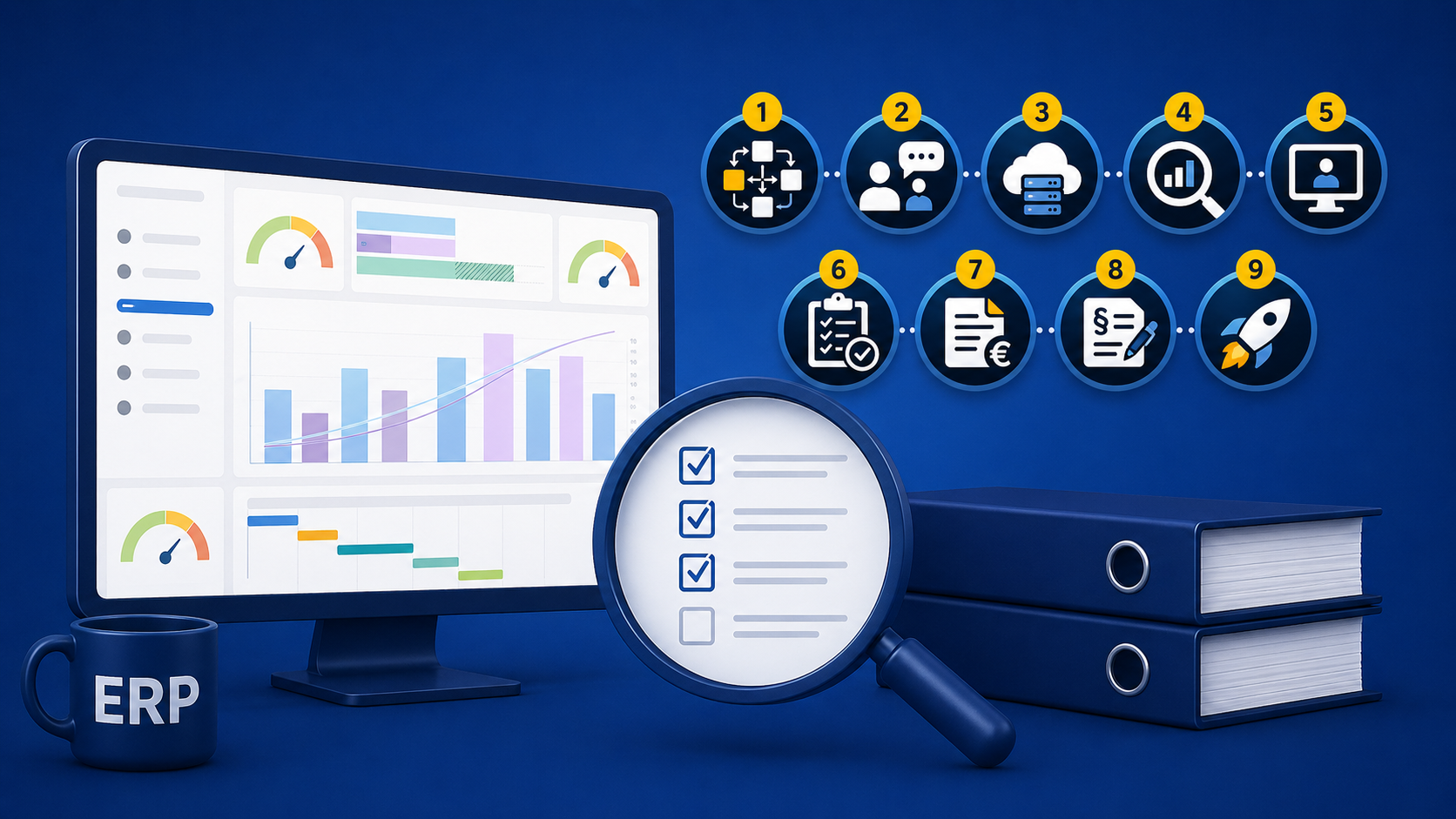
Abstract illustration of an ERP dashboard with a magnifying glass, symbolizing analysis, comparison, and informed software selection.