All Projects Are Treated the Same
Small projects are required to meet the same requirements as large strategic initiatives. The result is unnecessary bureaucracy, workarounds, and low acceptance.
08/25/2026 - Articles
When every project manager uses their own methods, templates, and status logic, organizations end up with many individual solutions but no manageable project portfolio. Learn how to standardize project management effectively, which standards and reference frameworks provide guidance, and how to establish common processes across your organization without forcing every project into the same rigid structure.

Standardizing project management means establishing common rules for roles, processes, templates, data, and reporting. This makes projects comparable without forcing them to be identical.
Project governance defines decisions, approvals, priorities, and escalation paths. A PMO can develop and maintain standards and support their consistent application.
Standards and methods such as ISO 21500, IPMA, PMBOK, and PRINCE2 provide guidance. However, organizations still need to develop their own project management standard based on their specific needs.
Tailoring ensures that scope and level of detail match the project type, size, and risk. A lean set of mandatory requirements helps prevent unnecessary bureaucracy.
Software makes standards usable in day-to-day work. BCS brings together project templates, resource planning, time tracking, project controlling, and reporting on a shared data foundation. Proalpha uses it to manage around 500 projects per year across multiple locations.
By definition, projects are unique endeavors. At first glance, standardization therefore seems contradictory: How can you standardize something that is different every time?
Standardizing project management does not mean managing every project in exactly the same way. Instead, organizations establish a binding framework within which project managers can manage their projects according to project type, complexity, and risk.
Project management standardization is the organization-wide definition of common rules, terminology, roles, processes, methods, templates, data, and management tools for initiating, planning, executing, and closing projects.
For example, the standard defines:
which initiatives qualify as projects and which project types are distinguished
which roles, responsibilities, and decision-making paths apply
which project phases, approvals, and escalation paths are required
which minimum information and planning rules apply to schedules, resources, and budgets
how project status, progress, risks, and deviations are reported
how projects are closed and evaluated
In this way, the standard defines a binding core while still allowing flexibility where projects genuinely differ.

Not every project needs the same process. But every project needs a common language, reliable minimum standards, and comparable data.
In project management, terms such as standard, method, framework, and process model are often used side by side. However, they describe different concepts.
| Term | Meaning | Examples |
|---|---|---|
| Formal Standard | A rule or guideline developed and published by a recognized standards organization. | DIN 69901, ISO 21500, ISO 21502 |
| Reference Standard | A widely recognized reference framework for knowledge, competencies, or good project management practices. | IPMA ICB, PMBOK Guide |
| Method | A specific technique for a particular task or a structured project management approach. | Earned Value Analysis, network planning techniques, PRINCE2 |
| Framework | A structured framework consisting of roles, principles, events, or rules. | Scrum, SAFe |
| Process Model | A description of the phases, processes, roles, and deliverables that make up a project lifecycle. | HERMES, PM², V-Modell XT |
| Organizational Standard | A system of rules, processes, and tools tailored to an organization's strategy, culture, and project environment. | Project management guidelines, role models, project classes, templates, and reporting rules |
ISO 21500 now describes the organizational context and fundamental concepts of project, program, and portfolio management. ISO 21502 complements it with guidelines for practical project management. ISO explicitly states that organizations can apply these guidelines regardless of size, industry, or project type and adapt them to their specific context.
By contrast, the IPMA Individual Competence Baseline follows a competency-based approach. It structures competencies into the areas of “People,” “Practice,” and “Perspective.” Rather than prescribing a single standardized process, the ICB describes what professional project practitioners should be able to do in different situations.
An external standard therefore provides guidance. You still need to develop your own organization-specific project management standard based on it.
Many organizations document their rules in a project management handbook. This is useful, but it is not enough. A handbook may define, for example, how project status should be structured. However, it does not ensure that all project managers update their status on time, use the same metrics, or maintain information in the same place.
An effective project management standard therefore connects four levels:
Only when these levels work together does a well-written policy become part of everyday project practice.
Standardization becomes especially important when multiple project teams, departments, locations, or business units work together. Different terminology, processes, and data structures make collaboration more difficult and also hinder cross-project management.
What does “green project status” actually mean? Without a shared definition, every project manager may interpret it differently. The same applies to terms such as milestone, effort, forecast, risk, or escalation.
A common standard ensures that project managers, sponsors, controllers, and resource managers speak the same language and assess information consistently.
In multi-project management, decision-makers need to be able to compare projects: Which initiatives are on track? Where are resources lacking? Which budgets or deadlines are at risk?
This only works when projects provide comparable data based on common rules. Consistent status logic, planning principles, and cost structures therefore create the foundation for multi-project and portfolio management.
Without standards, many projects begin with the same organizational questions about roles, templates, approvals, or reports.
Project templates, role models, and defined minimum processes answer these questions in advance. Project managers can get started faster and do not have to redesign recurring structures for every new project.
If every department requests, approves, or reports on projects differently, manual handoffs and individual workarounds quickly emerge.
Common processes, by contrast, enable automated approvals, notifications, escalations, reports, and data transfers. However, the process itself must be well designed: Automating a poor process does not make it better.
Personal templates and isolated local solutions often work as long as only a small number of people and projects are involved. As the organization grows, the need for shared structures increases. A project management standard makes it easier to onboard new employees, collaborate across departments and locations, and integrate new business units. At the same time, it creates a shared view of projects, resources, and results.
Especially after acquisitions, different methods, tools, and data models often collide. A common standard prevents the overall picture from depending permanently on manual consolidation.
Check which of the following statements apply to your project environment:
A single warning sign does not necessarily require an organization-wide transformation program. However, if several problems persist, you should determine whether the bottleneck is no longer an individual project, but the project management system itself.
Nearly every area of project management contains recurring elements. Even so, you should not standardize every detail down to the last form field. Focus on the underlying structures.
First, the organization needs to define what actually qualifies as a project. Not every task with a deadline needs a project charter. At the same time, some substantial initiatives continue for years under labels such as “initiative,” “special assignment,” “just a small thing,” or “IT can handle it on the side.” Define clear, traceable criteria, for example:
strategic importance uniqueness duration | budget departments involved resource requirements | risk external customer involvement contractual or billing relevance |
You can then define project classes. A small project usually requires less planning and governance than an international product launch. A customer project follows different business processes than an internal organizational project. Project classes make it possible to apply standards at different levels.
Every project needs clear answers to three questions:
Who makes decisions? Who manages the project? Who contributes? |
A role model may distinguish between the project sponsor, project manager, subproject managers, project team, steering committee, PMO, controllers, and resource managers. More important than the number of roles is their clear definition. For each role, authority, responsibilities, reporting obligations, and decision-making powers should be clearly defined. A project sponsor who appears only on the cover page of the project charter but never makes a decision is about as useful to the project as a milestone without a deadline.
Many projects go through similar management phases: initiation, evaluation, approval, planning, execution, monitoring and control, acceptance, and closure. The actual work performed within these phases may vary considerably, but the management framework can still remain consistent. For each phase, you should define:
what the phase is intended to achieve which deliverables must be available who reviews the deliverables | which decision triggers the transition to the next phase which minimum information the project must provide |
These transitions can be implemented as quality gates, stage gates, approval points, or milestones.
Templates translate the standard into a concrete starting point for a project. Depending on the project type, they can already include typical phases, work packages, tasks, roles, and milestones. A good template reduces routine work for project managers without predetermining the entire project plan. It should therefore not contain every conceivable activity. A project template with 600 standard tasks may look impressive, but it often means project managers first have to spend considerable time deleting everything they do not need.
Organizations should define common planning rules:
At what level are schedules planned? How detailed should work packages be? How are effort and duration distinguished? Which units do teams use for planning? How should project managers account for planning contingencies? | When is a resource considered firmly allocated? Who is authorized to reserve employees for projects? How are operational responsibilities taken into account? How does the organization resolve resource conflicts? |
Without such rules, two projects may formally provide the same data even though that data means something entirely different in each case.
Status reports are among the most important areas to standardize. They connect day-to-day project work with management decisions. A consistent project status should define at least:
reporting period overall status schedule status cost or budget status deliverable or performance status | resource status key risks pending decisions forecast required actions |
The traffic-light status system also needs clearly defined thresholds. Otherwise, one project manager may flag a two-week delay as red while another still considers a two-month delay “slightly yellowish-green.”
Risks, changes, and issues arise in almost every project. Yet organizations often handle them very differently. A standard should define:
which risks must be documented how probability and impact are assessed when action is required who owns each risk | which changes require approval when an issue must be escalated which decision-making level is responsible |
These rules are particularly helpful in complex customer projects, where changes can have a direct impact on schedules, deliverables, and billing.
Project management does not end with tasks and schedules. Organizations need a shared view of effort, costs, deliverables, and revenue. To achieve this, they should standardize time and cost tracking rules, cost categories, budget structures, and forecasting processes. If project managers structure planned costs according to different criteria than the finance department uses for actual costs, the result may be a large amount of data, but not meaningful project controlling.
The storage and organization of project information also require clear rules. These include document types, naming conventions, version control, access rights, and retention requirements. Project closure should cover at least acceptance, remaining open items, financial closeout, final evaluation, and lessons learned. Lessons learned only provide real value if future projects can find and apply them. A PDF buried in a folder named “Archive_old_final_2” fulfills that purpose mostly in theory.

Start by asking what decisions your organization needs to make and what information is required to support those decisions—not which documents every project has to complete. From there, define a lean set of minimum requirements.

Standardization creates orientation. Overdoing it creates bureaucracy. A good organizational standard therefore deliberately acknowledges that projects will remain different.
A software project, an ERP implementation, a construction project, and an internal reorganization require different domain-specific processes. The project standard should not try to eliminate these differences. It defines the common management framework, while the relevant departments supplement it with their own professional approaches.
The implementation of a new enterprise-wide ERP system requires different planning, risk, and decision-making structures than organizing an internal workshop. If both initiatives have to go through the same full process, the result is not greater professionalism, but more administrative overhead.
Project types and project classes therefore help scale the standard appropriately. A small initiative may only require a project charter, a responsible owner, objectives, key dates, and a defined closeout process. Larger or higher-risk projects may additionally require detailed resource planning, risk management, project controlling, or regular steering committee meetings.
Tailoring means the deliberate adaptation of the project management approach to the project type, size, complexity, and environment. The current PMBOK Guide from PMI emphasizes adaptability and the combination of different approaches. The eighth edition has been available since 2025. It continues the principles- and performance-oriented foundation while linking it more closely with concrete technical and practical guidance. PRINCE2 7 likewise emphasizes scalability, flexibility, and adaptation to the specific project environment.
A practical organizational standard can distinguish between three levels:
Mandatory standard: A small number of rules apply to every project. These may include the project charter, objectives, accountability, key dates, status reporting, and project closure.
Project type- or class-specific standard: Templates, phases, and methods depend on whether the project is a customer project, product development initiative, internal project, or investment project.
Project-specific additions: Project managers extend the standard when risks, contracts, technology, or stakeholders require additional measures.
This creates consistency without forcing every project into the same mold. The common core provides comparability and manageability, while projects remain flexible wherever differences are professionally justified or necessary.
A standard should answer more questions than it creates. For every rule, ask: Does it support a decision, reduce risk, or eliminate repetitive work? If not, it probably does not belong in the mandatory standard.
External standards, reference frameworks, and methods provide proven structures. However, organizations still need to decide which elements best fit their own project environment.
DIN 69901 is one of the best-known German project management standards. It covers fundamental concepts, processes, methods, data models, and terminology.
At the international level, the ISO 21500 family provides a broader framework. ISO 21500:2021 describes the context and concepts of project, program, and portfolio management. ISO 21502:2020 provides guidelines for project management.
Additional standards address program management, portfolio management, governance, terminology, work breakdown structures, and Earned Value Management.
Assessment: The ISO standards provide high-level guidance. They do not give organizations a ready-made project template, but they can help establish a consistent project management system.
The IPMA Individual Competence Baseline, or ICB, focuses on competencies for project, program, and portfolio management.
It organizes competencies into three areas:
Assessment: This approach is particularly useful for organizations that want to systematically develop qualifications, leadership, and collaboration in addition to processes and methods.
The Project Management Institute publishes the PMBOK Guide, one of the world's best-known reference works for project management.
The PMBOK Guide does not treat project management as a rigid sequence of identical processes. It provides principles, performance domains, models, methods, and tools that project professionals can adapt to the specific context.
The eighth edition of the PMBOK Guide builds on the principle-based foundation of the seventh edition while making the content more application-oriented and linking mindsets, technical aspects, and practical guidance more closely. PMI emphasizes value delivery, adaptability, and accountability.
Assessment: For an organizational standard, the PMBOK Guide is well suited as a knowledge and reference framework. However, it does not replace organization-specific process design.
PRINCE2 is a structured and scalable project management method. It combines principles, practices, processes, and clearly defined roles and responsibilities.
The method guides projects step by step from initiation through delivery and places particular emphasis on governance, the business case, clearly assigned responsibilities, and tailoring to the project environment.
PeopleCert describes PRINCE2 as a structured, globally recognized project management method.
Assessment: PRINCE2 is particularly suitable as a foundation for governance, decision-making paths, and stage-based management. Organizations can combine the method with their own domain-specific processes or agile approaches.
PM² is a project management methodology developed by the European Commission. It incorporates elements from various internationally recognized best practices and provides practical guidelines, activities, roles, and templates.
The method can be tailored to the needs of organizations and teams. In addition to project management, the PM² family now also includes approaches for agile work, programs, and portfolios.
Assessment: PM² is particularly suitable for organizations looking for an openly accessible, practice-oriented framework or those that regularly work in European or public-sector environments.
HERMES was developed by the Swiss federal administration and supports traditional as well as agile and hybrid project delivery.
Its phase model forms the backbone of the method. Different scenarios adapt roles, modules, and deliverables to different types of projects. HERMES therefore explicitly recognizes that projects differ in terms of content and complexity.
Assessment: The approach demonstrates how standardization and tailoring can work together: The core logic remains stable, while scenarios account for the specific project context.
Scrum is not a complete organizational standard for project, program, resource, and portfolio management. The framework primarily structures iterative product development within a team.
Nevertheless, Scrum can be part of an organization-wide project management system. The organizational standard can then combine agile ways of working with overarching rules for funding, resources, governance, portfolio decisions, and reporting.
Assessment: The choice is not between “standardized” and “agile.” A well-designed standard can support agile projects precisely by clarifying their interfaces with the rest of the organization.
There is no single right standard for every organization. The best foundation depends on factors such as project types, industry, company size, regulatory requirements, and existing competencies.
In practice, organizations often combine elements from different approaches. What matters is not methodological purity, but a consistent overall system: roles, processes, and terminology need to fit together, and it must be clear which rules are mandatory.
Sustainable standardization does not begin with purchasing software or writing a handbook. It starts with a shared understanding of which problem the organization wants to solve.
Start by defining the value that standardization should create. Goals might include faster project kickoffs, better resource utilization, more reliable project controls, or comparable portfolio information.
Also define the scope, responsibilities, and success criteria. “Introducing a new project management process” is not a goal in itself; it is simply a measure.
Analyze how project management actually works in practice. Review real projects, templates, reports, systems, and interfaces, and involve project managers, sponsors, controllers, and resource managers.
Pay particular attention to disconnected workflows, duplicate data repositories, and manual reporting . At the same time, identify practices that have already proven effective in individual teams.
Do not focus only on problems. Effective solutions already used by individual teams can serve as a starting point for the common standard.
Categorize projects by type and management needs. Project types might distinguish between customer, development, and internal projects, while project classes can differentiate by size, risk, or strategic importance.
This classification provides the basis for applying requirements at different levels later on.
Define a small set of minimum requirements that apply to every project.
Additional requirements should depend on the project type, project class, or specific risks.
Translate the mandatory standard into practical working structures. Define responsibilities, approvals, and information flows, along with suitable templates and checklists.
In particular, avoid duplicate data entry. It increases effort, reduces acceptance, and often even decreases data quality.
Define a shared data foundation for projects, resources, schedules, budgets, costs, risks, and status information.
Then implement the agreed structures in your software. Project templates, roles, permissions, workflows, and reports should support the standard, while interfaces help prevent duplicate data storage and manual data transfers.
Test the standard first in representative projects. Pay particular attention to which rules work well, where unnecessary effort is created, and which information is still missing.
Then refine the standard and prepare the rollout with role-based training, guidance, and support resources .
A project management standard is not a one-time result. Project types, organizations, and software continue to evolve.
Therefore, assign clear ownership for regularly reviewing adoption, data quality, and impact, collecting feedback, and systematically improving the standard.
Do not try to develop the perfect standard on the first attempt. A lean core standard that is consistently applied often creates more value than a comprehensive rulebook that people work around in day-to-day project management.
The Proalpha Group demonstrates how organically grown project structures can be standardized across locations and business units. The key was not simply introducing new software, but bringing project, resource, time tracking, billing, and controlling processes together on a shared platform.
Proalpha has more than 2,500 employees across 66 locations and serves more than 17,500 customers. Internationally distributed teams work on around 500 projects each year.
The in-house project management tool “goLive!” had proven effective for many years, but as the organization grew, it increasingly reached its limits. Multi-project management and portfolio controlling were only possible to a limited extent, some reports had to be created manually, and acquisitions had introduced different processes and systems.
Proalpha therefore needed a shared platform for project business across the group.
BCS was intended to bring together project planning, resource management, time tracking, billing, and controlling while remaining flexible enough to support different business units and project types. Following the decision in 2019, the system went live on June 1, 2020. BCS was then rolled out step by step to additional country organizations.
The implementation also showed that comprehensive standardization does not end with go-live. Training, guidance, and support accompanied the transition until the new processes had become firmly established in day-to-day work.

Business Application Manager, Proalpha Group GmbH
With BCS, we were able to bring our core project, resource, and controlling processes together on a shared platform, significantly improving the transparency and manageability of our international project business over the long term.
Today, Proalpha plans and manages its projects entirely in BCS. Project templates provide predefined phases, tasks, and milestones that project managers can adapt to ERP implementations, updates, and other initiatives. Object versioning makes changes traceable, while tasks, responsibilities, and progress are documented centrally. International teams work with the same data and status information.
Resource planning is also integrated with project management. Managers can identify utilization levels and bottlenecks across projects and prioritize capacity more effectively.
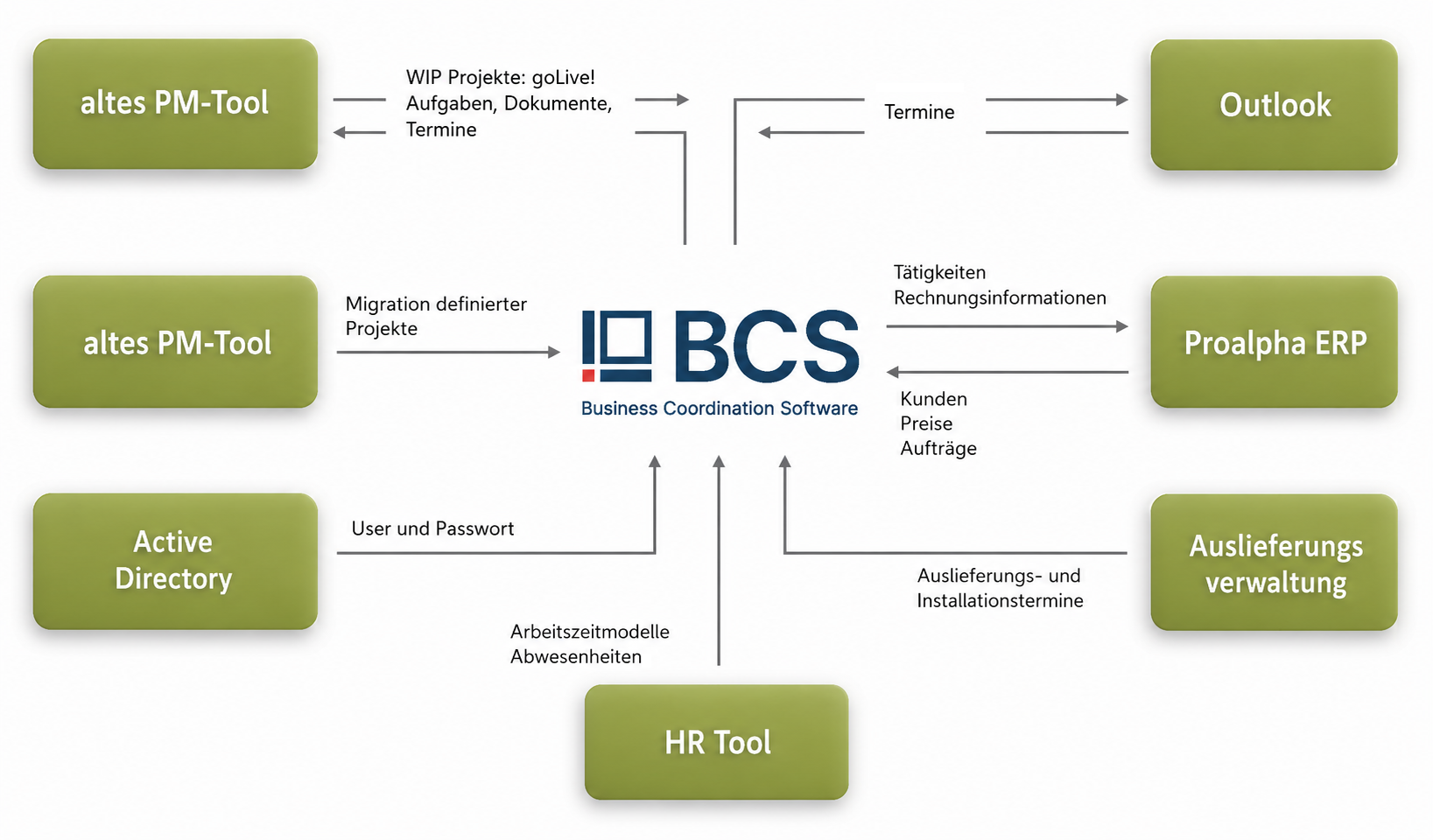
BCS is now operated as a group-wide shared service and is continuously enhanced. Around 800 to 900 users work with the platform.
This real-world example highlights a key principle of standardization: Standardized processes deliver the greatest value when organization, data, and software work together. Project templates create consistency, while flexible structures continue to accommodate different project types and business units.
The more processes you standardize at the same time, the more important realistic scheduling, role-based training, and a planned stabilization phase become. Go-live is not the end of implementation, but the first real-world test.
Software does not replace clear objectives or well-designed processes. Nor does it create a robust project management standard on its own. But it can help ensure that agreed rules are actually applied in day-to-day work.
Roles, project types, and approvals become technical structures. Project templates become reusable plans. Shared data becomes comparable reporting.
A project management handbook describes how projects should be managed. Integrated software turns these rules into concrete project structures, roles, permissions, required information, and workflows. For example, project managers can start with a suitable template instead of building every project from scratch. Phases, tasks, milestones, and responsibilities can already be predefined and then adapted to the specific project. This way, the standard does not remain a document—it supports the project from setup through completion.
Standardized project plans are not enough if resources are managed separately. A shared data foundation connects projects, tasks, employees, capacities, and time periods. This makes utilization levels and bottlenecks visible across projects and helps organizations prioritize resources more effectively between competing initiatives. This is especially important for multi-project and portfolio management.
Working hours, costs, services, and budgets should also be connected to project data. When employees record their work directly against projects and tasks, this information can be reused for project progress tracking, post-calculation, controlling, and, where applicable, billing.
Consistent data, in turn, provides the basis for comparable status reports, dashboards, and portfolio analyses without having to prepare the same information multiple times.
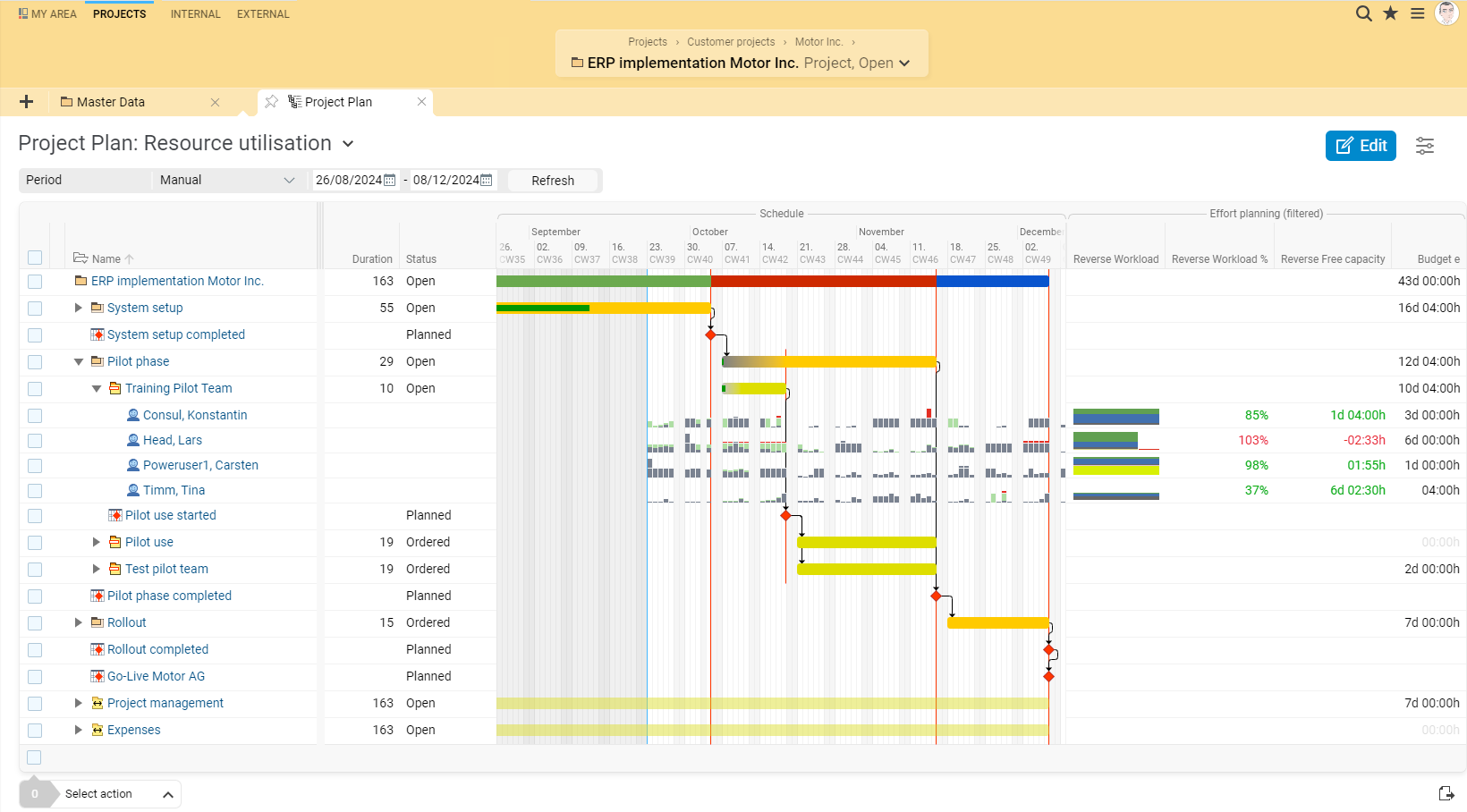
Working hours, costs, services, and budgets should also be connected to project data. When employees record their work directly against projects and tasks, this information can be reused for project progress tracking, post-calculation, controlling, and, where applicable, billing.
Consistent data, in turn, provides the basis for comparable status reports, dashboards, and portfolio analyses without having to prepare the same information multiple times.
Roles and permissions determine who is allowed to view, edit, or approve information. Workflows can support processes such as project requests, approvals, changes, escalations, or project closure.
Interfaces connect the project platform with directory services, ERP, calendar, document management, or development systems. It should be clearly defined which system serves as the system of record for each type of information to prevent new parallel data repositories from emerging. Customizing extends the standard wherever organization-specific project types, fields, or processes are required.
A suitable solution should support the project management standard in the following areas:
projects, programs, and portfolios project types, project classes, and project templates phases, tasks, milestones, and dependencies traditional, agile, and hybrid approaches organizations, roles, permissions, and approvals workflows, notifications, and escalations resource planning, capacity, and utilization forecasts | time tracking as well as service and cost entries budgets, project controlling, and post-calculation risks, status reports, and portfolio analyses expenses, travel costs, billing, and invoicing documents, tickets, and other project-related information interfaces, versioning, and customizing |
An integrated solution such as BCS does more than support individual methods. It brings together project management, resources, time tracking, and commercial processes on a shared data foundation, providing the consistency required for an organization-wide standard while offering maximum flexibility for different types of projects.
A project management standard changes ways of working, responsibilities, and often even established power structures. Some information becomes transparent for the first time, some decisions follow clearly defined paths, and some personal Excel file loses its status as indispensable insider knowledge.
Project managers have practical knowledge of workflows, customer requirements, and recurring challenges. Involve them early in the analysis of current processes and in designing the standard. This not only increases acceptance but also improves the quality of the standard itself.
Involvement does not mean that every individual preference needs to be adopted. The goal is not to preserve all existing solutions side by side. The team should decide together which practices are suitable for use across the organization.
Executives are interested in transparency, prioritization, and control. Project managers need less duplicate work and better support. Employees want clear tasks and simple time and service tracking. Controllers need consistent cost and performance data.
Communicate the benefits by role and make them as specific as possible.
Methodology training alone is not enough. Users need to learn how the organizational standard works in specific, real-world situations.
Suitable training scenarios include:
Supplement training with guides, short videos, FAQs, office hours, and clearly designated points of contact.
If leaders continue to request individual presentations and separate spreadsheets, they undermine the common standard.
They should make decisions based on the agreed data and reports. This demonstrates that standardized information is genuinely relevant and used for decision-making.
A Project Management Office can coordinate methods, templates, training, reporting, and portfolio information.
It should not act solely as a control function. An effective PMO supports project managers, gathers lessons from practical use, and continuously improves the organization's project management standard.
Depending on the size of the organization, this responsibility can also be assigned to a process owner or a cross-functional project management committee.
Not every organization needs to change all processes at once. A phased approach can start by standardizing project setup, roles, and status reporting. Resource planning, controlling, portfolio reporting, or billing can follow in later stages.
A big-bang approach can make sense when processes are closely interconnected or a legacy system must be shut down by a fixed date. However, it also places greater demands on preparation, training, support, and stabilization.

Standardization rarely fails because organizations define no rules at all. More often, the problem is too many rules, unclear objectives, or a standard that does not reflect the realities of day-to-day project work.
Small projects are required to meet the same requirements as large strategic initiatives. The result is unnecessary bureaucracy, workarounds, and low acceptance.
DIN, ISO, IPMA, PMI, and PRINCE2 provide guidance, but they do not know your organization, customers, systems, or decision-making structures. External approaches therefore need to be adapted to the organization’s specific context.
New templates and workflows are created before it is clear which decisions and improvements they are supposed to support. In the worst case, a software system’s default settings are simply declared to be the organization-wide process.
Project plans, status reports, time tracking, and controlling rely on parallel data sets. As a result, the standard increases effort instead of reducing it.
Additional Excel spreadsheets, presentations, and special reports quickly create a parallel system again. If management does not use the standard, it loses its authority.
Users know the features but receive no support when the first real-world problems arise. The initial phase in particular requires clear points of contact, practical support, and the ability to fine-tune the standard.
No one is responsible for maintaining the standard over time or deciding on necessary deviations. Processes and templates become outdated, while controlled tailoring gradually turns into arbitrary exceptions.
The organization knows that the new standard has been introduced, but not whether projects now start faster, data quality has improved, or decisions are better informed.
The following self-assessment provides an initial indication of your current level of standardization. Rate each statement with zero, one, or two points.
A new project management standard is not a success simply because it has been published and users have been trained. What matters is whether it actually improves project work and organizational decision-making.
First, determine whether employees are actually using the standard. Suitable metrics may include:
percentage of projects with the correct classification percentage of projects created from approved templates completeness of project charters timeliness of status reports use of standardized risk and change processes | number of approved exceptions training participation inquiries and support cases project manager satisfaction time required for recurring reports |
High adoption alone does not prove that the standard is delivering value. However, it does show whether the standard has become part of day-to-day work.
Consistent structures should result in more complete, up-to-date, and comparable data. For example, measure how many projects contain current schedules, budgets, resource plans, and status information. Also examine how often employees have to correct data manually or prepare it again in additional spreadsheets.
Determine whether projects start faster, deviations become visible earlier, and decisions are made more quickly. Possible metrics include:
time from project idea to approval duration of initial project planning number of overdue status reports response time for escalations | planned-versus-actual deviations in schedules and effort frequency of unplanned resource conflicts duration of project closeout percentage of completed lessons learned |
Over the long term, standardization should also improve portfolio and organizational decision-making. Management should be able to evaluate projects using consistent criteria, allocate capacity more effectively, and identify unprofitable or strategically less relevant initiatives earlier. These effects cannot always be reduced to a single metric. Therefore, combine quantitative data with interviews and regular reviews.
Measure what improves decision-making, not everything that can be measured. A dashboard with 47 traffic lights mainly creates one thing: an urgent need for a 48th light to explain the overall status of the dashboard.
Standardizing project management does not mean managing every project in the same way. An effective organizational standard creates a common language, mandatory minimum requirements, clear roles, recurring processes, and comparable data. At the same time, project classes and tailoring ensure that different projects are managed appropriately.
Standards and reference frameworks provide guidance, but each organization must develop the specific standard that fits its own needs. What matters is that processes, organization, and software work together and that the standard is actually used in day-to-day work. The best project management standard is therefore not the most comprehensive one, but the one project managers understand, employees apply, and leaders use to make decisions.
Project management standards are shared rules, terminology, principles, or competency models for planning and managing projects. Organizations often use them to develop their own standards for roles, processes, templates, and software.
It means creating a binding and reusable framework for projects. This framework defines areas such as project types, roles, minimum information, planning, reporting, approvals, and project closure.
A common standard improves comparability, transparency, and collaboration. Project managers can start projects faster, management receives consistent data, and resources and reports can be analyzed across projects.
Well-known references include DIN 69901, the ISO 21500 series, the IPMA Individual Competence Baseline, the PMBOK Guide, and PRINCE2. PM², HERMES, and agile frameworks such as Scrum complement these approaches.
That depends on project types, industry, company size, and organizational culture. Organizations often combine elements from several reference frameworks and use them to develop their own practical standard.
No. A handbook documents project types, roles, processes, templates, and rules, but it does not automatically put them into practice. Organizations also need training, clear ownership, management support, and suitable software.
A PMO often takes responsibility for the standard. Alternatively, ownership may lie with a process owner, a central project management function, or a cross-functional committee. Responsibilities and decision-making authority must be clearly defined.
Software puts the standard into operational practice. It supports project templates, roles, permissions, approvals, resource planning, and comparable reporting. It should support the agreed process rather than define it without review.
Yes. Common rules can cover the project charter, budget, governance, resources, risks, and reporting. Within this framework, teams can work using traditional, agile, or hybrid approaches.

Kai Sulkowski is an editor and in-house SEO specialist in the marketing department at Projektron GmbH in Berlin. As an IPMA-certified project management professional, he focuses on project management methods, organizational management, and the practical use of business software. Drawing on many years of experience in editorial work, SEO, and digital communication, he presents complex professional and technical topics in a clear, practical, and well-founded way.

A project management standard needs a clear target state. This article shows how to formulate and structure project objectives precisely and make them measurable using suitable criteria.

Standards need to define roles, responsibilities, and decision-making authority clearly. This article compares functional, staff, matrix, and autonomous project organization structures.

Common planning rules create a consistent view of capacity and utilization. Learn how to identify resource requirements, bottlenecks, and competing demands at an early stage.
Define the target state first, then choose the tool. This guide shows how to identify requirements, compare solutions, and select software that supports your processes and can evolve with your needs.

Standardizing project management means bringing different ways of working into a common, binding framework without eliminating the flexibility individual projects need.