07/13/2026 - Articles

What Is a Project—and When Is Professional Project Management Software Worth It?

A new customer portal, the implementation of an ERP system, or the development of a machine—initiatives like these are clearly considered projects. The distinction becomes more difficult with a website relaunch, a recurring campaign, or an annual certification. Is it still part of day-to-day operations, already a process, or truly a project?

Key Takeaways: What Is a Project?

A project is a temporary, goal-oriented initiative. It is intended to produce a defined result and ends once that result has been achieved, delivered, or the initiative has been deliberately terminated.

A project is defined by the interaction of several characteristics. These include a specific objective, a defined timeframe, limited resources, a dedicated organizational structure, and particular requirements, dependencies, or risks.

A project is more than a single task and differs from a process. Tasks are individual activities, while processes are recurring workflows. Projects coordinate multiple related activities to create a unique result under specific conditions.

Complexity does not begin only with large-scale projects. Even smaller initiatives can become difficult to manage when multiple teams are involved, work packages depend on one another, employees work across several projects at the same time, or requirements change frequently.

Professional project management software becomes worthwhile once a certain level of control is required. It is useful when resources, working hours, deadlines, budgets, risks, or multiple parallel projects can no longer be managed reliably with spreadsheets and simple task lists.

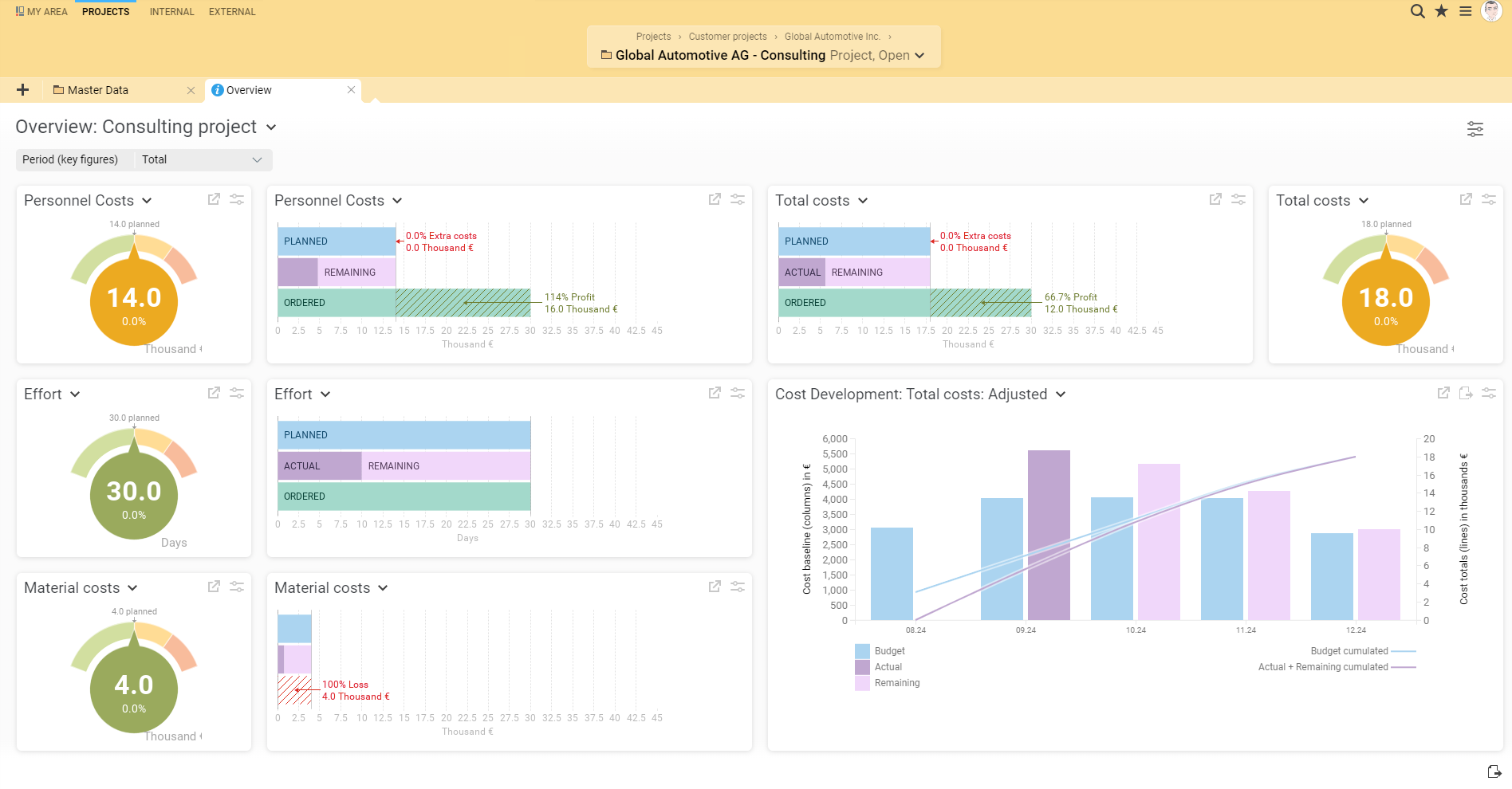
Integrated software creates a shared data foundation. Solutions such as BCS combine project planning, resource management, time tracking, project controlling, reporting, and commercial processes. This makes deviations visible earlier and allows decisions to be based on current, consistent information.

The distinction is more than an academic question. Treating every major task as a project creates unnecessary bureaucracy. On the other hand, treating complex initiatives like routine operational work can lead to unclear responsibilities, overburdened employees, schedule delays, and a lack of cost control.

What Is a Project?

A project is intended to bring about a defined outcome: software is implemented, a product is developed, an administrative procedure is digitized, or a new branch office is opened. The project ends once the agreed result has been achieved, delivered, or deliberately abandoned. The subsequent operation generally becomes part of day-to-day business.

Project Definitions According to DIN, ISO, PMI, and IPMA

There is no single universally binding definition of a project in project management. Formal standards, internationally recognized reference frameworks, competency standards, and project management methods emphasize different aspects. Some provide an explicit project definition, while others focus primarily on characteristics, conditions of application, or the project life cycle. The following definitions are particularly relevant to companies in German-speaking countries.

DIN 69901-5:2009-01

“An undertaking that is essentially characterized by the uniqueness of its overall conditions.”

DIN does not consider only the intended result to be unique. The decisive factor is the specific overall configuration of the undertaking. This includes the defined objective, limitations relating to time, finances, and personnel, differentiation from other undertakings, and a project-specific organizational structure.

A generally familiar type of project can therefore still be considered a separate project. A similar customer project may already have been completed several times. However, the specific combination of customer, requirements, team, technology, budget, and timeframe is unique.

Key characteristic: According to DIN, project character results from the uniqueness of the overall set of conditions.

Source:
DIN 69901-5:2009-01 – Project Management – Project Management Systems – Part 5: Terms: DIN 69901-5 at DIN Media
(last accessed July 10, 2026)

ISO 21506:2024

“Temporary endeavor to achieve one or more defined objectives.”

The ISO definition focuses on two fundamental characteristics: A project is temporary and directed toward defined objectives. Once these objectives have been achieved or the undertaking has been terminated, the project also ends.

The definition is deliberately broad. It can be applied regardless of industry, organizational size, project duration, complexity, or delivery approach.

Key characteristic: ISO defines projects concisely through their temporary nature and their defined objectives.

Sources:
ISO 21506:2024 – Project, Programme and Portfolio Management — Vocabulary: ISO 21506:2024
ISO Online Browsing Platform: ISO terminology definition
(last accessed July 10, 2026)

PMI / PMBOK® Guide, Eighth Edition

“A project is a temporary initiative in a unique context undertaken to create value.”

PMI combines the temporary nature of a project with the unique context of the undertaking. At the same time, the definition places value creation at the center. A project should therefore do more than simply complete tasks; it should create identifiable value.

This value may take the form of a new product, an improved service, a modified process, a technical solution, or another usable outcome.

Key characteristic: PMI emphasizes the unique project context and the value the initiative is intended to create.

Sources:
PMI, PMBOK® Guide – Eighth Edition: PMBOK® Guide at PMI
PMI, PMP® Examination Content Outline 2026: PMP® Examination Content Outline 2026
(last accessed July 10, 2026)

IPMA / GPM ICB4

“A project is a unique, temporary, multidisciplinary, and organized endeavor to realize agreed deliverables within predefined requirements and constraints.”

In addition to a project’s temporary and unique nature, IPMA explicitly emphasizes multidisciplinary collaboration and organizational structure. Projects frequently bring together people from different disciplines, departments, or organizations.

The agreed deliverables must be produced within defined requirements and constraints. These may include deadlines, costs, available resources, quality requirements, or technical specifications.

Key characteristic: IPMA combines uniqueness and a limited duration with organization, cross-functional collaboration, deliverables, and defined constraints.

Sources:
GPM / IPMA, Individual Competence Baseline for Project Management, Version 4.0: German-language ICB4
IPMA Individual Competence Baseline, Version 4.0: English-language ICB4
(last accessed July 10, 2026)

PRINCE2® Project Management, Version 7

“A temporary organization that is created for the purpose of delivering one or more business products according to an agreed business case.”

PRINCE2 considers a project to be a temporary organization. Roles, responsibilities, and decision-making structures are established for the duration of the initiative and do not necessarily continue in the same form after the project has been completed.

The project organization is intended to deliver defined products. The business case explains why the project is being undertaken and whether the expected benefits continue to justify the required effort and existing risks.

Key characteristic: PRINCE2 particularly emphasizes the temporary organization, the products to be delivered, and the project’s ongoing business justification.

Source:
PeopleCert, PRINCE2® Project Management, Version 7: PRINCE2® Project Management at PeopleCert
(last accessed July 10, 2026)

Classification of the Terms

DIN and ISO are standards. The PMI PMBOK Guide and IPMA’s ICB are internationally recognized professional reference frameworks. PRINCE2, by contrast, is a project management method.

According to DIN Media, DIN 69901-5 remains current. The standard also identifies factors such as defined objectives; time, financial, and personnel constraints; differentiation from other initiatives; and a project-specific organizational structure.

ISO 21500 provides the common vocabulary for project, program, and portfolio management. ISO 21502 provides guidance on project management and can be applied regardless of the organization, project type, size, cost, duration, or delivery approach. It explicitly covers predictive, iterative, adaptive, and hybrid approaches.

The Project Management Institute (PMI) emphasizes the unique result. PMI’s official explanation also links the definition to structured tasks, activities, and deliverables that are directed toward a desired outcome.

IPMA describes a project particularly clearly as organized, multidisciplinary collaboration carried out within predefined requirements and constraints. This makes the definition especially useful in B2B practice, where business units, customers, suppliers, and external partners often work together to produce a shared result.

Practical Working Definition: “Project”

A project is a temporary, organized undertaking that produces a defined and, in this form, unique result under limited conditions.

The 6 Most Important Characteristics of a Project

Not every characteristic has to be fully pronounced. An internal initiative may have a small budget, a research project may not yet have a fully defined final product at the outset, and a client project may be based on an approach that has already been used several times. What makes an undertaking a project is the overall combination of characteristics.

CharacteristicPractical Guiding QuestionExample
Objective and Outcome What specifically should exist or have changed by the end of the project? A fully operational customer portal with defined features.
Limited Timeframe When does the project begin, and when does it end? It begins when the contract is awarded and ends with acceptance and handover.
Uniqueness What is new about the objective, customer, technology, environment, or team composition? Existing software is rolled out for the first time within a new corporate structure.
Limited Resources What capacity, budgets, materials, and systems are available? Two developers, 80 consulting days, and a fixed budget for external services.
Dedicated Organization Who makes decisions, plans the work, contributes, and approves the results? A project manager, steering committee, specialist team, and external implementation partner.
Complexity and Risk What dependencies, uncertainties, or conflicts of interest exist? Data migration, interfaces, data privacy, and ongoing operations must be coordinated.

A Clearly Defined Objective

“Implement a new CRM system” may sound like a goal, but at first it is merely an intention. A viable project objective specifies what result should be achieved, by when, at what level of quality, and within which constraints. Only then is it possible to assess whether the project is on track and when it is complete.

Uniqueness Does Not Mean: Never Done Before

Companies regularly carry out similar customer projects, consulting engagements, or plant development initiatives. Nevertheless, each assignment can constitute a separate project. In such cases, uniqueness does not lie in the general project type, but in the specific combination of customer, requirements, team, contract, schedule, technology, and environment.

For example, a mechanical engineering company may develop ten similar systems. Each system still has customer-specific requirements, its own schedule, a separate budget, and an individual acceptance process. Standardized templates and reusable work packages make the undertaking more efficient, but they do not automatically eliminate its project character.

Constraints Create a Need for Management

Projects never operate with unlimited time, unlimited budgets, or employees who are available without restriction. Objectives, deadlines, costs, quality, and resources influence one another. If the delivery date is moved forward, the company may need to provide additional capacity, reduce the scope, or accept higher costs.

The Project Management Triangle

Projects operate within a field of tension among scope, time, and cost. These three factors are often represented as the project management triangle

A change to one side usually affects at least one of the others: If a project needs to be completed sooner, it may require additional employees or external support. This increases costs. If the budget remains unchanged, the scope may need to be reduced. When additional requirements are added, the project timeline often becomes longer or the project requires more resources.

DimensionKey QuestionTypical Metrics
Scope and Deliverables What specifically is the project expected to deliver? Requirements, features, deliverables, and quality
Time When must the results and milestones be achieved? Start date, completion date, duration, and deadlines
Cost What financial resources are available? Budget, labor costs, external services, and material costs

Depending on the model, quality is understood either as the result of the interaction among the three dimensions or as an additional dimension. In practice, resources, risks, and benefits also extend the classic model. However, the underlying principle remains the same: Project objectives cannot be changed independently of one another.

Software Project Example

A software project is scheduled to go live four weeks earlier. There are several ways to achieve this: The company can increase available capacity, reduce the scope of features, or accept greater schedule and quality risks. None of these decisions affects only the timeline.

The project management triangle highlights a fundamental difference between an individual task and a project. For a task, it is often sufficient to set a deadline. In a project, scope, time, cost, quality, and available capacity must be continuously balanced against one another.

The more work packages, dependencies, and departments a project involves, the more difficult it becomes to assess the effects of a change manually. Project management software connects scheduling, resource requirements, working hours, and budgets. This makes it possible to see whether additional scope puts the completion date, resource utilization, or profitability at risk.

Project, Task, Process, Program, or Portfolio?

Many misunderstandings arise because companies mix up different levels. A task can be part of a project or a process. A project, in turn, can belong to a program and/or portfolio.

TermNatureTypical EndExample
Task A single, clearly defined activity When the activity is completed Review the test plan
Process A recurring, standardizable workflow Generally continues indefinitely Review and approve incoming invoices
Project A unique, temporary undertaking with a defined outcome The objective is achieved, the result is accepted, or the project is terminated Implement new invoice workflow software
Program A coordinated group of related projects and initiatives The strategic change or intended benefits have been achieved Company-wide digital transformation
Portfolio The complete set of selected projects and programs managed to achieve strategic objectives No required end date All investment and customer projects within a company

Project or Task?

A task is a single work assignment. It may take only a few minutes to complete or require several days. A project, by contrast, consists of multiple coordinated tasks and requires additional management.

Creating a presentation is usually a task. Preparing an international customer event involving a budget, service providers, logistics, marketing, a registration system, and an evaluation of results is a project. What matters is not the number of slides or working hours, but the need for coordination.

Project or Process?

A process is designed for repetition. Its purpose is to handle comparable cases reliably, efficiently, and as consistently as possible. A project often creates or changes exactly these kinds of processes.

Monthly payroll processing is a process. Selecting and implementing a new payroll system is a project. After a successful go-live, responsibility transfers from the temporary project organization to ongoing operations.

Project or Program?

A program is not simply an especially large project. It coordinates multiple related projects and other initiatives to achieve a strategic change and its intended benefits. IPMA also defines a program as a temporary organization of interconnected components that are managed in a coordinated manner.

When introducing a new digital workplace, for example, the projects “Cloud Infrastructure,” “Document Management,” “End-User Devices,” “Training,” and “Workplace Strategy” could collectively form a program. Each project within the program delivers its own results. The program ensures that these results come together to create a cohesive transformation.

Project or Portfolio?

A portfolio takes a different perspective: It groups projects and programs regardless of whether they are directly related in terms of content. The key considerations are which initiatives align with the strategy, what benefits they promise, what risks they involve, and whether sufficient budget and capacity are available.

Examples of Projects Across Different Industries

Projects occur in nearly every industry, but they differ significantly in their objectives, constraints, and typical risks. In IT, the focus is often on implementing systems or developing applications. In engineering, the emphasis is on technical products; in consulting, on client-specific services; and in public administration, on organizational or digital transformation. The following examples show how project characteristics can be identified in different fields of work.

IT and Software

The implementation of an ERP system is a typical project. It includes requirements analysis, system configuration, data migration, interfaces, testing, training, and go-live. Subsequent support, user management, and regular maintenance, by contrast, are ongoing operational processes. Major updates or a fundamental expansion can, in turn, be organized as separate projects.

Consulting and Professional Services

A management consulting firm develops a new management framework for a client, analyzes the current situation, facilitates workshops, and supports implementation. The engagement, budget, consulting days, deliverables, and acceptance criteria are limited. Ongoing support after the project ends can continue under a service agreement or as a recurring process.

Engineering and Product Development

The development of a custom test bench includes design, procurement, manufacturing, software, documentation, and acceptance. Multiple disciplines work together, delivery dates depend on one another, and changes affect both costs and capacity. Series production after successful development, by contrast, is a process.

Public Administration

The digitization of an application procedure is a project when it creates a defined online service within a fixed timeframe, budget, and project organization. The subsequent processing of incoming applications is part of ongoing administrative operations. New legal requirements or a major technical redesign may trigger a follow-up project.

Agencies and Marketing

A brand relaunch involving strategy, corporate design, a website, a campaign, and rollout is a project. A weekly social media editorial calendar is more likely a process. Designing a single advertisement is a task. A product launch across multiple markets, channels, and service providers, however, clearly has the characteristics of a project.

Practical Rule

Do not ask only:

Is this initiative new?

Also ask:

Do we need a temporary collaboration, dedicated decision-making, and coordinated resources to achieve this specific result?

The more often the answer is yes, the more clearly the initiative qualifies as a project.

When Does Project Work Become Complex?

Complexity does not begin only with large-scale projects. Even a manageable assignment can become difficult to control when multiple departments need the same employees, external dependencies exist, or the client frequently requests changes.

SituationWhat Becomes More Difficult
Multiple teams, locations, or companies work together Responsibilities, communication, and handoffs
Work packages depend on one another Scheduling, the critical path, and the consequences of delays
Employees work in both operations and projects at the same time Capacity planning and prioritization
Services are billed based on time or effort Time tracking, documentation, budgeting, and invoicing
Requirements change during the project Version control, approvals, cost recalculation, and forecasting
Multiple projects compete for the same specialists Multi-project planning and portfolio decisions
Executive management, the client, or the funding provider requires reports Consistent data, status reporting, metrics, and documentation

At this point, optimizing individual project plans is no longer sufficient. The company needs a shared view of resource utilization, priorities, budgets, schedules, and dependencies. This is where multi-project management begins.

Common Problems Without Centralized Project Management

The more projects a company runs in parallel, the more difficult it becomes to reliably manage resources, schedules, effort, and budgets using individual spreadsheets and disconnected tools. A lack of transparency often becomes apparent only after bottlenecks, delays, or cost overruns have already occurred. The following problems are particularly common when planning, time tracking, project progress, and controlling are not consolidated in a central system.

Resource Bottlenecks Become Visible Too Late

In spreadsheets, a plan often appears plausible as long as each project is viewed in isolation. It is only in day-to-day work that it becomes clear that key employees have been assigned to multiple projects at the same time. The consequences are schedule shifts, constant reprioritization, and extensive coordination effort.

Working Hours and Progress Do Not Align

A work package may appear to be 80 percent complete even though almost its entire budget has already been used. Conversely, many hours may have been recorded without producing a deliverable that is ready for acceptance. Task status alone is therefore not sufficient for financially effective project management.

Comparing planned values, progress updates, remaining effort, and project hours makes it possible to identify deviations earlier. In consulting, IT services, research, and engineering in particular, recorded time also provides the basis for post-project costing, proof of performance, and billing.

Budgets Are Monitored Retrospectively Instead of Proactively

A cost overview shows what has already happened. Project controlling must also answer what is likely to happen next. This includes remaining costs, the expected completion date, outstanding purchase orders, external services, and potential changes to the project scope.

Without integrated data, status reports are often compiled manually from time-tracking systems, accounting records, task lists, and project plans. This takes time and produces inconsistent data. Project management software can combine planning, time entries, resources, budgets, controlling, and billing in a shared data model. Solutions range from simple planning tools to multi-project management systems and ERP-integrated platforms.

Status Reporting Becomes a Separate Production Process

When project managers compile figures from multiple files, the report may already be outdated before it is finished. There is also a risk that different projects use inconsistent terminology and status colors.

When many initiatives run in parallel, a Project Management Office often takes responsibility for standards, portfolio visibility, and management reporting. PMO software consolidates projects, programs, resources, budgets, risks, and dependencies, reducing the manual reporting effort.

When Does Project Management Software Become Worthwhile?

There is no universal threshold of five employees, ten projects, or a specific revenue level. A small organization with highly regulated client projects may need professional software sooner than a large team managing only a few independent initiatives.

The right question is therefore not: 

Are we large enough?

Instead, ask: 

Is our project work complex enough that a lack of transparency, disconnected systems, and manual coordination create measurable costs or risks?

SituationTool That Is Usually Sufficient
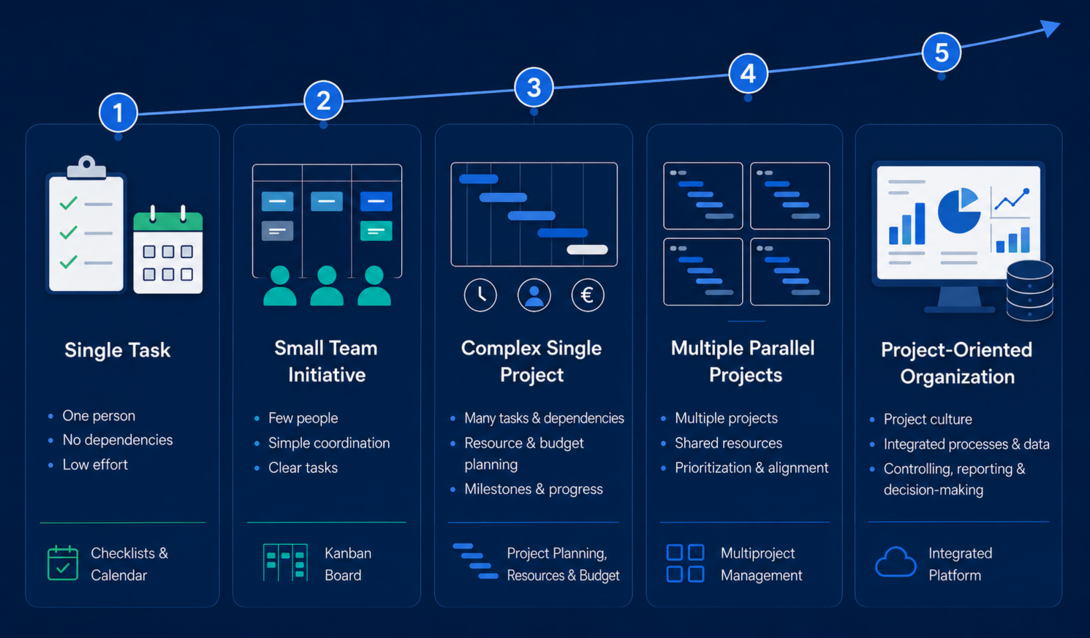
A short initiative, few participants, minimal dependencies, and no dedicated project budget Checklist, calendar, or simple task management tool
One team, multiple tasks and deadlines, and a need for transparent work status Collaborative task management or Kanban tool
Dependencies, milestones, resource requirements, project hours, budgets, and regular reports Project management software
Many projects running in parallel, shared resources, and cross-project priorities Multi-project or project portfolio management software
Client projects involving proposals, contracts, time tracking, travel expenses, billing, and controlling An integrated project management, PSA, or ERP-integrated solution
Centralized standards, governance, and management reporting across the entire project landscape PMO software or an integrated platform

A Task Management Tool Is Not Automatically Project Management Software

Task management tools are effective when teams want to make work visible, assign responsibilities, and track progress. For many small initiatives, that is entirely sufficient. In many cases, these simple tools are also marketed under the broader term project management software or project software.

Depending on the business model, professional project management requires additional capabilities: project structures, schedule dependencies, milestones, baselines, resource requirements, planned-versus-actual comparisons, remaining effort, budgets, risks, working hours, costs, revenue, and portfolio analysis. Client projects often also involve proposals, orders, proof of performance, and invoicing. At this point, the line between project management software and an ERP system or business coordination software gradually begins to blur.

Self-Assessment: Do We Need Professional Project Management Software?

Select all statements that apply to your current project work. The results indicate how urgently you should evaluate a centralized solution and whether there is already a clear business case.

Which Statements Apply to You?
When Does a Centralized Solution Become Cost-Effective?

Also select the statements for which measurable effort, costs, or risks are already occurring.

0 of 7 warning signs
0/7
Start the Self-Assessment Select the statements that apply to your project work. Your assessment will update automatically.

What Professional Project Management Software Should Provide

Good software does more than simply digitize a project plan. It creates a shared information base across the entire project life cycle, from the initial project request through completion, and provides information tailored to the needs of different roles.

The key factor is end-to-end integration. When data is maintained only in separate specialized tools, manual transfer effort and inconsistencies remain. An integrated platform can connect project planning, resource management, working time tracking and project time tracking, project controlling, and billing. BCS, Projektron’s Business Coordination Software, covers this entire range—from managing individual projects to multi-project management andportfolio management, as well as business process management.

However, software cannot replace clear objectives, roles, or decision-making processes. It strengthens good processes and makes poor processes more visible. A software implementation should therefore be managed as a project in its own right, with requirements, designated responsibilities, a pilot phase, data migration, training, and measurable success criteria.

From Individual Projects to a Manageable Project Landscape

An individual project can often be organized pragmatically. However, with each additional initiative, the number of interdependencies grows. Resources must be prioritized, methods standardized, and decisions made comparable. At that point, the company should no longer simply manage projects, but actively manage its entire project landscape.

For more in-depth information, see our articles on project planning, resource management, multi-project management, PMO software, project governance, and selecting project management software.

Plan, Manage, and Analyze Project Work Centrally

With BCS, you can bring project plans, resources, time entries, budgets, reporting, and commercial processes together on a single platform. This transforms numerous individual data points into a reliable foundation for project teams, management, and controlling.

Discover BCS

Conclusion: A Project Requires More Than a Task List

A project is a temporary, organized undertaking that produces a defined outcome under specific conditions. It differs from day-to-day operations primarily in its uniqueness, its defined end, and the additional need for coordination. Tasks are individual activities, processes are recurring workflows, programs coordinate related projects, and portfolios provide an overall strategic view.

Not every project immediately requires comprehensive software. Small, independent initiatives can be managed effectively with simple tools. However, once resources must be shared, time tracked, budgets monitored, dependencies planned, or multiple projects prioritized, a loose collection of spreadsheets, emails, and task boards reaches its limits.

Professional project management software therefore becomes worthwhile not at a specific company size, but when a certain level of management and control is required. It creates value when it improves transparency, reduces manual work, and enables better decisions. For project-driven companies, it then becomes more than a planning tool: It serves as the shared data foundation for performance, resource utilization, and profitability.

FAQ: Frequently Asked Questions About the Definition of a Project

Is Every Unique Task Automatically a Project?

No. Uniqueness is an important characteristic, but it is not sufficient on its own. A one-time task may be unique without requiring its own planning, organization, or management. A project combines a defined outcome with a limited timeframe, multiple coordinated activities, and limited resources.

What Is the Minimum Duration of a Project?

There is no minimum duration. A project can last a few days or many years. What matters is the objective, a defined beginning and end, and the required coordination framework. A short trade show appearance can be a project, while a monthly closing process repeated over many years remains a process.

Are Agile Initiatives Also Projects?

Yes. Agility does not eliminate the characteristics of a project. Agile projects also pursue an objective, work with limited resources, and have an organizational framework. The main difference lies in how planning and delivery are handled: Requirements are refined gradually, and results are delivered iteratively.

When Is Excel No Longer Sufficient for Project Management?

Excel becomes problematic when multiple people need to plan simultaneously, data from different sources must be consolidated, or changes affect other projects and resources. Version conflicts, manually created status reports, unclear capacity, and missing planned-versus-actual comparisons are typical warning signs.

What Is the Most Important Difference Between a Project and Day-to-Day Operations?

Day-to-day operations maintain recurring services and ongoing workflows. A project changes something, creates a new outcome, and then ends. The project often hands its result over to ongoing operations: A software implementation becomes system operation, and process development becomes routine work.

When Does Professional Project Management Software Become Worthwhile?

Professional software becomes worthwhile when dependencies, resources, project hours, budgets, or multiple parallel projects can no longer be managed reliably with spreadsheets and task lists. The determining factor is not company size, but the effort caused by a lack of transparency, disconnected systems, and manual coordination.

About the Author

Kai Sulkowski is an editor in Projektron’s Marketing Department. He combines marketing, SEO, and digital communications with professional expertise in project management. In his articles, he explains the fundamentals, methods, and software solutions involved in planning and managing projects. Among other topics, he clearly distinguishes projects from tasks, processes, programs, and portfolios, and shows how resource planning, time tracking, project controlling, and project management software contribute to greater transparency and more reliable decision-making.

More Interesting Articles on the Projektron Blog

A project combines a defined outcome with a limited timeframe, coordinated activities, and limited resources. This article explains the key characteristics of a project, distinguishes projects from tasks and processes, and shows when professional project management software is useful.

A project combines a defined outcome with a limited timeframe, coordinated activities, and limited resources. This article explains the key characteristics of a project, distinguishes projects from tasks and processes, and shows when professional project management software is useful.