1
Postponed Decisions
Decisions are postponed or discussed repeatedly.
07/09/2026 - Articles
Project governance determines whether projects are merely administered or truly steered. It defines who makes which decisions, when issues are escalated, which roles carry responsibility, and how projects remain aligned with corporate strategy. When implemented properly, project governance is not a bureaucratic burden, but the foundation for fast, transparent, and binding project decisions.

Project governance defines the decision-making framework for projects. It establishes roles, responsibilities, decision rights, escalation paths, tolerances, and reporting structures.
Project governance is not the same as project management. Project management controls operational execution. Project governance ensures that projects remain aligned with strategy, controllable, and ready for decision-making.
Good governance speeds up decisions. Clear mandates, defined escalation paths, and binding tolerances prevent endless alignment loops and politically driven one-off decisions.
Governance requires up-to-date and consistent project data. Without reliable information on status, budget, risks, resources, and dependencies, governance bodies remain reactive.
Software makes governance scalable. Integrated project management and ERP software such as BCS helps centralize project information, standardize reporting, and support decisions based on current data.
Many projects do not fail because of a lack of methods. Project plans, status reports, task lists, and milestones are often already in place. Yet projects still get stuck because decisions are made too late, responsibilities remain unclear, or strategic conflicts are not resolved.
This is exactly where project governance comes in. It creates the framework within which projects are led, prioritized, controlled, and decided. In doing so, it answers one of the most important questions in project management: Who decides what, when, on what basis, and with what level of responsibility?
Project governance is the structural framework within which projects are directed, controlled, and decided. It defines rules, roles, decision rights, escalation paths, reporting requirements, and responsibilities across the entire project life cycle.
While project management primarily manages a project’s tasks, schedule, resources, and deliverables, project governance answers higher-level questions:

Project governance ensures that projects are not only planned and executed, but also led with clear accountability. It is not a single committee and not just another report. It is the decision-making architecture of a project.
Effective project governance makes it clear who is accountable, which decision-making paths apply, and when management levels need to be involved. This reduces informal alignment efforts, unclear escalations, and decisions based on gut feeling.

The following definitions and statements show how project governance is described in established standards, methods, and official project management sources.
PMI describes project governance as a supervisory function above day-to-day project execution. It connects the project with the organization's governance model and applies across the full project life cycle.
Characteristic: PMI emphasizes project governance as life-cycle-wide oversight. It is not a single meeting or report, but a governance framework covering roles, responsibilities, stakeholder communication, reporting, risk and issue management, assurance and project control.
The PMI Practice Guide looks at governance across portfolios, programs and projects. It shows that project governance is not isolated from higher-level structures, priorities and strategic initiatives.
Characteristic: PMI highlights the level-based nature of governance. Project governance is part of a broader governance system that connects projects, programs, portfolios and organizational decision-making.
PM² defines project governance directly through decisions, roles and responsibilities. It also states that project roles are defined by the management responsibilities assigned to them.
Characteristic: PM² understands project governance mainly as a decision and role model. The focus is on who has which responsibility, which authority and which management domain within the project.
ISO 21505 places project governance explicitly in a management and organizational context. It addresses governing bodies, executive and senior management, sponsors, steering committees, portfolio owners and PMOs.
Characteristic: ISO 21505 treats governance as a leadership function that can be assessed, assured and verified. The focus is not only on steering projects, but also on making the governance function reviewable and auditable.
IPMA and GPM emphasize the organizational perspective. Project governance is not only a project management topic, but a management responsibility. It links projects with strategy, leadership structures, guidelines, performance monitoring and portfolio decisions.
Characteristic: IPMA/GPM emphasize project governance as a top-management responsibility. The focus is on embedding projects into corporate governance, strategy and organizational competence.
PRINCE2 does not describe project governance primarily as an abstract concept on this source page. Instead, it operationalizes governance through clear roles, business-objective alignment, risk management, flexibility and scalability.
Characteristic: PRINCE2 makes governance practical through role clarity, business justification and controlled project management. Governance becomes visible in how decisions, responsibilities, risks and project direction are structured.
HERMES describes project steering as comprehensive, cross-organizational steering of a project. It links governance to concrete decision points such as project initialization, execution approval, phase approvals, release approvals, project closure and project cancellation.
Characteristic: HERMES makes governance visible through formal approvals, steering decisions and reporting. Project governance is characterized by traceable decisions along the project life cycle.
The more complex projects become, the more important a clear governance framework becomes. In many organizations today, numerous projects run in parallel. Business units share limited resources, strategic priorities change, and project teams increasingly work in hybrid, agile, or distributed setups.
Without project governance, typical problems can quickly arise:
Decisions are postponed or discussed repeatedly.
Project managers take on responsibilities that should actually belong to the sponsor.
Steering committees discuss operational details instead of strategic questions.
Status reports are created, but they do not lead to decisions.
Escalations happen too late or do not reach the right level.
Projects compete for resources without clear priorities.
Strategic goals fade from view in day-to-day project work.
Risks are documented, but not effectively managed.
The problem does not necessarily lie in the project plan itself. In many cases, the structure above it is missing.
Project governance creates exactly this structure. It ensures that projects remain embedded in the organizational context, that decisions are made transparently and traceably, and that responsibility is not only formally assigned but actually exercised. The more projects run in parallel, the less sufficient it is to view each project in isolation. Project governance connects individual project control, resource prioritization, risk management, and strategic alignment.
This makes governance especially important for:
Project governance and project management are often confused. The two are closely connected, but they serve different purposes.
Project management focuses on the operational execution of a project. It plans tasks, schedules, budgets, resources, risks, and deliverables. It ensures that the work gets done.
Project governance, by contrast, defines the higher-level framework within which this operational project work takes place. It determines how decisions are made, how responsibilities are assigned, and how projects are strategically directed. It ensures that the right decisions are made.
| Project Management | Project Governance |
|---|---|
| Manages operational project work | Defines the decision-making and responsibility framework |
| Plans tasks, schedules, and resources | Defines roles, mandates, and escalation paths |
| Works within the project | Connects the project, management, and strategy |
| Focus: execution and efficiency | Focus: controllability and effectiveness |
| Responsible for results within the project | Responsible for clear decision-making structures |
| Uses status reports for project control | Defines which information is relevant for decision-making |
Both levels need each other. Without project management, governance remains abstract. Without governance, project management risks managing operational problems whose root causes lie at the management or portfolio level.
Project governance includes all structures, roles, and mechanisms that enable a project to make effective decisions. These include in particular:
Project governance does not mean introducing as many rules as possible. Good governance is as lean as possible and as binding as necessary.
It should not slow projects down, but rather help avoid unnecessary coordination loops.
Project governance only works when roles are not merely named, but are equipped with clear mandates. What matters is not the job title, but the question of who actually assumes which responsibility.
The sponsor carries strategic responsibility for the project. They ensure that the project has a clear benefit, aligns with the organization’s strategy, and receives the necessary management support.
Typical responsibilities of the sponsorA common governance mistake occurs when a sponsor is formally named, but does not take an active role in day-to-day project governance. As a result, strategic responsibility remains unclear and project managers have to make decisions that fall outside their mandate.
The steering committee is the central governance body for important project decisions. It reviews status, risks, deviations, and escalations, and makes decisions that go beyond the operational project mandate.
Typical responsibilities of the steering committeeA good steering committee does not discuss every operational detail. It focuses on decisions that are relevant to goal achievement, budget, schedule, risks, or strategic value.
The project manager is responsible for operational execution within the defined governance framework. They plan, coordinate, and control the project and prepare decision-relevant information for the sponsor, PMO, or steering committee.
Typical responsibilities of the project managerProject managers need clear decision rights. Only then can they remain effective without escalating every deviation to a governance body immediately.
A PMO supports project governance through standards, methods, transparency, and quality assurance. It ensures that projects become comparable and management decisions are based on consistent information.
Typical responsibilities of the PMOIn more mature organizations, the PMO evolves from an administrative reporting support function into an active governance partner for project and portfolio decisions.
Project governance is often discussed in abstract terms. In practice, however, its quality becomes visible through a few concrete elements. Roles, decision-making paths, reporting, risk control, and strategic alignment are especially important.
Without clear roles, there can be no effective decision-making framework. Effective governance therefore starts with accountability. Every governance structure should clearly answer:
Key questionsIt is not enough to simply name roles in a project organization. They must be connected to concrete mandates: a sponsor without an active decision-making mandate provides little value to the project. A steering committee without clear decision-making authority becomes a discussion forum. A PMO without management backing cannot make standards binding.
Project governance defines how decisions are made. Clear and measurable tolerance thresholds are especially helpful.
Examples of tolerancesThis kind of decision architecture prevents unnecessary escalations. The project manager remains able to act within defined limits. At the same time, it is clear when a higher decision-making level needs to be involved.
The principle behind this is similar to management by exception: as long as the project remains within agreed limits, decisions are made operationally. Only relevant deviations are escalated.
Reporting is an important part of project governance. However, it is often misunderstood. Good governance does not need more reports, but better decision-making input. Effective governance reporting primarily answers one question: Is action required or not?
This requires clear information onA consistent logic is important. If every project evaluates risks differently, interprets traffic-light indicators in different ways, and designs status reports individually, management loses visibility.
Governance reporting should quickly showGovernance reporting should be standardized, but not overloaded. Reporting is not an end in itself, but a steering instrument.
Risks are part of every project. What matters is whether they are identified early, assessed correctly, and passed on to the appropriate decision-making level.
Project governance definesWithout governance, risk management often remains just a list. Risks are documented, but not acted on. Governance connects risk identification with accountability. Looking beyond individual projects is especially important. If several projects report similar risks, this may indicate a structural problem: insufficient resources, unrealistic priorities, dependencies, or unclear goals.
This is where the difference between project management and project governance becomes particularly clear: project management identifies the risk within the project. Governance ensures that the organization can respond to it.
Projects consume time, budget, and resources. They therefore need to be regularly reviewed against the company’s strategic goals. Project governance ensures that projects are not viewed in isolation. It connects individual projects with the portfolio, strategy, and management priorities.
Important questionsThese questions are especially relevant in multi-project environments. In these environments, project success is not created only through good individual project planning, but through the right prioritization of the entire project portfolio.
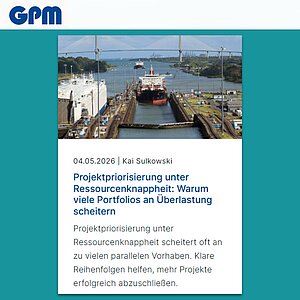
This perspective becomes especially clear when project portfolios are viewed under resource constraints. In that case, it is not enough to evaluate projects only by strategic importance or expected value. What also matters is whether the required capacity is actually available and which initiatives can realistically be implemented at the same time.
In my article for the blog of GPM, the German Association for Project Management, I explore this connection in more detail using the example of project prioritization under resource constraints. The article shows why many portfolios do not fail because of a lack of strategy, but because of too many parallel initiatives, overloaded bottleneck resources, and a lack of capacity transparency.
Read the article “Project Prioritization Under Resource Constraints” on the GPM blog (in German)
Governance ensures that companies do not merely execute projects, but implement the right projects at the right time with the right resources.
Project governance becomes a bureaucratic monster when it makes decisions harder instead of easier. The following mistakes are especially common.

Roles, committees, and processes are formally defined, but they are not actually put into practice. The sponsor is named, but does not make decisions. The steering committee meets, but remains noncommittal. The PMO creates reports, but has no real steering effect.
The result is governance in name only: structures exist, but there is no accountability.

More meetings do not automatically mean better steering. When the same topics are discussed at multiple levels without binding decisions being made, governance slows the project down.
Effective governance needs a small number of clearly mandated committees. What matters is not the number of steering meetings, but their ability to make decisions.

A steering committee should make decisions on strategic issues, not take over detailed operational planning. When management committees discuss work packages, sprint content, or individual deadlines, the separation of roles breaks down.
Good governance defines guardrails. It does not take over operational steering.

The sponsor is a key role. Even so, in many projects, this role remains too passive. When sponsors do not clarify priorities, resolve conflicting objectives, or provide backing, delays occur.
Project managers cannot replace strategic accountability. Governance only works when leaders actively fulfill their role.
Many organizations create extensive status reports without deriving decisions from them. Reporting then becomes a box-ticking exercise.
A governance report should always show:
What is critical?
Why is it critical?
What decision is needed?
Who needs to make the decision?
By when does the decision need to be made?
Only then does reporting support real steering.

Governance often fails not because of missing processes, but because of conflicting information. When status, budget, resources, and risks are maintained in different files, tools, or presentations, there is no reliable basis for decision-making.
A steering committee can only make good decisions when the data is up to date, comparable, and traceable.
In complex organizations such as healthcare institutions, service companies, or public institutions, many projects often run in parallel. Different departments, external partners, management levels, and project teams need to be coordinated. At the same time, resources are limited and strategic priorities are high.
Typical starting point:
Project information is stored in different files.
Status reports are created manually.
Resources are not viewed across projects.
Decisions depend on individual people.
Escalations take too long.
Priorities are not transparent.
Management receives information with a delay.
Two practical examples from the healthcare industry show how project governance works in day-to-day business.
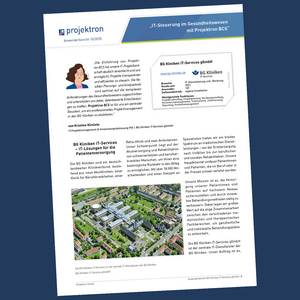
A fitting example is provided by the BG Kliniken IT-Services gGmbH user report. As the central IT service provider for a nationwide hospital network in Germany, the organization has to coordinate numerous IT projects in parallel and consolidate requirements from different departments. Before introducing BCS, project coordination was associated with a high level of manual effort, according to the user report; delays, lack of transparency, and difficulties in resource allocation made reliable steering more difficult.
With BCS, a central foundation was created for project planning, project controlling, resource management, reporting, multi-project management, and portfolio management. From a governance perspective, one aspect is particularly relevant: project data is no longer maintained in isolation, but consolidated in a shared environment. This creates better conditions for transparent status information, early detection of deviations, and data-based decisions.

Before introducing BCS, coordinating projects often involved a high level of manual effort. This led to delays, a lack of transparency, and difficulties in resource allocation. To manage our large number of projects efficiently, plan resources more effectively, and strengthen cross-team collaboration, we needed a tailored solution. By introducing specialized project management software, we aim to overcome these challenges and create a solid foundation that makes future IT projects more transparent and efficient. The goal is to establish professional project management that delivers real value to our hospitals.
This example shows that project governance is not only about rules and committees. What matters is whether project information is bundled in a way that enables leadership, project managers, and departments to make decisions based on the same foundation.
Read the full BG Kliniken IT-Services gGmbH report now
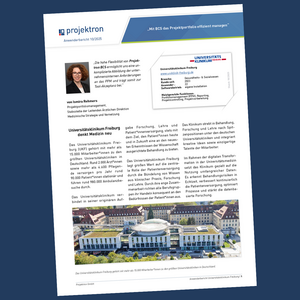
The University Medical Center Freiburg also shows why project governance becomes necessary in large organizations. The medical center uses BCS to capture and manage major IT, construction, and organizational projects in a shared project portfolio. The user report describes an initial situation in which project data had previously been distributed across different places and was only comparable to a limited extent. This made standardized evaluation, prioritization, management reporting, and escalation management more difficult.
With BCS, different types of projects are mapped in a shared structure. The portfolio serves as the basis for project descriptions, strategic evaluation, milestone planning, risk assessment, high-level cost planning, reporting, and decisions about priorities and resources. What is particularly relevant from a governance perspective is that management and steering committees do not just receive individual reports, but a consistent view of the overall progress of the project portfolio.

We wanted to present the large number of projects—between 50 and 200—in a clear way and manage them reliably. In addition, portfolio managers needed to be able to easily maintain their projects and provide information for controlling. To do this, we needed a tool that supports us in decisions about starting and steering projects while also creating transparency around overall progress.
Previously, project data was often distributed across different places and was only comparable to a limited extent. This made standardized evaluation and prioritization more difficult. There was also no central solution for management reporting and escalation management. With BCS, we can now map different types of projects, such as construction, IT, and organizational projects, in a shared structure. We use the software to create reports for top management and prepare decisions on a solid basis.
The examples clearly show that project governance creates the link between project information, prioritization, escalation, and management decisions. It ensures that projects are not only planned, but can also be evaluated comparably, steered across the organization, and escalated early when needed.
In such situations, operational project management alone is not enough. Project governance is needed.
Read the full University Medical Center Freiburg report now
Which projects are added to the portfolio?
Who reviews project requests?
What information is required for approvals?
What tolerances apply to budget, timelines, and resources?
When does the steering committee make decisions?
How are risks escalated?
How is status information reported in a standardized way?
Which data serves as the basis for management decisions?
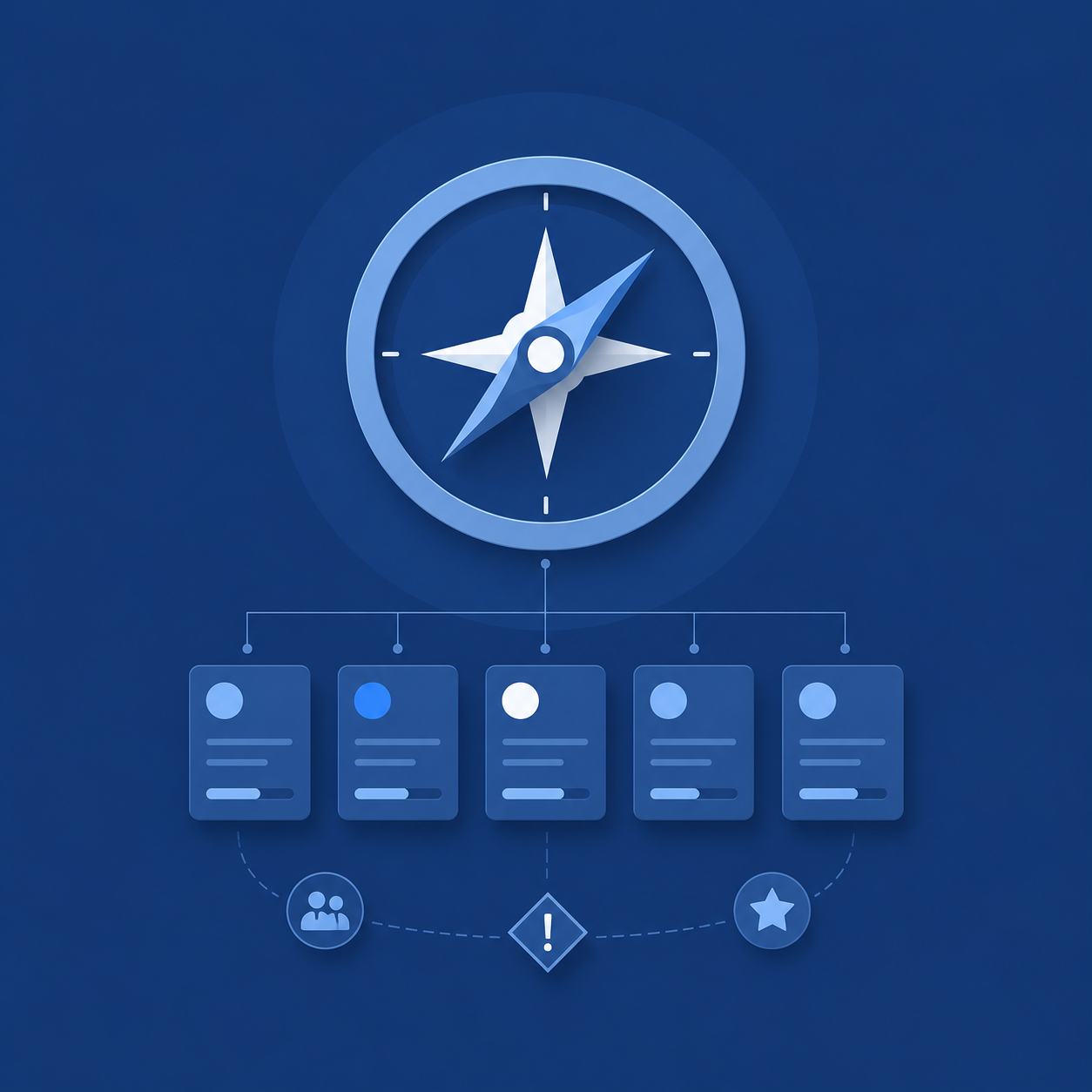
This creates a shared steering model. Project managers know what they are allowed to decide. Sponsors know when they need to be involved. The PMO can ensure data quality. Management receives consistent information.
The greatest benefit does not lie in additional control, but in shorter decision-making paths. When information is available centrally and decision-making rights are clear, decisions do not have to be reconstructed from scratch in every meeting.
Project governance is therefore particularly effective where many stakeholders, parallel initiatives, and limited resources come together.
Agile projects and governance are often seen as opposites. This is a misunderstanding.
Agility does not mean that there is no accountability, no priorities, and no decision-making rules. Agile projects in particular need clear guardrails so that teams can work in a self-organized way without losing sight of strategic goals.
| Project governance answers the following questions in agile environments |
|---|
|
Who prioritizes at the portfolio level?
|
|
Who is responsible for the budget and business case?
|
|
Which goals apply to agile teams?
|
|
How are dependencies between teams managed?
|
|
When are strategic conflicts of objectives escalated?
|
|
How are risks made transparent?
|
|
What reporting information does management need?
|
In Scrum, roles such as Product Owner, Scrum Master, and development team are clearly defined. However, these roles primarily govern operational collaboration. Governance adds the higher-level perspective: budget, strategy, portfolio, prioritization, and escalation.
In scaled agile environments, this need becomes even more apparent. Frameworks such as SAFe® therefore work with Lean Portfolio Management, budget governance, strategic epics, and clear decision-making rights.
Teams are given room to act when it comes to implementation. The organization defines goals, budgets, priorities, and escalation paths.
Governance is therefore not a contradiction to agility. It is the prerequisite for ensuring that agile work remains strategically effective. Without governance, typical problems also arise in agile organizations:
| Challenges Without Cross-Portfolio Steering |
|---|
|
Teams optimize locally instead of across the organization.
|
|
Strategic conflicts of objectives remain unresolved.
|
|
Resources are planned multiple times.
|
|
Portfolio priorities are unclear.
|
|
Management decisions come too late.
|
Project governance is not created by an org chart. It is created through clear mandates, binding decision-making paths, consistent data, and accountability that is actively practiced.
The following steps help build an effective governance framework.
Do not start with tools or templates. Start with today’s problems.
This analysis shows which governance problems actually need to be solved. An organization with an unclear sponsor role needs different measures than a company with too many committees or poor data quality.
Define key governance roles and their decision-making authority.
The sponsor role is especially important. It should not only be formally named, but actively enabled.
Determine which decisions are made at which level.
Also define tolerances for budget, timelines, resources, and scope. This helps you avoid unnecessary escalations and creates clear room for action.
Consistently revise your reporting from a governance perspective.
A good governance report is not as extensive as possible. It is decision-oriented.
Project governance is not a static model. Organizations change, projects become more complex, and new requirements emerge.
That is why governance should be reviewed regularly.
Possible Questions for a Governance ReviewAn annual governance review or a structured lessons learned evaluation after major projects helps keep the governance framework up to date.

Throughout all steps, make sure to take your organizational culture into account.
In highly hierarchical companies, decision-making processes often need to be simplified.
In very informal structures, roles need more formal accountability.
In agile organizations, governance should be communicated as guardrails, not as a control mechanism.
Project governance is not an end in itself. It should make your organization more capable of making decisions, not more complex. If governance does not fit the culture, it will be perceived as a burden. If it fits the organization, it becomes an enabler.
Answer the following questions. The more questions you answer with “Yes,” the more stable your governance framework is.
If many answers remain open, the need for action is often not in the individual project, but in the governance structure.
Project governance needs clear roles, binding decision paths, and reliable data. Without current information on status, budget, resources, risks, and dependencies, sponsors, the PMO, steering committees, and executive leadership can hardly make well-founded decisions.
In many organizations, this is exactly where the problem lies: the governance structure formally exists, but the information foundation is weak. Project information is spread across Excel files, emails, presentations, and standalone systems. Status reports are created manually, budget data and project status are not synchronized, resource bottlenecks are identified too late, and risks are assessed inconsistently. As a result, governance becomes reactive. Committees first discuss data quality and whether the information is up to date instead of focusing on priorities, risks, and the decisions that need to be made.
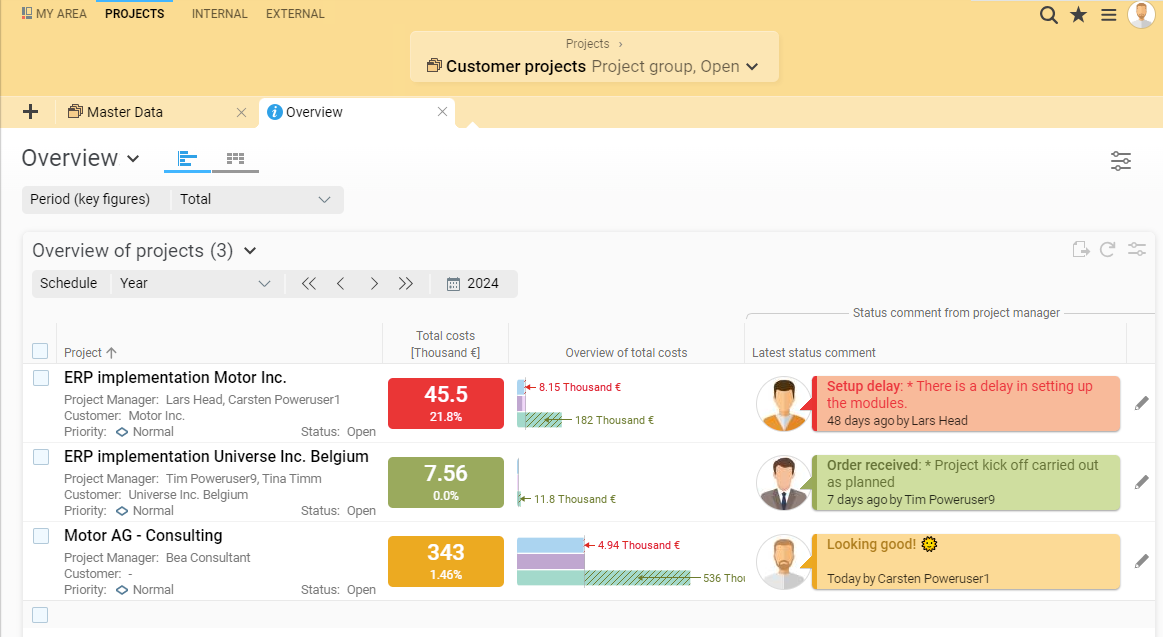
Project management, ERP, and business coordination software supports project governance by centrally consolidating project information, making it possible to evaluate it in a standardized way, and providing it by role. Project managers maintain operational data, the PMO reviews standards and data quality, business units see resources and priorities, steering committees receive decision-relevant status information, and executive leadership gets portfolio overviews and management KPIs.
BCS from Projektron addresses exactly these points. The software combines project management, resource planning, controlling, reporting, portfolio management, multi-project management, and ERP functions in one system. This creates a shared data foundation for project managers, the PMO, business units, steering committees, and management.
Project progress, effort, costs, milestones, resources, risks, and status information come together in one system.
Reports, dashboards, and planned vs. actual comparisons are based on current project data and support decisions instead of manual report maintenance.
Bottlenecks become visible across projects, so priorities can be set based on actual capacities.
Projects can be viewed and compared by status, priority, cost, effort, progress, or strategic relevance.
Effort, costs, budgets, quotes, invoices, and controlling information can be linked to project status.
Different ways of working can be mapped in a shared environment while reporting and management information remain comparable.
Project governance is not an additional bureaucratic tool. It is the framework that makes projects capable of moving decisions forward. It clarifies who carries responsibility, which decisions are made at which level, when escalation is required, and how projects remain connected to strategic goals. In doing so, governance prevents exactly the problems that often slow projects down: unclear responsibilities, late escalations, conflicting information, and missing management decisions.
The greatest value is created when governance is not only formally described, but actively practiced in everyday work. This requires clear roles, binding decision paths, focused reporting, and an up-to-date data foundation. Especially in complex project environments, software becomes a critical enabler. Integrated solutions like BCS help make project, resource, budget, and portfolio information centrally available. This allows the PMO, sponsor, steering committee, and executive leadership to make decisions based on consistent data.
Good project governance therefore does not make projects slower. It reduces uncertainty, shortens decision paths, and ensures that projects consistently contribute to the right goals.
Project governance is the framework of roles, decision-making rights, processes, reporting, and escalation paths that defines how projects are managed and monitored. It ensures that projects remain aligned with strategy, transparent, and capable of moving decisions forward.
Project management handles the operational execution of a project, including tasks, timelines, resources, and deliverables. Project governance defines the overarching decision-making and accountability framework within which project management operates.
Project governance is important because it creates clear responsibilities, binding decision paths, and strategic alignment. Without governance, decision bottlenecks, unclear escalations, conflicting priorities, and inefficient resource use often arise.
Project governance is worth it as soon as projects are strategically important, cross-functional, budget-relevant, or risk-prone. For small, manageable individual projects, lean governance with clear roles, decision-making rights, and simple status rules is often enough.
Project governance is especially important for companies with many parallel projects, complex customer projects, regulatory requirements, limited resources, or an active PMO. IT, ERP, transformation, digitalization, and portfolio projects also benefit greatly from it.
Typical roles in project governance include the sponsor or project owner, project manager, steering committee, PMO, and, where applicable, portfolio owners. What matters is that each role has clear mandates and decision-making authority.
Project governance becomes bureaucracy when it slows down decisions instead of making them easier. Typical causes include too many committees, unclear mandates, overloaded reporting, micromanagement, and a lack of decision-making authority.
Yes. Agile projects also need clear decision-making rights, budget responsibility, strategic priorities, and escalation paths. Agile governance creates guardrails within which teams can work in a self-organized way.
Project governance should be introduced step by step: analyze the current situation, clarify roles and mandates, define decision paths, align reporting with decisions, and review the governance framework regularly.

Kai Sulkowski is an editor in the marketing department at Projektron. He combines marketing, SEO, and digital communication with subject-matter expertise in project management and creates content on project management, project governance, PMO structures, project portfolio management, resource management, and organizational steering. In his articles, he explains complex topics related to decision-making structures, software selection, evaluation methods, and the implementation of enterprise software in a clear and accessible way.

How PMO software makes projects, resources, and portfolios transparent, standardizes reporting, and puts governance decisions on a reliable data foundation.
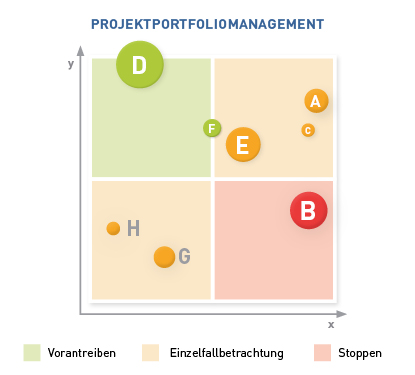
What is project portfolio management, why is it important for strategic steering, and how can projects be prioritized, evaluated, and managed across the portfolio?

Resources are often the bottleneck in project portfolios. The article shows how resource planning works and how bottlenecks become visible early.

Functional, staff, matrix, or autonomous project organization: Which organizational form fits which projects, and how are roles and responsibilities clarified?

Project governance connects roles, decision-making processes, strategic goals, risk control and reporting into a clear framework for successful project oversight.