Blog
News from Projektron
In our blog, you can regularly read new technical articles and find out what's new and exciting in the world of project management.

ZUGFeRD Format: Definition, Benefits, and How to Create One
18. June 2026
The ZUGFeRD format combines a readable PDF invoice with structured XML data. It is especially relevant for e-invoicing in Germany and is widely used in B2B invoice processes, where companies need both a familiar invoice view and machine-readable data for automated processing. Depending on the requirements of the invoice recipient, portal, or platform, ZUGFeRD can also be relevant for B2G scenarios. Learn more about its benefits, how it differs from XRechnung, and the continued development of ZUGFeRD 2.5.

XRechnung: A Milestone in Invoicing?
18. June 2026
XRechnung, Germany’s standard for electronic invoices issued to public-sector clients, has long been mandatory for suppliers and service providers working with the public sector. Since November 27, 2020, incoming invoices have only been accepted in electronic invoice format. This means that paper invoices and PDF invoices are accepted only in exceptional cases. The introduction of XRechnung was certainly a milestone — but was it a step forward or a step back?

Choosing an ERP System for Service Providers: A Guide to Comparison, Testing, and Implementation
13. May 2026
Anyone looking to select an ERP system for service providers should not start with checklists or feature tables. For agencies, IT service providers, and consulting firms, it’s not just the range of features that matters, but the integration of project management, resource planning, CRM, time tracking, and billing. This guide shows you how to approach the selection of an ERP system for service providers in a structured way, avoid common pitfalls, and find a solution in 9 steps that truly fits your processes.

Scrum in Software Development: Agile and Structured
30. April 2026
When it comes to agile methods in software development, there’s one term you can’t avoid: Scrum. But what exactly is Scrum, and how does it demonstrate its strengths in software development? What roles and activities are part of Scrum? What are the advantages and disadvantages of this agile framework? You’ll find answers to all of these questions in this article. In addition, we provide insight into our own Scrum model, which we have continuously refined for the development of BCS. In doing so, we use BCS itself as our Scrum software—not only for sprint planning, but also for coordinating requirements, responsibilities, release goals, and processes across multiple teams.

Return on Digital Investment: How to Make the Value of Digitalization Measurable
23. April 2026
Digitalization costs time, budget, energy, and organizational attention. Introducing new software, adapting processes, training employees. And yet, at some point, the questions inevitably arise: What does it actually deliver in the end? Can you prove that it was worth it? This is exactly where the concept of return on digital investment comes in. It describes the measurable value that digital initiatives actually create. Not just in euros, but also in terms of time savings, fewer errors, better planning, and faster decision-making.
IAPM certification: flexible, practical, international – is it worth it?
15. April 2026
Is IAPM certification really worth it – or are PMI, PRINCE2 or IPMA the better choice? Anyone looking to gain certification in project management soon finds themselves faced with precisely this question. But what exactly is the IAPM? The International Association of Project Managers (IAPM) takes a deliberately practical and method-neutral approach. But how does this approach compare to established certifications, and for whom is IAPM particularly worthwhile?
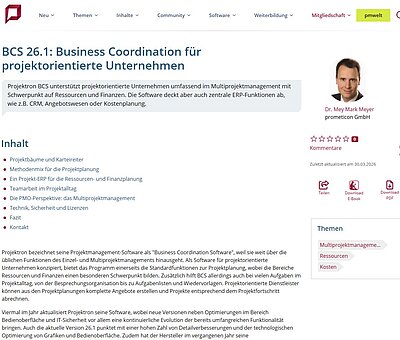
How good is BCS 26.1? The review in projektmagazin
31. March 2026
What remains of BCS when marketing claims are set aside and an experienced technical writer evaluates the software? The latest software review in projektmagazin provides a well-founded answer to exactly that question. In “BCS 26.1: Business Coordination for Project-Oriented Companies,” published on March 30, 2026, Dr. Mey Mark Meyer describes BCS as a solution for multi-project management with a focus on resources, finances, and related ERP functions.