Greater Transparency in the Project Portfolio with BCS
Customer Case Study: KGAL GmbH & Co. KG
At KGAL, we have used BCS to establish a centralized standard for our project and portfolio management. Previously, project information was primarily consolidated via individual status slides and reported to committees. Today, we have a centralized overview of projects, budgets, risks, resources, and dependencies, enabling us to manage them in a significantly more transparent and structured manner. What is particularly valuable to us is that BCS allows the PMO to perform its actual management and governance tasks, and enables executive management to make more informed decisions based on up-to-date project data.
KGAL at a Glance
KGAL is an independent investment and asset manager headquartered in Grünwald near Munich. Since 1968, we have been developing and managing investment solutions with a focus on real estate, sustainable infrastructure, and aviation. We also invest in innovative sectors. We manage approximately 15 billion euros in assets on behalf of our institutional investors.
I work at KGAL as a Senior Project Lead and am responsible for IT and organizational projects. Additionally, I serve as Product Owner for BCS, for project management in general, and for the PMO within KGAL. Organizationally, I am part of the Corporate Organization division. Our department has three main areas of focus: project management, process management, and business continuity management.
Our projects are often cross-functional, typically last one to two years, and address key organizational or IT-related issues. We carry out approximately 25 projects per year. These include mandatory regulatory projects, IT and organizational initiatives, as well as efforts to further develop our business processes.

Why We Needed a PM Tool
Before implementing BCS, we primarily organized our projects using Office 365. Monthly project status reports were prepared using status slides and presented to a committee. This approach generally worked, but it had clear limitations.
We lacked a consistent standard for the project proposal and approval process. Our project management procedures were also inconsistent. There was no binding framework that all project managers could use as a guide. As a result, the level of project management expertise varied widely.
Transparency was particularly challenging. We could not reliably determine at any given time what the current resource situation was, where projects were falling behind, what risks existed, which budgets might be exceeded, or what dependencies existed between projects. Although this information was often available, it was not accessible in a centralized, up-to-date, and comparable manner.
For the PMO, this meant a lot of manual effort. Information had to be collected, consolidated, and prepared for reporting. That’s why it was clear to us: We need a tool that supports our project management processes, enables standards, and helps the PMO better fulfill its steering and governance responsibilities.
The Path to BCS
We conducted a structured search for suitable software through a request for proposals with the support of an external consulting firm. We compared several solutions and created a list of requirements that vendors had to review in advance.
Project and portfolio management, resource management, cost control, and web-based access were particularly important to us. In addition, the solution needed to be flexibly customizable, integrate various project processes, and support cross-departmental collaboration.
We became aware of BCS because our Corporate Organization management team was already familiar with Projektron from an event and included the solution in the request for proposals.
In the end, BCS convinced us both technically and economically. BCS met our requirements very well and was also competitively priced compared to other competitors. Another important factor was that Projektron focuses on exactly one product and brings many years of experience in the field of project management software.
Rollout with a Pilot Phase
We deliberately chose to roll out BCS in stages rather than opting for a “big bang” approach. Including the pilot phase, we went live after just under twelve months. This approach was important to us because we didn’t just want to implement a tool; we also wanted to refine our project management processes at the same time.
During the six-month pilot phase, we tested small and medium-sized projects across various categories in BCS. This allowed us to identify early on which settings worked well, where processes still needed refinement, and what questions arose among users.
Interface development posed a particular challenge. Importing organizational units, employees, cost centers, absences, and work time models took significantly longer than planned. It took us about six months to get these interfaces running smoothly. A solid data foundation is crucial, especially for areas like resource management.
Today, nearly 60 employees use BCS. Among those involved are IT, the Real Estate asset class as a pilot area, HR, and Marketing.
For the rollout, we conducted training tailored to specific target groups: for executive management, managers, project managers, and project team members. We then offered consultation hours to address questions directly and support day-to-day use.
BCS in Our Day-to-Day Work
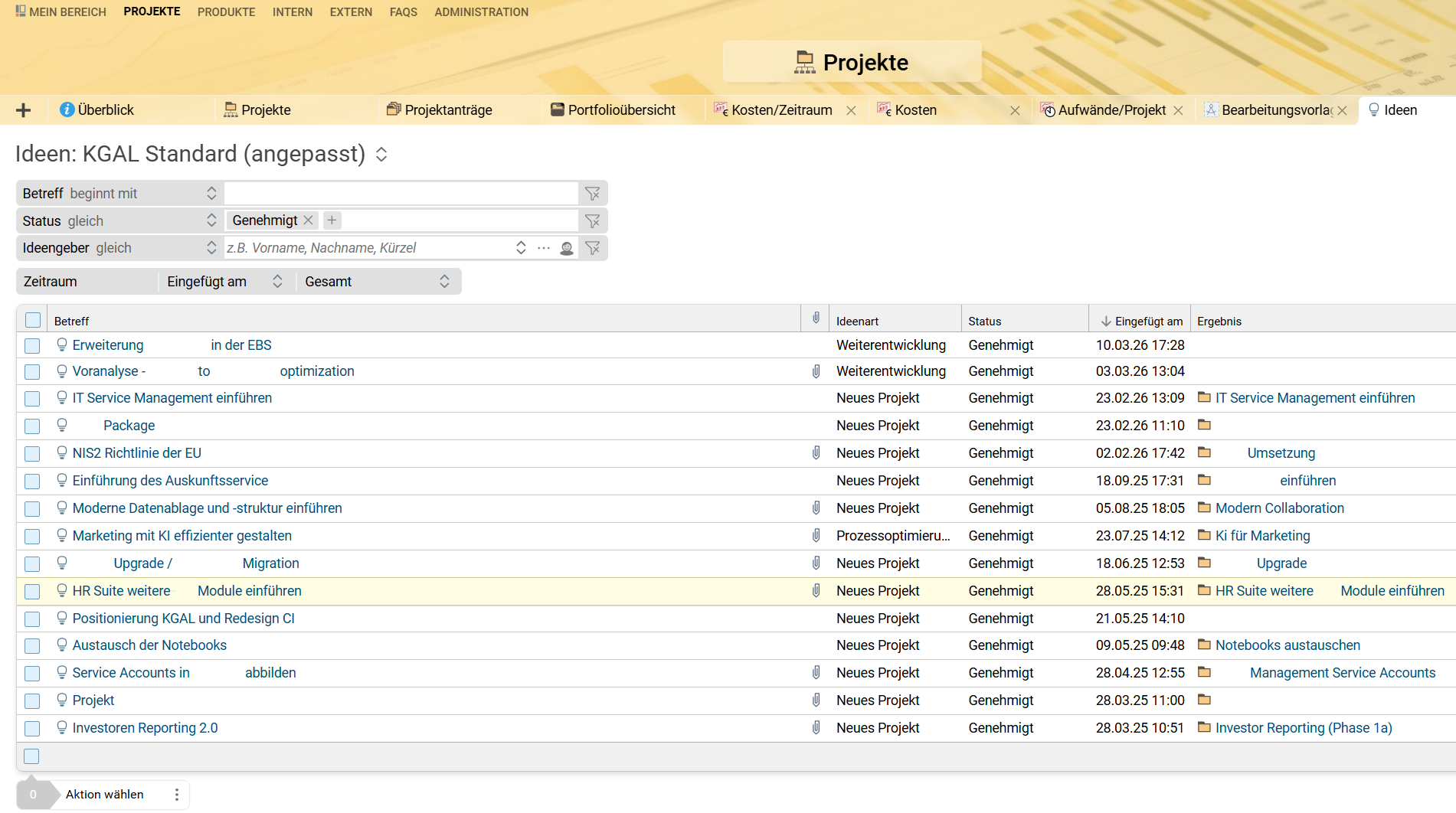
Today, we use BCS in several key areas. One important component is our idea management system, which we have implemented in BCS as a project proposal process. Through this process, new project ideas are submitted in a structured manner, evaluated, and can then be converted into approved projects. This has significantly improved the quality of the project approval process and sped it up.
We also plan and manage projects, programs, and further developments at BCS. For both small and large projects, we have developed custom tools that guide project managers through the planning and management process. This ensures that all key metrics for each project are recorded and regularly reviewed. This includes, for example, objectives, deadlines, budgets, risks, resources, and responsibilities.
The PMO also conducts regular quality checks as part of its monthly reporting. This allows us to identify not only deviations in individual projects but also training needs among project managers.
For employees, the personal overview is an important starting point. This is where they check their tasks and tickets on a daily basis. Project managers document important decisions in the meeting minutes and actively use BCS in steering committees. We have also created a dedicated wizard for this purpose.
The PMO and representatives from the business units also use BCS in committees to decide whether an idea will become an approved project or how projects should be prioritized. Once a quarter, we report on our project portfolios to senior management.
Manage projects and portfolios centrally
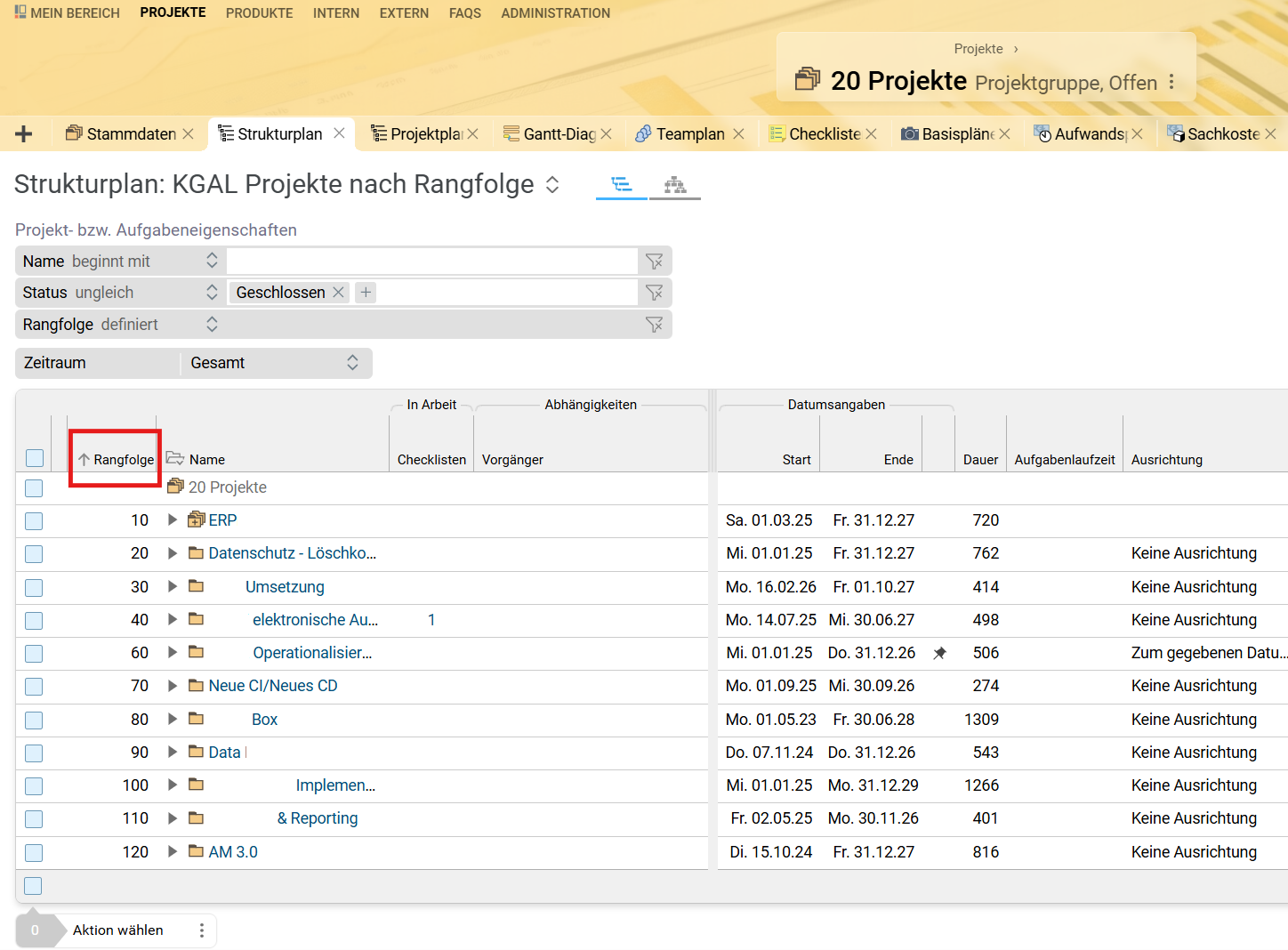
A particularly defining moment was our first executive meeting, during which we reported on the project portfolios exclusively using BCS, without any additional slides. The executive team even extended the allotted time slot because so many questions were asked that we were able to answer very effectively directly from within BCS.
For us, this was clear proof of the added value that transparency and up-to-date data create in portfolio management.
BCS supports our project management processes and ensures transparency regarding project status, budgets, potential overruns, delays, and resource bottlenecks. At the same time, the tool helps us make project dependencies more visible and manage projects more consistently.
All project managers now work according to a defined standard in BCS. This ensures comparability and traceability. At the same time, there remains enough flexibility to accommodate different project sizes and types.
Greater transparency, less effort
Before the system was implemented, a great deal of information had to be manually collected, consolidated, and entered into status reports. Today, about 90 percent of these manual tasks have been eliminated. That’s a huge relief.
At the same time, we have a much better overview of our strategic projects and their “health.” We can see more quickly whether projects are on track, whether budgets might be exceeded, whether delays are occurring, or whether resources are overloaded.
For the PMO, BCS is a decisive step forward. Only with the support of the software can we properly fulfill our actual management and governance responsibilities. We no longer have to focus primarily on gathering information and updating slides; instead, we can concentrate more on quality, standards, prioritization, and portfolio management.
We currently still handle a few topics, such as lessons learned, outside of BCS.
Improve collaboration
Our projects span multiple departments. That’s why it’s important for information to be centrally available and for everyone involved to be working from the same foundation. BCS significantly supports this collaboration.
When different teams are involved in a project, BCS helps us consolidate tasks, tickets, decisions, risks, and deadlines in one place. This reduces coordination efforts and creates clarity.
In IT, we also work with numerous service providers. There, too, a clear project structure is important so that internal and external stakeholders share a common understanding of status, tasks, and responsibilities.
Better Resource Management
Resource management is a key priority for us, but it is still in its infancy. We are already seeing the benefits, as resource bottlenecks are identified earlier.
At the same time, the topic is complex. We’re still finding the right balance: It needs to be detailed enough to be useful for management, but it can’t get so granular that the maintenance effort increases disproportionately.
That’s exactly why it’s helpful that BCS gives us the opportunity to proceed step by step and further develop its use together with the organization.
Changes in Day-to-Day Project Work
The introduction of BCS was a major adjustment for many project managers. Previously, there was no centralized project management tool. Now, project data must be updated regularly and standards must be followed.
This is perceived differently by different people. Some still view the new transparency as a form of control and see BCS primarily as a reporting tool. The majority, however, has a very positive attitude and is gradually discovering new ways to organize themselves better—for example, using the Kanban board or project tickets.
We view this as a normal change process. Introducing a project management tool doesn’t just mean providing software. It also means clearly defining roles, processes, responsibilities, and expectations.
What’s Working Better Today
Today, our project proposal process is significantly higher in quality. Ideas are described, reviewed, and decided upon in a more structured manner. The approval process has become faster. Processes, responsibilities, and decision-making authority are clearer.

Management is also becoming more deeply involved in strategic portfolio management. BCS makes interdependencies more visible: Which projects are running in parallel? Which resources are tied up? Which initiatives are particularly critical? Which projects contribute to strategic goals?
A concrete example of the benefits was the implementation of BCS itself. We used BCS directly for our own implementation project. This allowed us to identify very early on where the system supports us and where we still needed to refine our processes.
Furthermore, through our quality loops in BCS, we can specifically identify training needs among individual project managers and respond with appropriate offerings.
Our Conclusion
Overall, we are very satisfied with BCS. The biggest advantage for us is that we have everything in one tool at a glance. BCS helps us manage projects in a consistent, traceable, and transparent manner.
Customizations are possible, though our approach is to stick to the standard as much as possible.
We find Projektron’s consulting services to be very good. We hardly use the training offerings anymore because we onboard new employees internally and set up projects together with them. When it comes to support, the experience depends more on the specific issue and the person handling it; we see room for improvement here.
We would like the user interface to be a bit more intuitive in some areas. Those who don’t use BCS daily regularly come back with similar questions. At the same time, we see that many users are gradually discovering additional features and are increasingly making active use of the tool.
We would definitely recommend BCS.
Further Expansion
We plan to continue expanding our use of BCS. If the two pilot projects in the real estate asset class are successful, we could eventually map additional construction projects and our product development for new funds in BCS.
We are also exploring whether to make greater use of time tracking in BCS in the future. Another possible step is to implement an additional interface to import material costs and further improve project controlling.
Our most important recommendation to other organizations is: don’t start with a big bang. A phased rollout, a clear pilot phase, and a strong focus on processes are crucial. The tool alone does not solve project management problems.
In our view, a PMO is a key success factor in this process. It ensures that standards are followed, questions are addressed, and the organization learns step by step to manage its project portfolio more professionally.