10/17/2025 - Articles
Leadership in change processes – how behavior in companies is changing and what managers need to know
In a world where crises, upheavals, and uncertainty have become the new normal, traditional leadership tools are no longer sufficient. Routines are breaking down, conflicts are increasing—and suddenly it is no longer the best process that determines success or failure, but people's behavior. This article shows why managers today need to lead differently, what role adaptability and resilience play in this, and how models such as DiSC® can provide guidance without becoming pigeonholed.
Contents
Crises, routines, conflicts: Why leadership needs new answers
Crises, upheavals, and constant change are part of everyday life, pressure is increasing, and individual conflicts are becoming a regular occurrence. More and more often, those involved feel abandoned by the routines they have established in business and interpersonal relationships, which until recently were reliable. Processes that used to benefit a company in certain situations suddenly no longer work. Conflicts in companies are on the rise.
This reflects the realization that stability no longer comes so much from rigid structures, but rather from
adaptability
resilience
conscious interaction with one another
More and more people are recognizing that it is not strategies or processes alone that determine success or failure, but above all the behavior of the people in the company. It determines whether cooperation succeeds or whether stress and distance block interaction.

I have been preoccupied with this topic for a long time, for three main reasons.
- Firstly, in my own business activities, I have found that it is only by clarifying how the other person ticks that a truly connecting conversation and a truly effective conflict resolution become possible.
- Secondly, I have noticed that many people in their everyday lives or in crises and conflicts are unable to make progress with the usual means: The “standard measures” do not work, and in the worst case, you become increasingly entangled in stress and failure.
- Thirdly, as a trainer, consultant, and coach, it is important to me to be able to provide people in companies with models and concrete instructions that do exactly what they need: to clarify their problems, which they cannot solve on their own and which they would continue to carry with them without professional help.
In this article, I share my view on why people's behavior is a key issue today, what role the DiSC® model can play—and where its limitations lie.
Leadership in change processes as a key issue in the world of work
I sense that the world of work has changed in almost all of the projects I am involved in. Global crises, technological leaps, and economic uncertainties make reliability the exception. What worked yesterday may already be obsolete today. Even stable processes are stalling, and traditional recipes for success are showing cracks.
For me, this means that control and planning alone are no longer enough. What is needed is the ability to respond flexibly to the unexpected and guide people through uncertainties. Adaptability and resilience are no longer just buzzwords, but survival factors – for companies as well as for teams and managers. And at the heart of it all: people with their behavior, their habits, but also their ability to learn new things and adapt.
Whether a team emerges stronger from a crisis or falls apart depends less on tools and strategies and more on the relationships within the team:
Is there trust?
Are conflicts resolved constructively?
Does everyone take responsibility?
Or do uncertainty and stress block cooperation?
When I look at my own team, I ask myself:
What happens when routines break down?
Do we retreat and make ourselves comfortable on our “islands”?
Or do we manage to explore new paths together and reach new islands?
For me, this is precisely the crux of the matter: behavior has become the decisive factor. And that is why it is worthwhile to take a critical look at tools such as DISC® and comparable models—not as magic formulas, but as possible aids for promoting resilience and revealing behavior patterns.

“It's not tools that matter, but behavior.”
Why leadership needs to realign itself in change processes
My recent experiences show me that leadership today almost always takes place in the context of upheaval. Whether it's the pandemic, difficulties in recruiting personnel and supply chain issues, or digital transformation – radical change is now the norm for companies. Routines that used to provide stability and orientation are losing their significance.
New expectations of managers
The consequence for managers is that today, more than ever before, they are expected to cultivate relationships and tolerate contradictions. They are also expected not to be guided by patterns that have become meaningless.
Agile methods, new work, and value-based leadership are not temporary fads, but responses to the experiences of the present: we need to rethink the language of leadership. Instead of wanting to decide everything ourselves, it is now more important to empower people so that they can take responsibility for decisions and remain capable of acting in unusual situations.
This also challenges me in my own environment:
Understanding people when they are under pressure
Demonstrating my own values when the numbers are down
Making diversity effective when differences lead to crisis
I cannot do all this if I rely on a bag of tricks. It requires me not only to apply methods, but also to question them myself and keep options for action open.
Practical questions about leadership in change processes
When I work with teams or managers, the same questions come up again and again:

How can I better understand my team during the crisis?
How can I prevent escalations when tensions are running high?
How does my leadership style come across, especially in uncertain times?
What impresses me is that these questions arise not primarily from a need for efficiency, but from a genuine concern for cohesion. In times when routines are constantly being disrupted, companies are looking for ways to create stability.
And this is precisely where a model like DiSC® becomes interesting: it promises to make behavior tangible and describe differences in a comprehensible way.
The DiSC® model as a tool for leadership in change processes
The DiSC® model – at first glance, it may sound like the latest trend in coaching, but it is actually based on a very practical methodology. It was developed in the 1920s by William Moulton Marston, a man of many talents. He wanted to know: How do people react to challenges? Instead of getting lost in psychological depths, he focused on what matters in everyday business life – visible behavior.
The model divides behavior into four basic styles: Dominance (D), Initiative (i), Steadiness (S), and Conscientiousness (C). Each style represents certain preferences and approaches.
D = Dominant
Direct, decisive, results-oriented
Priorities in behavioral style: Results, challenges, action
i = initiative
Optimistic, communicative, enthusiastic
Priorities in behavioral style: Enthusiasm, cooperation, action
S = Steady
Empathetic, loyal, team-oriented
Priorities in behavioral style: Support, cooperation, stability
C = Conscientious
Careful, systematic, fact-oriented
Priorities in behavioral style: Accuracy, quality, stability
Important to note:
No one fits 100% into just one category. Most of us are somewhere in between—sometimes assertive, sometimes more analytical, depending on what the situation requires. The division into four basic styles is deliberately kept simple—and therefore very helpful in uncertain times.
DISC is not a tool for personality analysis, but rather an orientation system. It helps to better classify behavior and thus creates a common basis for communication within the company. This can be extremely helpful, especially in teams where different personalities come together. When familiar processes break down, points of reference that team members can use to guide themselves are enormously helpful.

Where does the DiSC® model bring real added value?
Firstly, it provides greater clarity regarding one's own strengths and areas for development.
Secondly, communication within the team runs more smoothly because different response patterns are understood and respected.
Thirdly, the model brings structure to the diversity of human behavior without oversimplifying it.
Last but not least, differences between employees or situations can be described more objectively.
In short, the DiSC® model provides a compact, understandable framework that creates orientation and comparability—a real advantage in everyday business life, without falling into stereotypical thinking.
DiSC® model: practical example
In a situation where I, as a manager, fell heavily into my “D role” – i.e., I acted quickly, directly, and in a decision-oriented manner – I later received feedback from a team member that my behavior seemed overwhelming, especially to someone with a strong orientation toward consistency. It was only through the perspective of the DiSC® model that I realized I needed to adjust my communication style. Not to pretend to be someone else, but to remain capable of acting even in a situation characterized by uncertainty.

“Essentially, I see DiSC® as a tool for self-reflection. It provides a language for structuring behavior in a world that often seems chaotic.”
Opportunities and risks of the DiSC® model for leadership in change processes
At the same time, I know that in times of crisis, the temptation to seek simple answers is great. The power of DiSC® can be a breeding ground for this illusion. But people are not four letters. And they behave completely differently depending on the situation. That's why I don't see the model as a diagnostic tool, but as a starting point for conversation. Especially when processes are faltering, it is important not to cement differences, but to view them flexibly. DiSC® can show me where my patterns lie – but it must never become a pigeonhole into which others are placed. I find DiSC® most valuable when it is embedded in feedback, coaching, and value-oriented leadership. In this way, it becomes part of a resilience strategy—an attitude that uses differences instead of smoothing them over.
DiSC® workshops at Projektron
This year, I had the opportunity to accompany six active DiSC® workshops with reflection prompts at Projektron—and the response was overwhelmingly positive. It was particularly exciting for me to see how quickly the participants were able to relate the theory to their everyday work. Exercises, reflection rounds, and practical examples clearly demonstrated how helpful the model is for open and constructive collaboration.
Further workshops are planned for the coming months, including special formats that specifically address the needs of managers at Projektron. This is because, especially in everyday management, it is crucial to be able to consciously control one's own behavior and adapt communication to different personality styles.
Conclusion: Leadership in change processes requires reflection rather than routines
If we have learned one thing from crises, it is that stability no longer comes from routines, but from the ability to adapt. For me personally, this means that behavior is the lever that leadership must use. DiSC® can be a useful tool here—as long as I understand it not as a label, but as an invitation to self-reflection. Ultimately, the crucial question for me is: How do I come across to others in uncertain times—and what can I do to lead my team through change in a way that strengthens them?
Copyright Everything DiSC®/DiSC® Wiley&Sons

About the author
André Türpe is the managing director of projecDo GmbH and an expert in agile organizational development. For many years, he has been helping managers and teams to remain capable of acting in complex change situations and to build resilience. His focus is on developing leadership skills, facilitating transformation processes, and introducing modern working and project methods. With practical reflection prompts and a broad repertoire of methods, he supports companies in recognizing new perspectives and implementing them sustainably.
More interesting articles on the Projektron blog

Project communication
One of the main reasons for project failure is a lack of project communication - according to a PMI study, communication management in a project is just as important as an accurate cost estimate, a clear definition of project goals and a thorough risk analysis. 3 practical tips for your project communication!
Choosing PM software
If your SME or company is about to choose project management software, you probably don't know where to start looking for the right PM tool for you. This guide will guide you through the PM software market and lead you to the right decision in 9 steps.
Eisenhower matrix
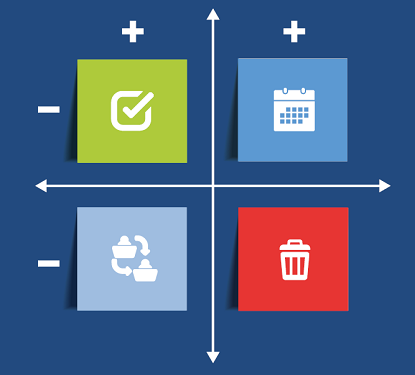
Less stress, less chaos, more time, more success, more structure, more effective work. All this is what the Eisenhower principle stands for. Find out how the productivity method works, what advantages and disadvantages it offers and start using it straight away with our free Eisenhower matrix template.

7 advantages of PM software
From better Excel spreadsheets to comprehensive business coordination software: what advantages does project management software offer and for whom is it worth buying a PM tool? We provide 7 good reasons why your company will benefit from project management software.

The lighthouse symbolizes leadership in turbulent times: it radiates the four colors of the DiSC® model and provides orientation in change processes.