06/25/2026 - Network
Flexus AG manages project costing, resource planning, and invoicing with BCS
How can a project-based service business be managed so that costing, quotes, time tracking, project controlling, and invoicing do not run in separate systems? The new Flexus AG case study shows how BCS has become the central platform for project, service, and billing processes at the SAP intralogistics specialist.
It is not just about project planning, time tracking, or invoicing. It is about how a growing IT services and software company structures its internal value creation in such a way that many different service, contract, and billing models remain manageable. Flexus describes in very concrete terms how BCS is used as an ERP system for a project-based service business — from initial costing to invoicing.
A case study about more than project management
Many companies start using BCS because they want to improve their project planning, record time more accurately, or prepare invoices in a more structured way. At Flexus, the use of BCS goes much further.
Today, the company uses BCS as a central platform for master data, project structures, costing, quote creation, project management, resource planning, time tracking, expense management, invoicing, and DATEV preparation. This makes the case study a best-practice example for all companies that do not want to view project management, ERP functions, and commercial control as separate areas.
Flexus has been on the market since 1995 and has developed from a consulting company into a product manufacturer, license vendor, and consulting firm for SAP intralogistics. The company supports customers along the entire material flow. This includes yard management, deliveries, goods receipt, warehousing, production logistics, picking, loading, and shipping.
This breadth of expertise is also reflected internally. Flexus does not work with a simple standard project model, but with many different types of services: time-and-materials projects, fixed-price projects with milestones, change requests, support and maintenance, subscriptions, internal product development, and internal organizational projects.
Why Flexus rethought its system landscape
In the case study, Stefan Popp, Managing Director of Flexus AG, describes an initial situation that many service providers are familiar with. Over the years, an internal system landscape had emerged that basically worked, but required more and more coordination.
Flexus had developed its own solutions, including tools for time tracking and other internal processes. In addition, there were systems and repositories such as SharePoint, Teams, Outlook, Word templates, OneNote, Planner, Zammad, Jira, Git, HubSpot, and DATEV.
Each of these tools served its purpose. The problem was not that individual systems were poor. The problem lay in the transitions. Media discontinuities emerged between sales, project management, service delivery, and invoicing. Information had to be transferred, checked, supplemented, or reconciled again.
For a company that develops software itself and implements customer projects, this has an additional dimension: every internal custom development ties up capacity. Development time spent on internal tools is not available for customer projects and product development.
The case study therefore also highlights a strategic decision: Flexus did not want to build any new custom developments for internal processes. Instead, where it makes sense, processes should be aligned more closely with the BCS standard.
This approach makes the report particularly interesting for management teams and operations managers. It is not just about selecting software. It is about the question of how much individuality internal processes really need — and where an established standard provides the better foundation in the long term.
The central topic: a shared data foundation
One of the strongest ideas in the case study is the shared data foundation. Flexus clearly describes that the true value of BCS does not lie in a single function, but in the connection of processes.

With BCS, we have placed our project, service, and billing processes on a shared data foundation — from costing and quote creation to time tracking and invoicing.
Stefan Popp, Managing Director, Flexus AG
This quote gets to the heart of the case study: Flexus no longer wanted to organize costing, quote creation, project execution, and invoicing as separate process islands. Instead, sales, project management, and invoicing were to work on the same data foundation — with shared master data, project structures, orders, and bookings.
The case study shows how Flexus puts this approach into practice with BCS. A costing becomes a quote, the quote becomes an order, the order becomes a project, and the recorded services create a prepared basis for invoicing. These are exactly the handoffs where many companies experience friction: through Word and Excel templates, duplicate data entry, separate systems, or a lack of transparency between the specialist department, sales, project management, and invoicing.
One system for different business models
One particularly interesting aspect is the process diversity at Flexus. In BCS, the company does not map just a single project model, but seven different process types: time-and-materials projects, fixed-price projects with milestones, change requests, support and maintenance, subscriptions, internal development, and internal organizational projects.
This makes the report a very clear example of what modern project-based service business means today: companies need to manage time-and-materials work, fixed prices, recurring services, support, product development, and internal control in parallel. That makes the report especially relevant for IT service providers, consulting firms, software companies, and engineering service providers — particularly when project business, product business, and commercial processes are becoming increasingly interconnected.
Why invoicing starts earlier
A central topic of the report is invoicing. At Flexus, invoicing was one of the most important reasons for introducing BCS. This is where it becomes clear whether the upstream processes are working: Is customer data up to date? Are hourly rates and function rates correct? Have services, expenses, milestones, and recurring billings been fully recorded? Flexus bills a wide range of services — from time-and-materials services to fixed-price projects, licenses, maintenance, and support, as well as subscriptions, tickets, travel expenses, and surcharges. The case study shows how BCS helps prepare this variety in a more structured way and manage commercial processes more transparently.
Resource planning, controlling, and better decisions
Resource planning and project controlling also play an important role. Flexus uses the utilization forecast to assign employees, departments, and placeholders to projects and to identify early on how capacities are developing. Especially for long-term projects, fixed-price projects, and internal product development, it becomes clear how closely resource planning, time tracking, profitability, and billing are connected. As a result, BCS becomes not only an operational platform, but also a basis for better day-to-day decisions.
Who should read the report
The case study is particularly interesting for companies that work on a project basis and want to connect their processes more closely. Management teams gain a strategic perspective on internal value creation and standardization. Commercial managers see how project billing, DATEV preparation, expenses, function rates, and recurring services can work together. Project managers, PMO leaders, and operations teams gain insight into project structures, templates, time tracking, resource planning, and controlling.
The report is aimed at all organizations that have to deal with growing project volumes, diverse billing models, increasing transparency requirements, and evolved system landscapes. It is a strong example of how BCS can be used in a demanding, established corporate environment. It does not show the introduction of a single function, but the reorganization of an entire process chain — from project costing to invoicing.
Read the full case study now and learn how Flexus uses BCS to connect project costing, quote creation, time tracking, resource planning, project controlling, invoicing, and DATEV preparation on a shared data foundation.
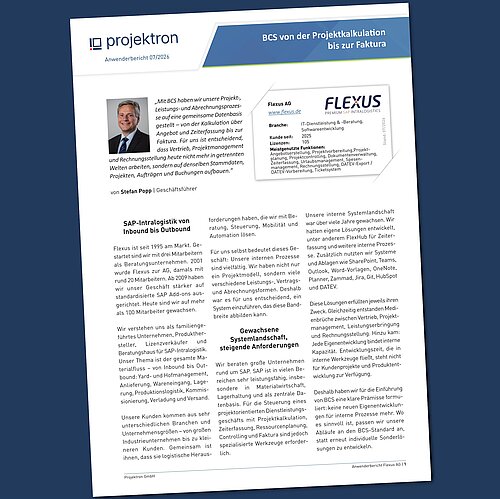
Cover page of the Flexus AG case study: The report shows how Flexus uses BCS as a central platform for project costing, quote creation, time tracking, project management, and invoicing.