08/26/2026 - Network
Digital Project Lifecycle in Public Administration
Many administrative processes are digital today, yet media and system discontinuities still occur between the project idea, proposal, approval, planning, resource management, controlling, and project completion. In his latest article on the “Verwaltung der Zukunft” (VdZ) blog, Projektron editor Kai Sulkowski explains why only a shared data basis can turn individual digital work steps into a seamless digital project lifecycle.
Digital Does Not Yet Mean End-to-End Digital
A project proposal is submitted digitally, approval is coordinated by email, planning takes place in a project management solution, and resources are managed separately in spreadsheets. Status reports and project completion documentation are also frequently created in additional applications.
Each individual step is digital. Nevertheless, information repeatedly has to be transferred, re-entered, or consolidated between the different phases.
This is precisely where the latest VdZ article comes in. The decisive question is not which tool is used for an individual project phase, but how information can be retained and reused throughout the entire project lifecycle.
Every transition between applications and data sets increases effort and introduces risks.
- Information may be entered multiple times.
- Data in different systems can diverge.
- Decisions and the assumptions on which they were originally based can become difficult to trace later on.
- Reports often have to be compiled from several different sources.
End-to-end digital project management therefore primarily means connecting the individual phases at the information level.
The Project Proposal Becomes the Basis for Subsequent Management
The project lifecycle does not begin with the project plan, tasks, and deadlines. Important information is already generated during project preparation, including objectives and expected benefits, responsibilities, required resources, risks, dependencies, and initial budget assumptions.
If this information is captured systematically in the project proposal, it can be incorporated directly into subsequent planning once the project has been approved.
The proposal thus evolves from a mere approval document into an integral part of project management. The initial situation and the subsequent course of the project remain connected. If deadlines shift, effort increases, or requirements change, it becomes possible to trace how the project has developed compared with its original plan.
The same principle applies through to project completion. If progress, decisions, effort, and key figures are continuously maintained during project execution, they do not have to be reconstructed retrospectively from documents, spreadsheets, and emails for the final project report.
Connecting Project Planning and Resource Management
Looking at individual projects alone is not enough. As soon as several initiatives compete for the same employees, budgets, or organizational units, project management becomes multi-project management.
A project may be realistically planned in isolation and still run into difficulties if the employees it requires have already been assigned to other projects during the same period.
This is why project planning and resource management need to be connected.
At the next level, project portfolio management comes into play. Here, the question is which projects can realistically be implemented at the same time under the available conditions. Priorities, resource requirements, dependencies, and strategic importance need to be considered together.
An individual project may still have a “green” status while a resource bottleneck is already emerging across the organization as a whole.
A Shared Data Basis Connects the Project Phases
The technical answer to this challenge is not to introduce another isolated solution for every individual work step.
Organizations first need to define which types of projects they distinguish, which information must be captured as standard, who makes which decisions, and which data is required throughout the entire project lifecycle.
On this basis, an integrated platform can ensure that project proposals, planning, tasks, resources, actual data, status information, controlling, and reports all use the same data basis.
This is exactly the approach taken by BCS. The Business Coordination Software combines project management, multi-project management, resource management, and portfolio management with additional ERP functions on a shared platform.
The practical examples presented in the VdZ article demonstrate how differently public-sector organizations can use these capabilities, including the Hanseatic and University City of Rostock, the Data Processing Center Mecklenburg-Vorpommern (DVZ), and SWE Digital GmbH of the Stadtwerke Erfurt Group. What they have in common is not an identical project process, but the consistent use of project information across multiple management levels.
Read the Full Article on the VdZ Blog
Kai Sulkowski explains in detail the role the project proposal plays in subsequent management, why resource, multi-project, and portfolio management should not be considered separately, and how a shared data basis connects the different project phases in his guest article on the “Verwaltung der Zukunft” specialist portal.
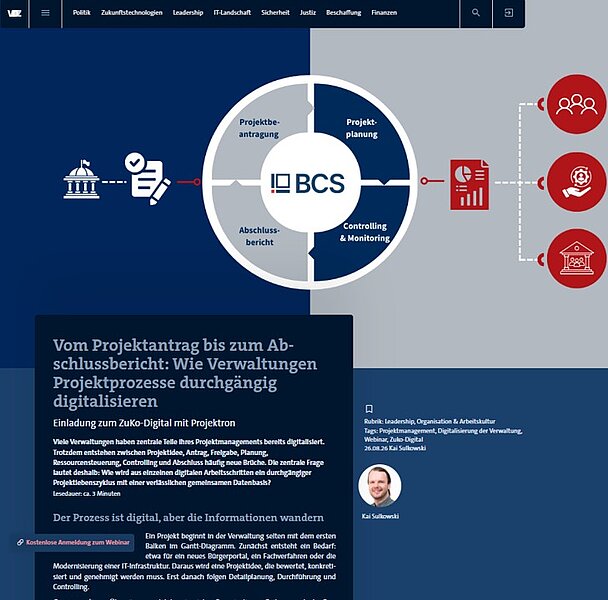
Screenshot of the guest article “Vom Projektantrag bis zum Abschlussbericht: Wie Verwaltungen Projektprozesse durchgängig digitalisieren” by Kai Sulkowski on the “Verwaltung der Zukunft” (VdZ) blog. URL: https://www.vdz.org/leadership-organisation-arbeitskultur/vom-projektantrag-bis-zum-abschlussbericht-wie-verwaltungen (last accessed on 26 August 2026)