11/18/2025 - Articles
Attention in AI: How machines understand context
In today's world of artificial intelligence (AI), transformer models such as BERT, GPT, and LaMDA are ubiquitous. These models are revolutionizing natural language processing (NLP) and enabling applications ranging from machine translation to chatbots. But what exactly makes these models so powerful? The key lies in the so-called attention mechanism: it evaluates which words in the text are particularly important for a specific word and thus generates context-dependent embeddings. In this article, you will learn how the attention mechanism works mathematically, why it makes the difference compared to older methods such as LSTM, and where it is used in AI systems today.
Content
What does “attention” mean in neural networks?
In neural networks, attention refers to a model's ability to focus specifically on the most relevant elements of an input. Instead of treating all tokens in a sequence equally, the model learns to assign weights that determine which information is particularly important for the current calculation.
In a sentence such as “The cat is sitting on the mat,” for example, the model recognizes that the word ‘mat’ is semantically more closely related to “cat” than to other words in the sentence. This weighting makes it possible to capture dependencies between words or tokens across different distances.
This mechanism creates a contextualized representation vector for each word, which reflects not only the isolated meaning of the word, but also its semantic relationship to other tokens within the sequence. In this way, the neural network can understand complex linguistic structures and efficiently integrate contextual information into its calculations.
What is the attention mechanism?
The attention mechanism is a calculation method used in neural networks that controls how strongly individual input elements are taken into account during processing. It models dependencies between tokens by assigning each element in a sequence an attention value that indicates how relevant it is in the current context.
While classic network architectures, such as feedforward or recurrent networks, process all inputs with equal weighting, the attention mechanism enables dynamic context adaptation: the weighting is learned during the calculation and can change depending on the input and position. This allows the model to recognize which pieces of information within a sequence belong together in terms of content or influence each other.
In practical applications, this mechanism enables systems to specifically highlight and interpret linguistic, visual, or semantic relationships. This makes the attention mechanism a central component of modern transformer models—it forms the basis for machine learning to not only recognize patterns, but also to grasp meaning in context.
All blog articles on the main topic of AI: AI knowledge (1-4) and AI at Projektron (5-8)

Step by step: How does the attention mechanism work?
The attention mechanism within the Transformer model ensures that each word (or token) takes into account its relationship to all other words in a sequence. This allows the model to establish grammatical, semantic, and logical relationships—for example, between a subject at the beginning of a sentence and a verb at the end. In the Transformer architecture, encoders and decoders are connected by several layers of self-attention or cross-attention and feedforward networks. These layers use matrix operations to calculate attention weights. In other words, they determine which parts of the input the model focuses on.
The process can be divided into five key steps:
1. Vectorization of input data
Before Attention can take effect, words or tokens are converted into numerical representations. To do this, they are transformed into vectors in a high-dimensional space using embeddings, which map semantic similarities between words. Position embeddings are added so that the model also knows the order of the tokens. This creates a unique, mathematically processable vector for each word that represents both its meaning and its position in the sentence.
2. Query, Key, Value (Q, K, V)
Three new vectors are formed from each embedding through linear transformations:
Query (Q) – asks the “question”: What information is relevant to me?
Key (K) – describes all tokens in the sequence: When am I important to others (and myself)?
Value (V) – contains the actual semantic information that is passed on if the token is classified as relevant.
These three vectors form the basis for calculating the attention weights between the tokens.
3. Calculation of attention scores
For each token, the query vector is multiplied by the key vectors of all tokens (including its own key vector). The result of the multiplication indicates how strongly two tokens are semantically or syntactically linked. Mathematically, this is a scalar product: the higher the resulting value, the stronger the relationship between the tokens. For “technical” reasons, they are divided by the root of the vector dimension. This is the “scaled” part of the scaled dot-product attention. A softmax function is then applied, which normalizes the sum of the scores to 1. This results in a probability distribution that indicates how important each token is for the current token.
The image shows the formula for the “scaled dot-product attention” mechanism, which is a central component of the Transformer model:
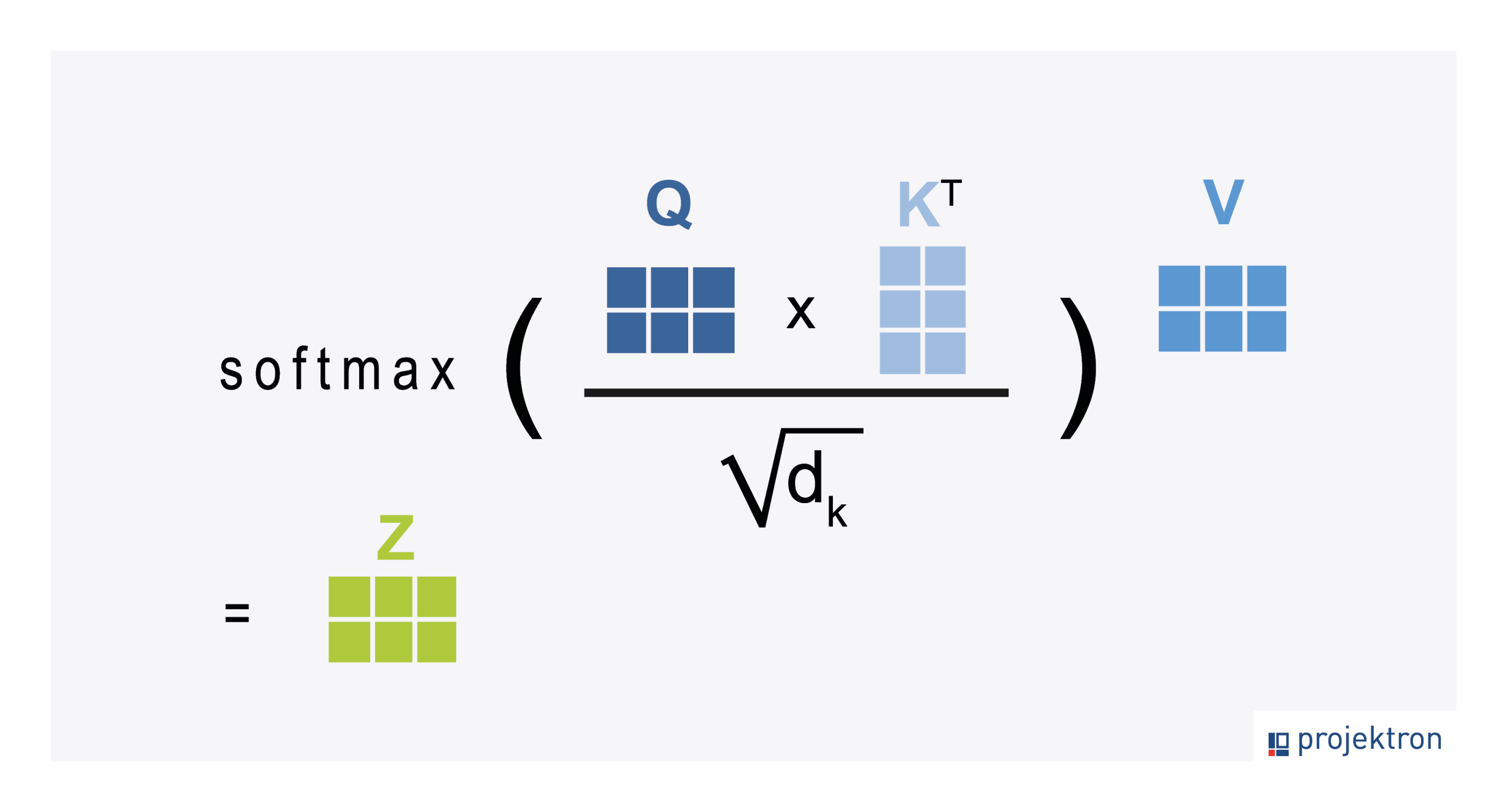
The formula calculates the weighted sum of the values (V) based on the similarity between the queries (Q) and the keys (K).
The matrices Q, K, and V are created from the input data.
Division by dk (the square root of the dimension of the keys) is used to scale the scalar products to prevent the softmax result from obtaining very small gradients for large values.
The softmax function normalizes the scalar products to obtain a probability distribution that represents the importance of each value (V) for the respective query (Q).
The result Z is the output matrix of the attention mechanism.
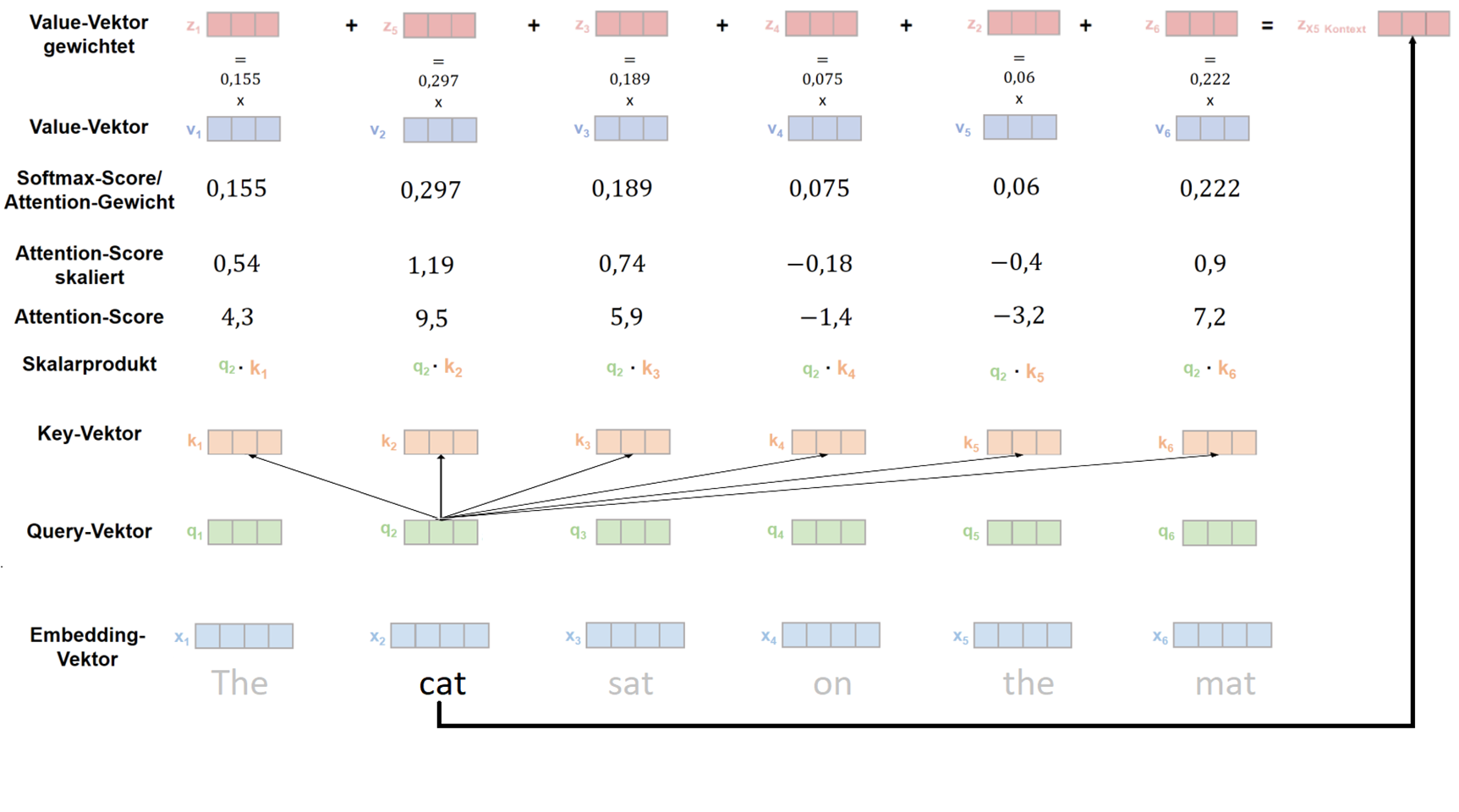
The diagram above shows how the attention mechanism works in a transformer model, specifically self-attention:
Embedding vector (x1 to x6): Each input word sequence (“The cat sat on the mat”) is first converted into a vector.
Query, key, and value vectors (q, k, v): The embeddings are used to form query, key, and value vectors, which are needed to calculate attention.
Scalar product (q2·k1, etc.): The query vector of the current word (q2 for “cat”) is multiplied by all key vectors to measure how relevant each word is to “cat.”
Attention score: The scalar products are scaled (usually by the root of the vector size) and then normalized by softmax to generate attention weights.
Value vector weighted: The attention weights are applied to the value vectors to generate the contextualized vector (z5 context). The result is a weighted sum of the value vectors that represents the word “cat” in the context of the entire sentence information.
Final result: z5 context is the context vector for the word “cat” that integrates information from all relevant words in the sentence.
4. Weighted sum: Context weighting through attention
The calculated attention weights are now applied to the corresponding value vectors. Tokens that are particularly relevant to the current word receive higher weights; less relevant ones contribute less. The weighted vectors are then added together.
This creates a new contextualized representation vector – it does not describe the word in isolation, but contains the important meanings of the other tokens in the sequence.
Example: Information from “sits” and “mat” is incorporated into the vector for ‘cat’ through weighted vector addition. This creates a vector that describes a cat sitting on a mat, so to speak. The model “understands” that cat – sits – on – mat forms a coherent unit of meaning.
This calculation step is performed for each token.
The name self-attention means that the key, query, and value vectors are formed from the same text—this variant is used to “understand” a text. Later, based on the understood text (the user input), another text, the answer, is generated—this is where cross-attention comes into play.
5. Multi-head attention (multiple perspectives)
In practice, the calculation is not performed on the entire vector, but rather the vector is first divided into, for example, eight vectors, each with a length of 1/8. There are also eight query, key, and value matrices, meaning there are eight parallel attention heads. This allows the model to better take multiple semantic levels into account simultaneously and accurately map complex relationships in context.
For example, one head can capture grammatical dependencies (e.g., subject-verb relationships),
another head can capture semantic relationships (e.g., cat – animal),
and another head can identify causal structures (because – therefore).
The results of all heads are concatenated (joined together) and processed by another linear layer.
Six or more of these attention blocks are then stacked on top of each other, as this has been shown to produce better results in practice than using a single block.
The Transformer: Attention in Action
Der Transformer ist die Architektur, die den Attention-Mechanismus zum Kernprinzip moderner KI gemacht hat. Er bildet die Grundlage für nahezu alle leistungsfähigen Sprachmodelle der Gegenwart, darunter BERT, GPT, T5 oder LaMDA.
Der Transformer besteht aus zwei Hauptkomponenten: einem Encoder (Kodierer), der den Eingabetext analysiert, und einem Decoder (Dekodierer), der daraus eine Ausgabe erzeugt, beispielsweise eine Übersetzung, Zusammenfassung oder Chat-Antwort. Beide Komponenten bestehen aus mehreren identisch aufgebauten Schichten, die Attention-Mechanismen und Feedforward-Netze kombinieren.
a) the encoder:
The encoder processes the input sequence by converting it into a series of contextualized vectors.
Each encoder layer contains a multi-head self-attention component and a forward-looking feed-forward network (FFN).
The multi-head self-attention part allows the encoder to look at each position in the input sequence and evaluate the relevance of the other positions.
b) the decoder
The decoder processes the encoder's output and the output sequence generated so far to generate the next element of the output sequence.
Each decoder layer contains three sub-layers: a masked multi-head self-attention layer, a multi-head cross-attention layer, and a feed-forward network.
In the first decoder step, the “masked self-attention” predicts the next token based on the token chain generated so far. Masking ensures that the model can only generate the next token in each prediction. The other following tokens are blocked.
In the cross-attention layer, information from the input sequence is incorporated. The query vector is created from the vector that the masked self-attention has “suggested” as the next link in the answer chain. Key and value vectors are generated from the encoder output. As described in the encoder diagram, the scalar products of key and query vectors are now calculated, which are then used to weight the respective value vectors. Finally, all weighted vectors are added together and, after passing through the last “linear” layer, result in a probability distribution across all tokens in the vocabulary. The token with the highest probability is appended to the chain, and the next pass begins.
The process continues until a special end-of-sequence token (<EOS>) signals: “Section end.”
The image shows a schematic representation of a neural network used to generate text. It is a transformer model typically used for tasks such as language translation or text completion:
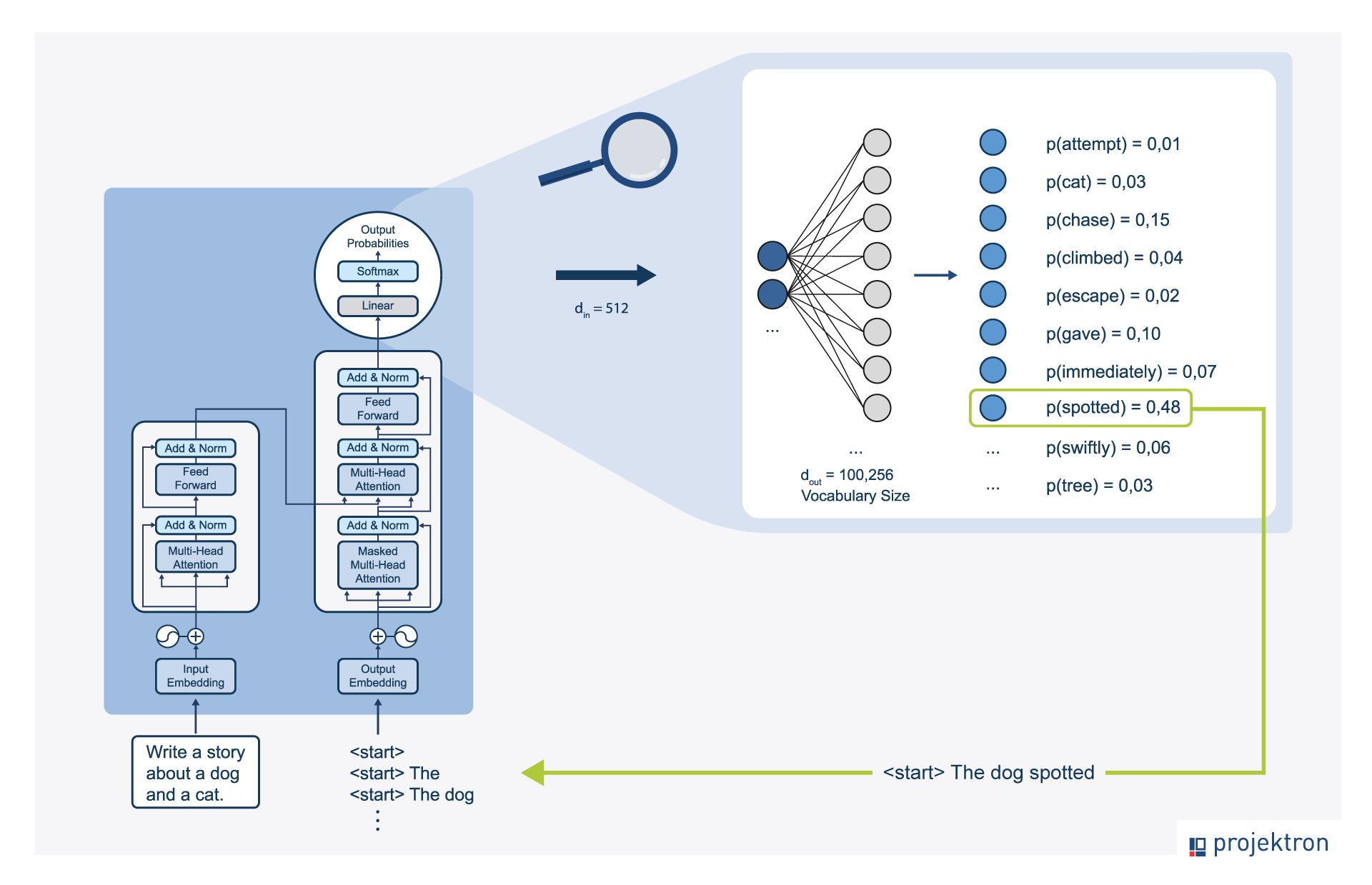
The model consists of an encoder part (left) and a decoder part (right).
The encoder processes the input sequence (“Write a story about a dog and a cat.”) and creates an internal representation.
The decoder generates the next word in the sequence based on this representation and the words generated so far.
The probabilities on the right show which words the model suggests next to complete the sentence beginning “The dog.” The word “spotted” has the highest probability of 0.48. It is appended to the chain.
The new chain is entered back into the decoder to generate the next element.
The process continues until a special element (<eos>, end of sequence) is selected. This signals that the answer is complete.
The rigid selection of the most probable token often results in boring, repetitive texts. Sometimes the language model even gets stuck in a loop from which it cannot escape. To solve this problem, instead of just considering the most probable token, a selection of the most probable tokens is considered and one of them is “rolled” out. This makes the responses more lively. The technique is called sampling.
Parameters can be used to control the effects, e.g., the number of most probable tokens from which the roll is made. A “temperature” parameter can be used to post-process the probabilities: a high temperature evens out the probabilities of token selection – unusual texts become more probable. So, for a poem, a high temperature is chosen, while for a faithful translation, a low temperature is better.
With the help of these sampling strategies, a natural-sounding text sequence is gradually created. The result appears to the user as a coherent, meaningful text, but is actually based on a sequence of vectors, matrices, and weighted probabilities.
Why is attention so important for modern AI?
The attention mechanism has permanently changed the landscape of machine learning and forms the foundation of modern deep learning models. Without it, transformer models such as GPT, BERT, T5, and PaLM would be inconceivable. Its importance is based on several key advantages:
Better context understanding and higher model performance: Attention allows the entire context of an input to be considered simultaneously. This enables the model to recognize semantic dependencies even in long sequences and produce consistent results.
Efficient parallelization: Unlike recurrent neural networks (RNNs), which process inputs sequentially, attention allows the transformer to calculate all tokens in a sequence simultaneously. This parallelizability is what makes training high-performance models on modern GPUs and TPUs feasible in the first place.
Improved interpretability: The attention weights are visualizable and provide insight into which tokens were decisive for a decision. This allows neural decisions to be traced and partially explained, which is an important step toward explainable AI (XAI).
Architectural versatility: Attention is not limited to language. It is successfully used in computer vision (e.g., Vision Transformer, ViT), speech recognition, music analysis, and time series modeling. Wherever relationships between elements of a sequence or image need to be modeled, attention delivers superior results.
Practical examples: Where attention is everywhere
Machine translation: Services such as DeepL and Google Translate use attention to correctly interpret ambiguous words in context. This allows the model to recognize whether the word “bank” in a given sentence means ‘seat’ or “financial institution.”
Dialog systems and chatbots: Systems such as ChatGPT or AI-supported customer service platforms use attention to understand the relationship between user questions and context. This enables them to generate coherent, contextually appropriate responses.
Image processing (computer vision): Attention mechanisms highlight relevant regions in an image, such as objects, tumor structures, or textures. In Vision Transformers (ViTs), visual relationships are also modeled in this way.
Speech and audio data analysis: In automatic speech recognition, attention helps to focus on temporally relevant passages, while in music processing, patterns are recognized across multiple time levels.
Web and usage analysis: Modern web applications that integrate AI models often use tracking cookies or local storage mechanisms to collect usage data. This data, such as device information or interaction behavior, can be incorporated into training processes and help make models more context-sensitive, efficient, and secure.
Conclusion: Why attention is at the heart of modern AI
The attention mechanism is the foundation on which today's AI systems are built. It ensures that machines not only “see” words, but also understand meaning to an extent that is astonishingly close to human reading. Whether in translation, chat, or text analysis, attention enables the crucial step: from merely recognizing individual characters to understanding context.

About the author
Dr. Marten Huisinga heads teknow GmbH, a platform for laser sheet metal cutting. In the future, AI methods will simplify the offering for amateur customers. Huisinga was one of the three founders and, until 2015, co-managing director of Projektron GmbH, for which he now works as a consultant. As DPO, he is responsible for implementing the first AI applications in order to assess the benefits of AI for BCS and Projektron GmbH.
More interesting articles on the Projektron blog

Product management at Projektron
How does software remain successful for 25 years? Projektron BCS shows that continuous updates, user feedback, and modern technologies ensure long-term success. Learn how product management works at Projektron.

Use cases for AI in BCS
Step by step, an AI ecosystem is emerging at BCS that is making everyday work noticeably easier. The article shows which use cases are already productive and which functions are still to come.

AI-Help in BCS
Since version 25.3, the new BCS AI user help has been providing precise answers to questions about Projektron documentation. The article shows how iterative optimizations in retrieval and splitting have significantly improved the quality of responses.
Choosing PM software
If your SME or company is about to choose project management software, you probably don't know where to start looking for the right PM tool for you. This guide will guide you through the PM software market and lead you to the right decision in 9 steps.

A neural network in which a spotlight illuminates a specific node – symbolizing the attention mechanism used by AI systems such as Projektron AI to recognize relevant information in context.