Standardizing Complaint Handling with BCS
Customer Case Study: Eichsfelder Schraubenwerk GmbH / esw GROUP
With BCS, we have transitioned our complaint handling from emails, Excel spreadsheets, and local files to a standardized ticket process. Today, responsibilities, statuses, documentation, and analyses are all centrally tracked, right through to reporting for management reviews.
The esw GROUP – safety-critical components and “Best Connections”

Eichsfelder Schraubenwerk GmbH is part of the esw GROUP, headquartered in Heilbad Heiligenstadt. In addition to the German location, ESW Bohemia k.s. in the Czech Republic is also part of the group. The esw GROUP describes itself as a family-run, medium-sized company with approximately 330 employees in Germany and the Czech Republic. The company manufactures sophisticated metal-plastic products and supplies the automotive, commercial vehicle, furniture, and construction industries, among others.
A particular focus is on safety-critical components. Many of our products are installed in seatbelt pretensioners, restraint systems, and door latch systems in cars. For us, this means that quality, traceability, and clear processes are central requirements in our daily work. The lives of car occupants depend on 80% of our products.
BCS in Action: From Project Planning to Corporate Communications
Today, we use BCS in many areas of our company. We started with project planning and resource management. Since then, we have expanded its use step by step – including project controlling, project communication, quality management, ticketing system, project costs, document management, contact management, as well as inventory and contract management.
Our projects vary widely: They range from internal organizational projects, such as short-term 5S audits, to multi-year customer projects. Our classic project typically follows a waterfall model. At the same time, we work in a hybrid way in certain areas and use Kanban, tasks, tickets, history logs, follow-ups and checklists.
BCS helps us map these different ways of working in a single system. Project management, steering and controlling, request processing, task overviews, complaints, resource management, deadline tracking, change management, ticket processing, and document management are especially important to us.
Before introducing or expanding BCS, we worked in many areas with Excel, whiteboards, paper, and various workflows. For complaints, we also used email, Word, Excel, PowerPoint, and local storage locations. We gradually replaced these distributed systems with structured processes in BCS.
A key goal of our digitalization strategy is to use BCS as a shared element of corporate communication. This ensures that information is not only documented, but also remains directly connected to tasks, projects, tickets, customers, and processes.
Initial Situation: Complaints Not Managed Centrally
Even before the transition, our complaint handling process followed a standardized procedure. However, the analysis revealed that the actual processing was spread across many different systems: email, Word, Excel, PowerPoint, and local storage.
This led to typical problems: Communication was not always clear, structures were not consistently defined, knowledge levels varied, and lessons learned were not fully documented.
Links to related topics or customer references were sometimes missing. Additionally, generating reports was only possible with significant effort because Excel spreadsheets had to be maintained and responsibilities were not always clearly assigned. Costs could also not be accurately allocated.
Our solution was therefore clear: We wanted to map the complaint handling process through the ticket system in BCS.
Complaints via ticket: consistent, transparent, and traceable
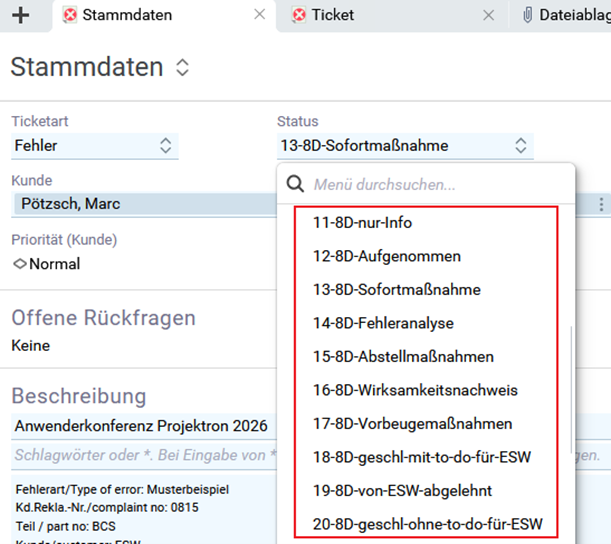
To handle complaints, we first established the necessary infrastructure in BCS. This included a dedicated structure for complaints, cross-functional teams in the team plan, global ticket notification settings, and standardized descriptions using text modules.
Standardizing the ticket description was particularly important to us. By using text modules, we ensure that all necessary information is recorded in a structured manner. This makes it clear to everyone what a complaint is about and ensures it is clearly documented. Changes remain traceable.
We have also adapted the status messages to our complaint process. We use statuses based on the 8D system according to VDA. This makes it clear at all times what stage of processing a complaint is in.
Clear Responsibilities in the Workflow
Ticket processing isn’t just about capturing information. It’s crucial that responsibilities, follow-up questions, files, images, and lessons learned are preserved throughout the process.
In BCS, we ensure responsibilities and knowledge transfer through links. The workflow documents relevant information without any data loss—including images, file attachments, and follow-up questions. At the same time, the status with a timeline shows where we are in the process.
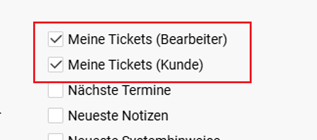
We have also customized the views in “My Area” to fit our workflow. We use board elements for tickets and “My Tickets” and can distinguish between the primary assignee and additional assignees. In an email context, this is roughly equivalent to the distinction between “To” and “CC.”

Kanban Board: A Bird's-Eye View of Complaints
In addition to the detailed view of individual tickets, we use the Kanban board to get a bird's-eye view of complaints. This allows us to see at a glance which complaints are in which status and where action is needed.
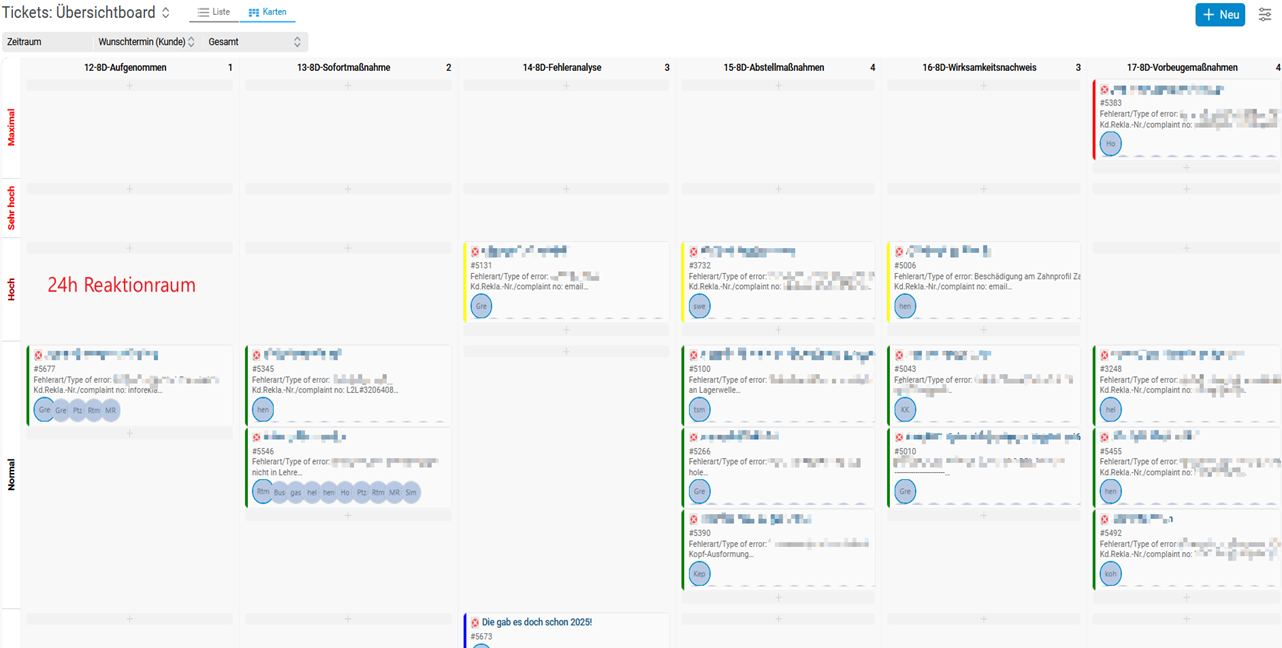
This is particularly helpful because it allows us to combine the day-to-day handling of individual complaints with a broader view of the process. The details remain documented in the ticket, while the Kanban board provides an overview of the entire process.
Reporting for Management Review and Continuous Improvement
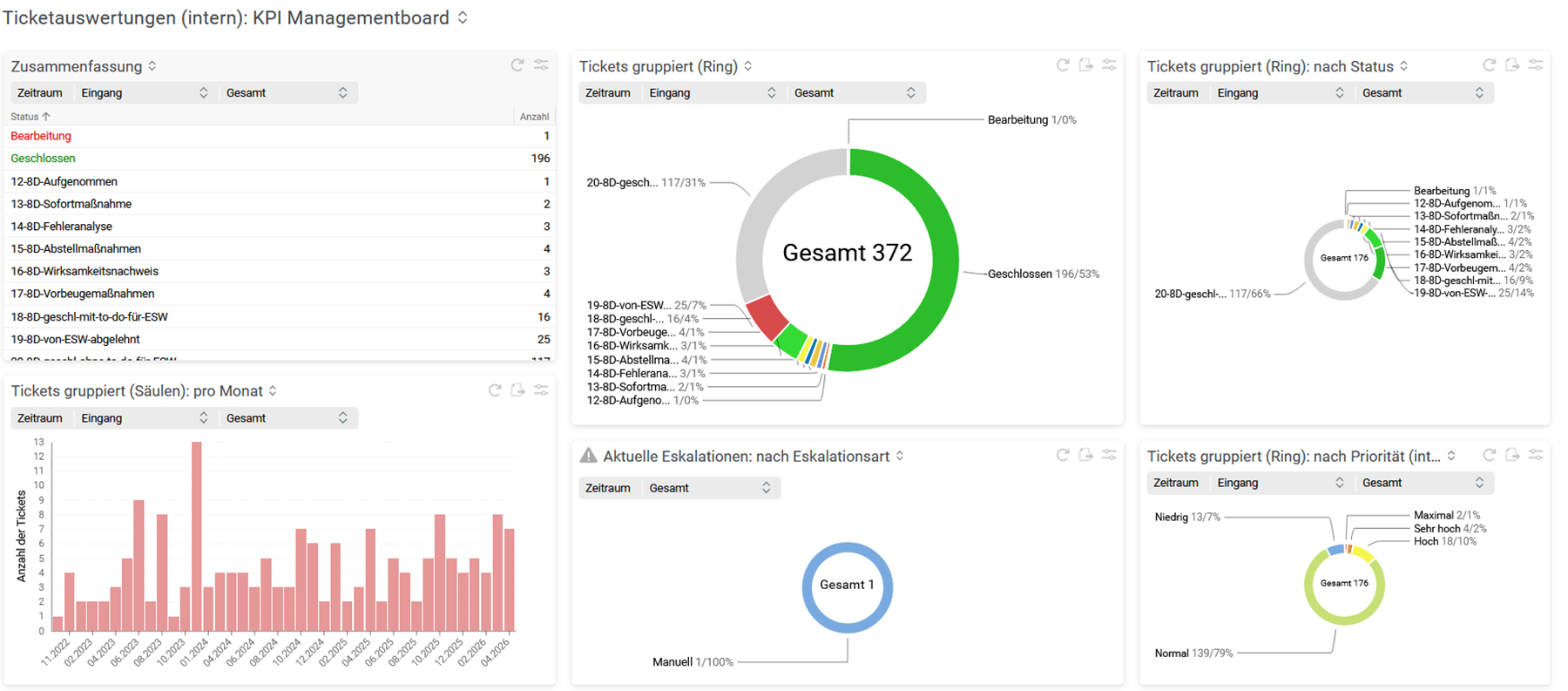
Another key component is reporting. In the past, generating reports was a time-consuming process because Excel spreadsheets had to be maintained. Today, we use BCS ticket reports for regular reporting.
KPI reports are available for management review, covering topics such as ticket status, error categories, error types, or other complaint metrics. This ensures that complaint handling is not only managed operationally but also supports quality management, management review, and continuous improvement.
Evaluation and Next Steps
From management’s perspective, the BCS project structure offers the opportunity to map additional processes, such as those within the quality, environmental, and energy management systems.
Project-related emails and Excel spreadsheets have been replaced by tickets and activity logs. The BCS authorization structure also offers us significant advantages over sharing information via email and server structures. The cloud version also enables unrestricted access.
As next steps, we are preparing for an ISO/IEC 27001 audit for an information security management system. We also plan to migrate additional management system processes to BCS.
Our Conclusion
With BCS, we have transitioned our complaint handling from scattered emails, local files, and Excel spreadsheets to a standardized ticket process.
Today, we record complaints in a structured manner, manage them via defined statuses, document responsibilities, and capture knowledge directly within the workflow. This simplifies daily processing, improves traceability, and creates a robust foundation for evaluations and management reviews.
For us, BCS is thus far more than just a tool for project planning. BCS helps us make communication, quality assurance, and management processes more centralized, transparent, and reliable.