03/17/2026 - Articles
Project Management in Aerospace: Product Development for Safety-Critical Applications
Guest article by Dr. Manfred Nolle – Project management in aerospace is one of the most demanding disciplines: Projects must meet the highest safety requirements, integrate complex technical systems, and simultaneously comply with strict regulatory standards, often over development periods spanning many years. How can innovation and absolute reliability be successfully combined? What role do risk management, regulatory standards, and international cooperation play? And why do project decisions in aerospace often have repercussions spanning several decades? Dr. Manfred Nolle, member of the steering committee for the Aerospace Project Management Division at GPM (German Association for Project Management), highlights the unique challenges that define project management in the aerospace industry and explains which methods and competencies are necessary to successfully implement complex aerospace projects.
Key Takeaways: Project Management in the Aerospace Industry
Project management in the aerospace industry is one of the most demanding disciplines. Projects must simultaneously meet technological innovation, strict regulatory requirements, and the highest safety standards—demands that traditional industrial or IT projects rarely combine in this way.
An overview of the key aspects of this field:
Safety is the top priority. Development processes must be designed to identify technical risks early on and systematically mitigate them.
High system complexity requires interdisciplinary project management. Mechanics, electronics, and software are closely interconnected and must be integrated across many suppliers.
Regulatory requirements shape the entire development process. Standards such as DO-178 or DO-254 define mandatory development and verification processes.
Projects have very long lifecycles. Decisions made during development often influence operation, maintenance, and further development over several decades.
Risk management and configuration management are key control instruments. Safety-critical systems can only be certified through systematic documentation and traceability.
International collaboration requires active stakeholder and cultural management. Projects involve authorities, customers, suppliers, and partners from different countries and organizations.
The “Project Management in Aerospace” specialist group of GPM e.V. facilitates the exchange of experiences regarding the specific challenges of project management in the aerospace industry. To this end, it meets twice a year at one of the participating companies in the industry. The central challenge for companies is to ensure the safety of crew and passengers in order to prevent incidents such as those involving the Boeing 737 MAX in 2019[1]:

... Aviation authorities around the world had imposed a grounding order on the 737 Max in March, following the second devastating crash within five months. This model is the fuel-efficient new version of the Boeing 737 medium-range jet. The MCAS control software developed for the Max is being held partly responsible for the crashes. Boeing intends to fix the defects with an update. In the meantime, however, additional problems have emerged.
FAA Administrator Dickson is scheduled to testify before a congressional committee in the U.S. this Wednesday. The hearing is also expected to address errors in the jet’s certification by the U.S. agency. Whether everything was above board during the original 737 Max certification is the subject of various investigations in the U.S. Boeing is accused of rushing the ill-fated aircraft to market amid fierce competition with Airbus, thereby neglecting safety.
The events surrounding the Boeing 737 MAX clearly demonstrate just how critical structured project management is in the aerospace industry. Unlike traditional industrial or IT projects, project management in the aerospace industry is much more heavily influenced by
safety certifications
regulatory approval
long product lifecycles
international development networks
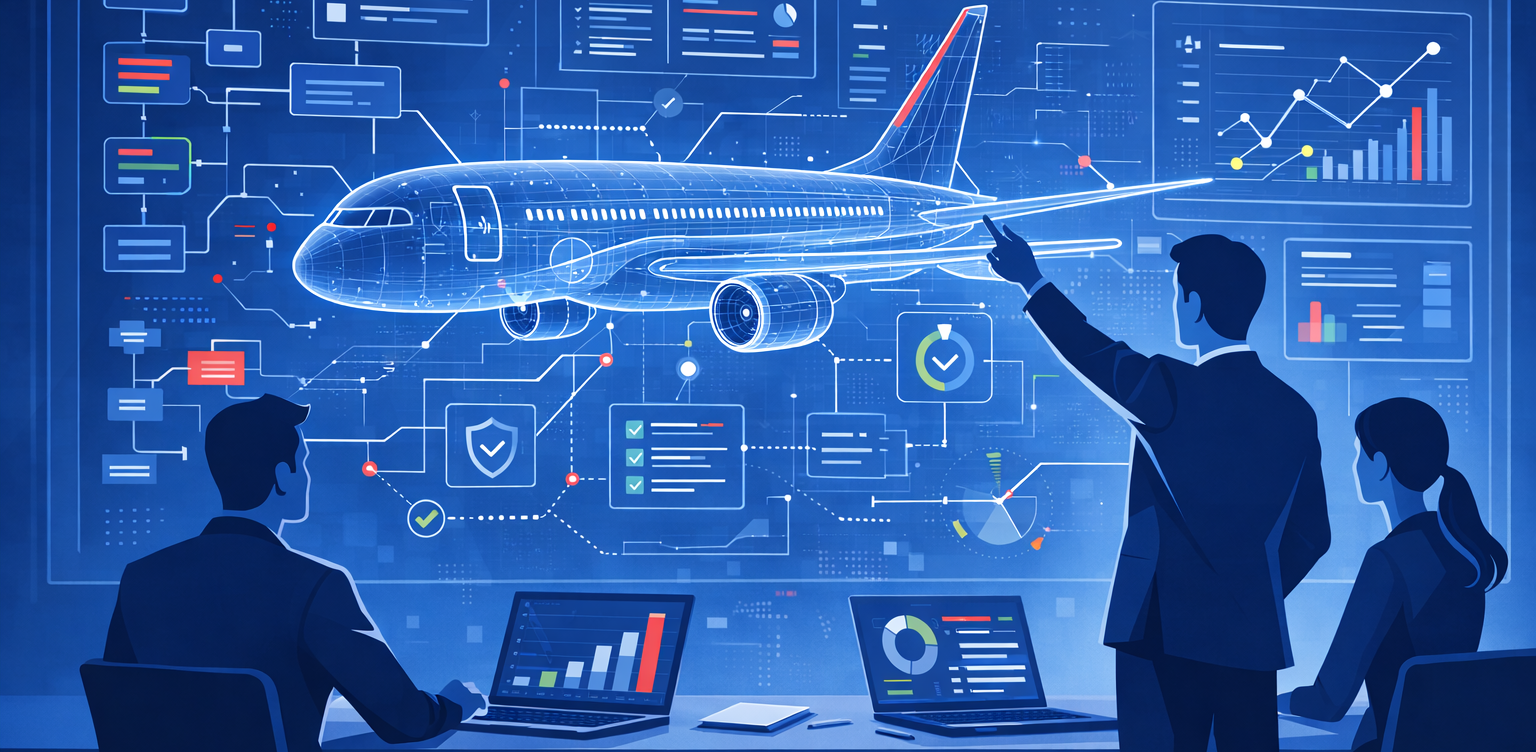
Between the Pressure to Innovate and Absolute Reliability: Unique Aspects of Project Management in the Aerospace Industry
The aerospace industry is synonymous with technological excellence. Modern aircraft, satellites, and space systems combine mechanics, electronics, and software into highly integrated, complex systems that must function reliably under extreme conditions while meeting strictly defined safety requirements. Such safety-critical systems require a closely integrated interplay between systems engineering and project management.
That is why these systems are subject to strict regulatory requirements. Safety is not just one quality feature among many, but the central development goal. In this environment, project management is far more than simply meeting requirements within given deadlines and budgets. It requires a structured approach in a technological environment characterized by regulatory requirements, a high level of risk awareness, and interdisciplinary collaboration over many years.

Project Management in the Aerospace Industry
Project management in the aerospace industry refers to the planning, oversight, and execution of complex development programs for aircraft, satellites, and other aerospace systems under strict safety and certification requirements. It encompasses, in particular, systems engineering, risk management, regulatory compliance, and the coordination of international development and supply networks over long project durations.
Specific Challenges in Aerospace Project Management

Safety-critical systems in the aerospace industry differ fundamentally from consumer products or traditional IT applications. They are developed within complex aerospace programs that often require the coordination of international development and supply networks over many years. A failure in, for example, flight control or satellite stabilization can have fatal human and financial consequences.
A modern aircraft consists of a multitude of subsystems and devices developed and supplied by different companies. This requires careful coordination of interfaces—both technical and in terms of scheduling—since cross-system tests can only be conducted if the individual subsystems and devices with the corresponding functions are available on schedule.
Three key characteristics define projects in the aerospace industry:

Systemic complexity
Every technical decision can affect other subsystems. Project management must therefore promote a systemic approach and avoid silo structures.

Regulatory integration
Standards and specifications are an integral part of the development process. Reviews and documentation are standard components of a project, and regulatory authorities must be involved at an early stage.

Long-term responsibility
Aviation systems often remain in service for 20 to 40 years. Project decisions have an impact far beyond the development phase—for example, on future maintenance or necessary modifications and upgrades—which is only possible with rigorous configuration management.
Specific challenges include:
| Extensive Regulatory Framework | Technical Requirements | Environment |
| Fail-safety | ||
| Interoperability of Subsystems | ||
| System Integrity | ||
| Development Process | Clearly structured development process in phases with high planning and coordination effort | |
| Fully and precisely defined technical requirements | ||
| Extensive verification and validation | ||
| Traceability of requirement implementation | ||
| Documentation | Comprehensive and complete documentation | |
| Configuration Management | Strict configuration management | |
| Certification | Certification of products and systems in accordance with the requirements of the German Federal Aviation Authority as well as European and international aviation safety authorities (e.g., EASA, FAA) | |
| Contractual Aspects | Maintenance & Repair | Very long-term maintenance and repair obligations |
| Offset / Georeturn | Offset and georeturn obligations | |
| Cooperation | Cross-border cooperation obligations | |
| International Orientation | Customers & Suppliers | On both the customer and supplier side |
| Regulation | Different national regulations | |
| Stakeholders | Complex stakeholder network |
Project Management Requirements in the Aerospace Industry
This gives rise to key requirements for project management in the aerospace industry across all phases of product development:
a plan-based approach divided into phases with clearly defined (interim) objectives and verification criteria
comprehensive risk management
stakeholder management with clearly defined involvement of various stakeholder groups
Handling of intercultural differences in international collaboration
Procedures for the development of (safety-critical) products
Ultimately, safety takes precedence over all other aspects and requirements. But when can a system, a subsystem, or a product be classified as safe? To address this, we will first provide an overview of possible technically induced causes of failure:
| Mechanical Failure | Breakage or deformation due to corrosion, wear, improper handling, etc. |
| Electronic Failure | Failure of electronics due to improper handling, component failure, etc. |
| Human Error | Input of incorrect data or incorrect settings during installation, etc. |
| Development Error | Incorrect implementation of requirements, faulty requirements, or incomplete requirements, etc. |
In practice, the likelihood of a mechanical defect, an electronic failure, or an operator error can be significantly reduced through measures such as manuals, training, maintenance, and others. In contrast, identifying errors during development is much more difficult.
The following considerations primarily apply to electronic products whose functions are implemented in hardware and software. The challenge with products of this type is that, due to their complexity, they can only be tested incompletely. As a result, errors originating from the development phase may occur in certain situations. To keep the probability of such errors as low as possible, the development process requires strict adherence to specified process steps. The project manager must be aware of this and be familiar with the relevant procedures, methods, and processes, etc., and insist on their strict adherence.
There are guidelines that must be followed in order to obtain certification for a safety-critical product. The DIN EN 61508 standard, “Functional Safety of Safety-Related Electrical, Electronic, and Programmable Electronic Systems,” provides the overarching framework for this. Specific regulations derived from this standard exist for various applications and industries, such as medicine, chemistry, railways, and others.
For the aviation industry, specific aviation standards such as DO-178 for software and DO-254 for electronic hardware apply. These standards define key requirements for the development processes of safety-critical aerospace systems. They contain concrete specifications for the development process, compliance with which is a prerequisite for the product’s certification upon completion of development:
| DO-178 – Software Considerations in Airborne Systems and Equipment Certification | “This document provides recommendations for the production of software for airborne systems and equipment that perform functions with safety requirements consistent with the requirements of the certification authorities.” |
| DO-254 – Design Assurance Guidance for Electronic Airborne Hardware | “This document is intended to support both aircraft manufacturers and suppliers of electronic systems in ensuring that products can be shown to perform their intended function.” |
The DO standards divide the development process into phases, separately for hardware and software development, which can be further subdivided as shown in the following figure.
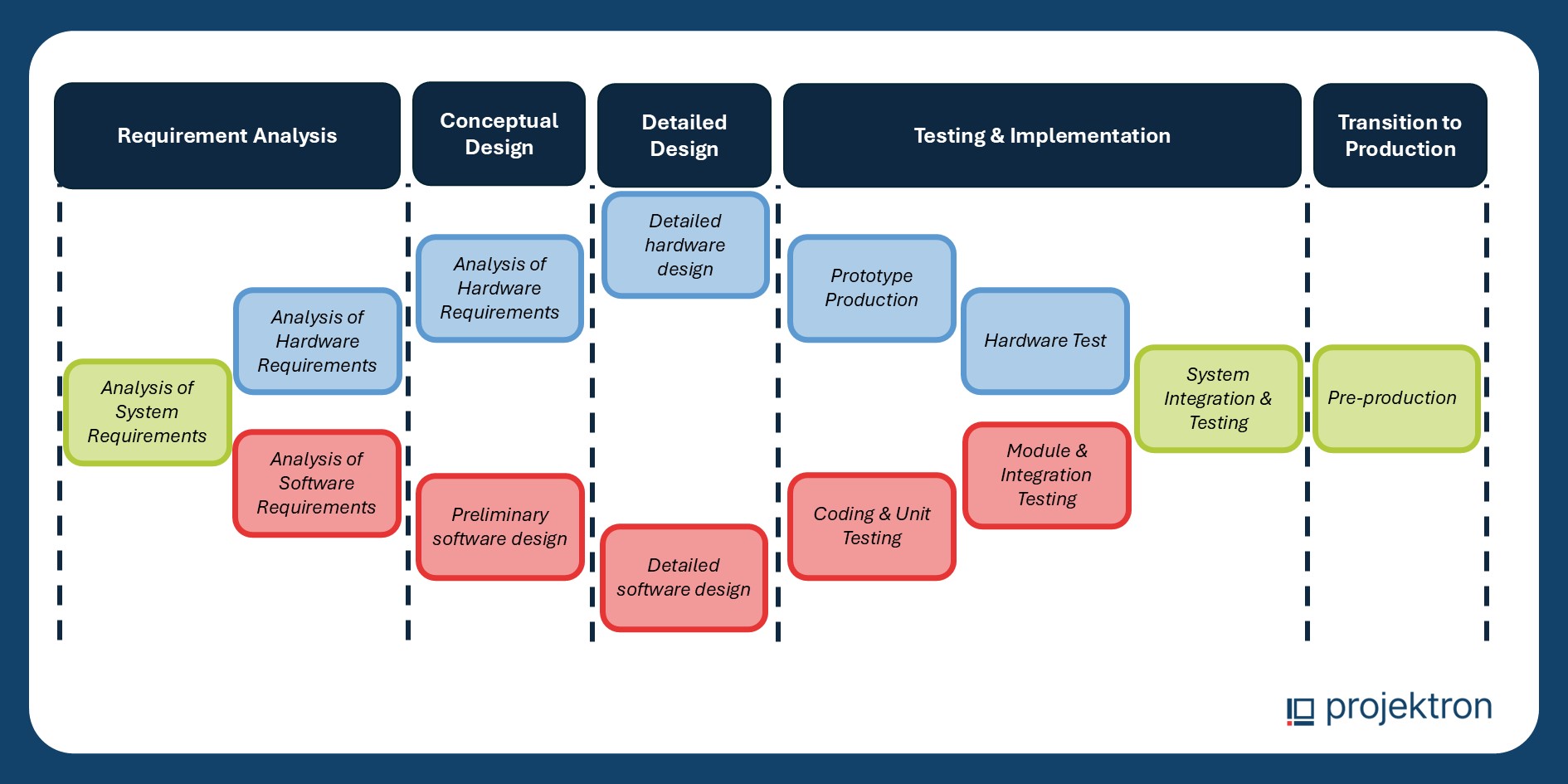
This results in the following constraints regarding the development process:
clearly defined and verifiable requirements at the outset
division of the process into phases
detailed planning of the individual phases, including the respective (interim) results
early coordination of the process through the involvement of regulatory authorities
Risk management in aerospace projects
Large-scale technology projects in the aerospace sector are subject to significant uncertainties due to their long durations and high technical complexity. The use of new technologies, scarce resources, a lack of external support, unclear requirements, and many other problems are part of everyday project life. Problems of this kind often become apparent even before they occur, offering an opportunity to mitigate or even avoid them through appropriate measures. This requires systematic and, above all, transparent management.
The goal of risk management is to
identify potential unplanned events early on,
realistically assess their impact, and
limit potential damage through appropriate measures.
Risks that typically exist in projects in the context considered here can be categorized as follows, for example:
| Technical Risks | New or insufficiently tested technologies, high quality requirements, lack of knowledge and experience within the project team, etc. |
| Economic Risks | Unexpected cost increases for procurement during the project lifecycle, financing issues, liquidity of the external client (in customer-funded projects), exchange rate fluctuations, etc. |
| Organizational Risks | Lack of resources, inexperienced project management, etc. |
| External Risks | Supplier issues, changes in regulatory requirements during the project lifecycle, political or cultural conditions, etc. |
A prerequisite for successful risk management is clearly defined processes and procedures that are carried out at regular intervals—such as monthly—and whenever changes occur. The process is divided into the steps commonly known in project management (see, for example, [2]):
Identification of unplanned events that pose a risk to the project
Description of the identified risks and their potential impacts
Analysis and assessment of individual risks in terms of probability of occurrence as well as potential impacts on costs, schedules, and changes in service delivery
Strategy for individual risks classified as critical, aimed at mitigating the impact of a risk or even preventing it
Definition of measures to implement the strategy and estimation of the necessary expenses
Implementation of the defined measures and regular monitoring of progress and effectiveness
A risk register is recommended for a transparent and structured implementation of the described steps, in which the information developed above for the individual risks is compiled. This register forms the basis for risk management throughout the entire project duration and, if necessary, beyond. For reporting purposes, a risk matrix can be used, in which the individual risks are classified according to their probability of occurrence and the severity of potential impacts, thereby providing a transparent overview of the risk situation in the project.
Stakeholder Management in the Aerospace Industry
In hardly any other industry is the stakeholder landscape as diverse as in international aerospace projects. Project management here involves structured management of a wide variety of interests. Due to the very long service life of the products, stakeholder groups and their interests evolve over time. Although the project manager’s responsibility ends with the completion of the project, he must take future stakeholder expectations into account as early as possible during the project, to the extent that these are foreseeable or even known.
Due to the high development costs, a product is not developed for just one customer, but rather in such a way that it can be used for multiple applications—that is, aircraft. For applications where the requirements are very specific, the customer will (co-)finance the development. Regardless of this, a potential first customer who is willing to support the development through consultation and possibly also through flight tests is of great benefit in terms of the implemented functions, and this can also result in significant cost savings.
Once the development phase is complete, the project team’s responsibility ends. However, a large portion of stakeholders’ expectations in later phases can only be met if these expectations are taken into account as much as possible during the development phase, which, in turn, remains the responsibility of the project team. For example, cost-effective repair of a device using available spare parts can only be achieved during development through appropriate design and the use of components that will remain available for as long as possible after development is complete.
Depending on their function and the technology used, aviation products are often subject to German, European, or international export restrictions. Under certain circumstances, restrictions can be reduced or avoided by using alternative technologies. Restrictions may arise for so-called dual-use products; these are products that are developed for civilian use but can also be used for military purposes without modification, such as a thermal imaging camera or a drone for filming.
Intercultural Collaboration in International Aerospace Projects
The aerospace industry is a highly internationally oriented sector. Hardly any company offers its products exclusively on the domestic market. Products are usually only economically successful if they are designed for global use, from development and production through to service and maintenance.
As a result, project teams work with people from different cultural backgrounds, such as international customers, suppliers, partner companies, government agencies, and others. At the same time, many organizations themselves are multicultural, with professionals from different countries and diverse cultural backgrounds working together.
This diversity is a great strength, as it brings together different perspectives, experiences, and approaches to problem-solving. At the same time, however, it can also lead to conflicts and misunderstandings if those involved are not aware of cultural differences. Here are two examples:
| Different Communication Styles | Cultural differences are reflected in communication styles. In some cultures, criticism is expressed very directly, while in others it is communicated more indirectly. What one side perceives as clear and efficient communication may be seen by the other as impolite or confrontational. |
| Different Expectations Regarding Planning and Decision-Making Processes | In some cultures, decisions are made in a highly consensus-driven manner, while others are more hierarchical. Some project partners expect detailed planning, while others prefer more flexible approaches. |
Such differences are not inherently problematic—as long as they are recognized and consciously taken into account.
An important step in dealing with cultural differences is a fundamental awareness that not every misunderstanding stems from technical differences or a lack of knowledge. Often, different cultural influences are at the root of the issue. That is why it is helpful for project teams to take cultural aspects just as seriously as technical or organizational issues.
There are various ways to prepare for international collaboration and develop an understanding of other cultural backgrounds:
| Intercultural Training | Many companies offer training programs that explain typical communication and working styles of different cultural contexts. |
| Direct Exchange | Direct dialogue with colleagues from different cultural backgrounds is often the most effective source of learning. Openness and interest in other perspectives help build trust. |
In international programs, intercultural competence and effective project communication play a key role in preventing misunderstandings, building trust, and successfully managing complex projects. This is particularly evident in the aerospace industry, where international cooperation and long-term partnerships converge: successful projects result not only from technical excellence, but also from mutual understanding among people, which enables them to collaborate in a spirit of trust. For more on models of cultural differences, see, for example, in [3][4].
Conclusion: Expertise, processes, and risk management
Project management in the aerospace industry requires a combination of technical expertise, structured development processes, and consistent risk management. Only through a systematic approach can innovation, regulatory requirements, and long-term safety be successfully integrated.
Compliance with regulations—some of which are highly restrictive—is no guarantee of safety in aviation technical systems, but it enables an approach that Significantly increases safety and thus substantially reduces the risk of technical failure. The incident at Boeing described at the outset was the subject of intensive investigations [5] , which concluded that several involved departments had apparently failed to apply the guidelines with the necessary diligence and thus had not properly implemented a series of measures that were actually necessary, ultimately to avoid falling behind a competitor. As a result, this led, among other things, to Boeing being unable to deliver any aircraft of this type for over two years until new software had been developed and extensively tested., dass Boeing über zwei Jahre keine Flugzeuge dieses Typs ausliefern konnte, bis eine neue Software entwickelt und intensiv getestet war.
Sources and further reading
[1] Aero International, article on the Boeing 737 MAX,https://www.aerointernational.de/aviation/faa-keine-wiederzulassung-von-boeings-ungluecksjet-737-max-vor-2020.html, accessed March 2026.↩
[2] GPM (ed.): Kompetenzbasiertes Projektmanagement (PM4), 2019.↩
[3] Meyer, Erin: The Culture Map – Decoding how people think, lead, and get things done across cultures. Public Affairs, New York, 2015.↩
[4] Hofstede, Geert: 6D Model of National Culture,https://geerthofstede.com/culture-geert-hofstede-gert-jan-hofstede/6d-model-of-national-culture/, accessed March 2026.↩
[5] MCAS: Improvements & Enhanced Controls,https://players.brightcove.net/800000612001/a7975ab0-d4c3-4514-a6c3-d7bfff0667c5_default/index.html?videoId=6226446328001, accessed March 2026.↩

About the Author
Dr. Manfred Nolle spent over 30 years in the aviation and defense technology sectors at LITEF GmbH, holding positions of responsibility such as project lead, program manager, and head of the defense technology division. For the past 15 years, he has volunteered with the GPM German Society for Project Management e. V. as
- a member of the Specialist Group on Project Management in Aerospace
- a member of the Committee on Technical Work (Spokesperson)
- Member of the Standards and Norms in PM Technical Group
- Delegate for Baden-Württemberg
At KIT (Karlsruhe Institute of Technology), he lectures on the topic “Project Management in the Development of Products for Safety-Critical Applications.”
Contact: m.nolle(at)gpm-ipma.de
Why Structured Project Preparation Is Crucial
As a provider of the project management software BCS, we at Projektron repeatedly observe in practice that the phase of project preparation is underestimated in many organizations. For project teams, it often initially appears to be administratively demanding. As a result, teams frequently move quickly into operational execution. However, especially in complex projects—such as those typical in the aerospace industry—it becomes clear how crucial structured preparation is. Risk management and stakeholder management should be systematically established at the very beginning of the project in order to avoid later delays, cost increases, or safety-critical issues. Digital solutions like BCS support this phase through structured project templates, centralized risk registers, and transparent stakeholder analyses.
Discover BCS in an Online Presentation
Learn how to structure the entire project lifecycle—including project preparation, risk management, and stakeholder management—within BCS.
Book an online demo and discover BCSFrequently Asked Questions About Project Management in the Aerospace Industry
Why is project management in aerospace particularly complex?
Why is project management in aerospace particularly complex?
Because projects involve safety-critical systems, must comply with numerous regulatory requirements, and often require coordination of international development and supply chains.
Which standards are particularly important in aerospace project management?
Which standards are particularly important in aerospace project management?
The most important standards include DO-178 for software, DO-254 for electronic hardware, and DIN EN 61508 for functional safety.
What role does risk management play in aviation projects?
What role does risk management play in aviation projects?
Risk management is central, as technical failures or delays can have serious safety and financial consequences.
How long do typical aerospace projects last?
How long do typical aerospace projects last?
The development phase can take several years, while products often remain in operation for 20 to 40 years.
Which competencies are particularly important in aerospace project management?
Which competencies are particularly important in aerospace project management?
Key competencies include technical system understanding, structured risk management, knowledge of regulatory requirements, stakeholder management, and intercultural competence in international projects.
What is the importance of systems engineering for project management in aerospace?
What is the importance of systems engineering for project management in aerospace?
Systems engineering is essential because it structures the requirements, interfaces, and dependencies of complex subsystems throughout the entire development process, forming a key foundation for successful project management.
More interesting articles on the Projektron blog

ProjectCommunication
A major reason for project failure is poor project communication – according to a PMI study, communication management in projects is just as important as accurate cost estimation, a clear definition of project objectives, and thorough risk analysis. 3 practical tips for your project communication!

RiskManagement
Projects are never risk-free – but with the right risk management, obstacles can be mitigated at an early stage. Our guide shows how to systematically address risks, apply methods effectively, and lead projects safely to success.
ProjectManagement-Software-Comparison
Get a current overview: We compare 15 of the most popular and best project management software solutions. Start here, explore the market, and compare for yourself!

Project Organization
Project success starts with the right organization. Learn about common project organizational structures and find the one that fits your project landscape and corporate strategy.

The development of modern aircraft requires complex project management that integrates systems engineering, international collaboration, and strict safety requirements.