01/15/2026 - Articles
PRINCE2 project management method: principles, strengths and weaknesses
As standardized approaches, project management methods provide guidance for the planning, execution and controlling of projects. PRINCE2 is a process-oriented method that can be scaled and puts the benefits of a project at the center of project management. Our technical article offers an introduction to the basic idea, strengths and weaknesses of the PRINCE2 method.

Why PRINCE2 is particularly relevant today
In tough economic times, companies are under a lot of pressure to manage projects efficiently, spot risks early, and make sure investments are in line with strategic goals. PRINCE2 really gets this: a project is only worth doing if it makes a measurable contribution to the company's goals. Deviations from time, cost, or benefit targets are not only documented but also actively used for decision-making—up to and including the deliberate termination of a project if the expected added value is no longer there. PRINCE2 thus understands project success not as mere implementation but as an ongoing management decision.
Contents
What is PRINCE2?
With over a million certificates issued and a presence in more than 150 countries, PRINCE2 is one of the world's leading project management standards. It is considered the most important project management standard in Great Britain.
At its core, PRINCE2 is more than just a method: it is a comprehensive project management system that provides a complete control model for projects of all types and sizes. Unlike other approaches (e.g. PMI or IPMA), PRINCE2 does not so much describe the operational implementation of individual tasks as it focuses on the overarching structure and control of projects.
PRINCE2 consists of:
clearly defined processes for managing the entire course of the project
specific roles and responsibilities,
standardized management templates (e.g. business case, risk register),
established methods for results orientation and project control.

PRINCE2 (Projects IN Controlled Environments)
PRINCE2 (Projects IN Controlled Environments) is a process-oriented project management framework used worldwide for the structured and controlled execution of projects.
PRINCE2 is more than just a method: a systematic approach to project success
A key feature of PRINCE2 is its product-based approach: the focus is on the deliverables (products), not just on activities. In addition, PRINCE2 requires continuous business justification—projects should remain economically viable at all times and deliver real benefits.
This consistent focus on benefits makes PRINCE2 particularly effective in dynamic project environments. The business case is not created once at the start of the project, but serves as a central control instrumentthroughout the entire project. Project progress, risks, and goal achievement are regularly reviewed and compared with strategic expectations. If projects deviate significantly from their original justification, PRINCE2 expressly provides for countermeasures to be taken or for the project to be terminated in a controlled manner – not as a sign of failure, but as an expression of responsible project management.
Thanks to its modular structure, PRINCE2 can be applied across industries and flexibly adapted to the needs of organizations and projects of all sizes. In practice, PRINCE2 is therefore often used as an overarching governance framework and combined with agile process models such as Scrum to ensure both management security and flexible implementation. PRINCE2 thus offers an internationally proven best practice approach for the successful planning, management, and completion of projects.
A brief overview of the history and development of PRINCE2
PRINCE2 was developed from the original PRINCE methodology, which was published by the British government in 1989. This first version was an adaptation of the existing PROMPT (Project Resource Organization Management Planning Techniques) method, which was developed in the 1970s. PRINCE was originally designed for IT projects and was difficult to apply in other areas due to its strict rules.
To make the framework more universally applicable, PRINCE2 was published in 1996 by the Central Computer and Telecommunications Agency (CCTA), a British government agency. This new version was developed to be suitable for projects of all types and sizes. Since then, PRINCE2 has been continuously developed and updated several times to meet current requirements and reflect best practices in project management. PRINCE2 7 was published in 2023. The retention of the name “PRINCE2” (instead of “PRINCE3”) is intended to express that the method remains true to the basic principles.
In 2000, the CCTA was integrated into the Office of Government Commerce (OGC), which was later administered by the Cabinet Office. In 2013, the management and further development of PRINCE2 was transferred to AXELOS, a joint venture between the UK government and Capita. Since 2021, responsibility for PRINCE2 has been with PeopleCert, a leading global certification provider that continues to develop the methodology and integrates international standards.
Who works with PRINCE2?
PRINCE2 has established itself worldwide as one of the leading project management methods. It is used in over 150 countries and is available in several languages. PRINCE2 is particularly widespread in Europe, especially in the United Kingdom, Germany, the Netherlands and Scandinavia. However, it is also increasingly used in Australia, Asia and North America.
PRINCE2 is used in a variety of industries, including:
| Publuc sector: Many government agencies around the world use PRINCE2 to plan and implement public projects | |
| IT and Software development: Companies use PRINCE2 to manage complex IT projects, often in combination with agile methods. | |
| Construction and engineering: PRINCE2 helps to manage large construction projects in a structured way and to minimize risks. | |
| Finance and insurance: banks and insurance companies use PRINCE2 to comply with regulatory requirements and improve their processes. | |
| Healthcare: hospitals and pharmaceutical companies use PRINCE2 to efficiently manage research and digitization projects. |
The universal applicability of PRINCE2 makes it attractive for companies and organizations of all sizes – for public institutions and administrations, from small start-ups to multinational corporations.

Jannik Knoblich
Project Manager, Modernization & Digitization, E-Government, Hanseatic and University City of Rostock, Office for Digitization and IT
The project management of the Hanseatic and University City of Rostock is based, among other things, on the cornerstones of the project management methodology PRINCE2. Accordingly, the use of the BCS is aligned with the methods. Functions that can be used by the module ‘PRINCE2’ implemented in the BCS are helpful here.
What advantages does PRINCE2 offer over other methods (e.g. PMBOK, Agile)?
PRINCE2 offers some key advantages over other project management methods:
| Structured and scalable approach: WhilePMBOK (Project Management Body of Knowledge) is a knowledge framework, PRINCE2 offers a concrete methodology with clearly defined processes and roles. This often makes it easier to apply in practice. | |
| Process orientation: PRINCE2 places a strong focus on clear process steps and decision-making mechanisms, which makes it particularly attractive for organizations with complex structures. | |
| Flexibility and adaptability: Although PRINCE2 provides a clear structure, it can be adapted to the specific needs of a company or project. This distinguishes it from more rigid methods. | |
| Focus on the business case: PRINCE2 ensures that every project has an economic justification and is continuously evaluated, leading to better long-term investment decisions. | |
| Integrated risk management: Unlike many agile methods, which focus heavily on iterative development, PRINCE2 takes comprehensive risk management into account from the outset. | |
| Compatibility with agile methods: PRINCE2 can be combined with agile frameworks such asScrum or Kanban. The specially developed extension PRINCE2 Agile enables companies to combine the structure of PRINCE2 with the flexibility of agile methods. | |
| International recognition: PRINCE2 certifications are recognized worldwide and are valued by many companies as proof of a project manager's qualifications. |
What does the PRINCE2 method consist of?
The method is based on a clearly structured framework that is divided into seven basic principles, seven core practices and seven processes. This interplay ensures that projects can be systematically planned, managed and completed from start to finish. The seven fundamental principles define the basic rules that must apply in every PRINCE2 project, while the seven core practices cover the central aspects of project management, such as the business case, organization and risk.
7 Principles | 7 Practices | 7 Processes |
|---|---|---|
| ◆ Continuous business justification | ✏️ Business case | ⚙️ SU: Starting up a project |
| ◆ Learning from experience | ✏️ Organizing | ⚙️ IP: Initiating a project |
| ◆ Defined roles and responsibilities | ✏️ Quality | ⚙️ DP: Directing a project |
| ◆ Managing via management phases | ✏️ Plans | ⚙️ CS: Controlling a stage |
| ◆ Managing according to the exception principle | ✏️ Risks | ⚙️ SB: Managing a stage boundary |
| ◆ Product orientation | ✏️ Issues | ⚙️ MP: Managing product delivery |
| ◆ Adapting to the project environment | ✏️ Progress | ⚙️ CP: Closing a project |

The basic idea of PRINCE2
The basic idea of PRINCE2 is that a project has a business justification at all times. This ensures that a project is only continued or completed if it yields a benefit.
The 7 Principles of the PRINCE2 method
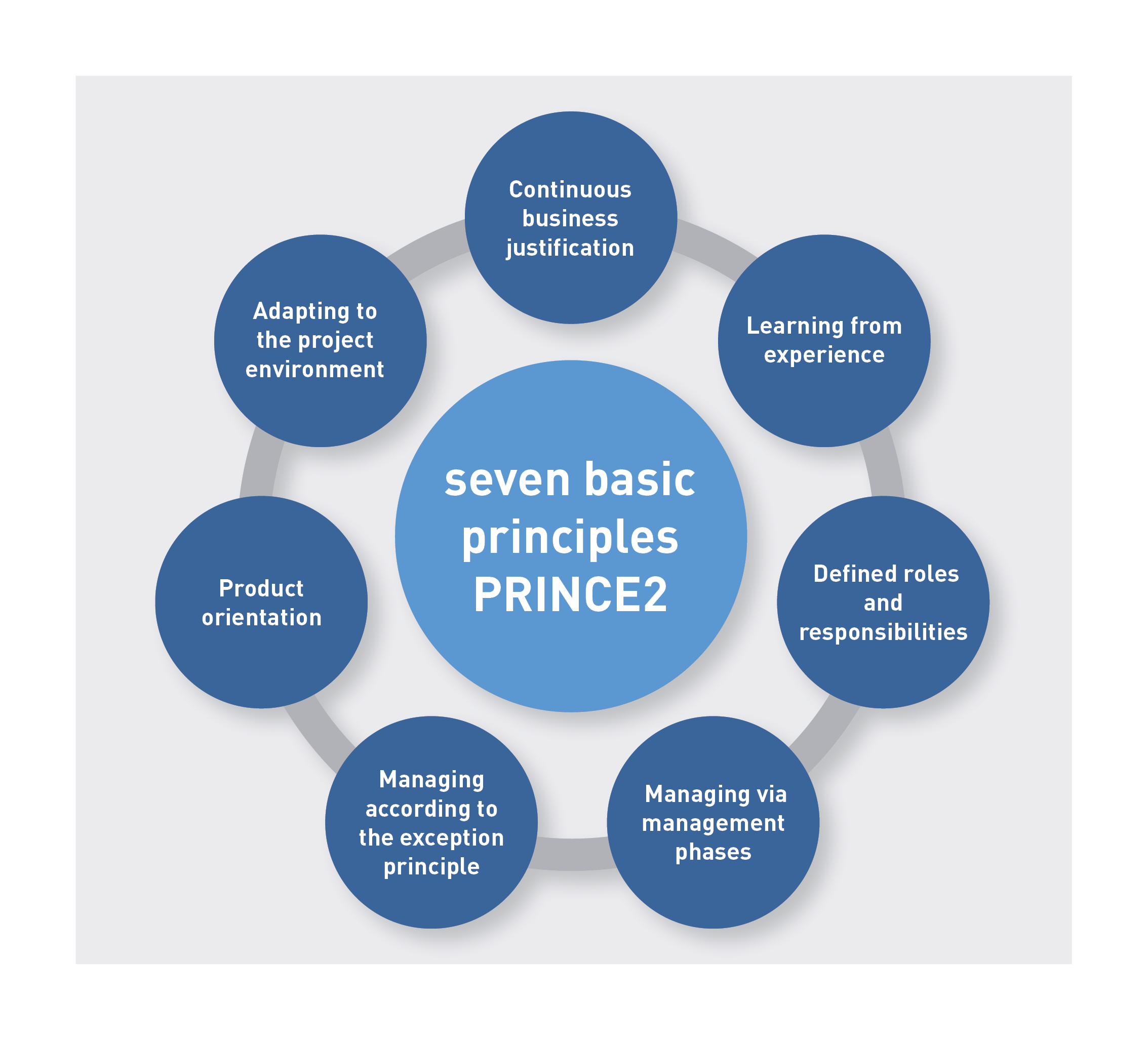
The seven principles of PRINCE2 form the backbone of the entire framework. They create a reliable framework that enables project teams to work in a clearly focused, targeted and controlled manner. Each principle helps to
minimize risks
clearly allocate responsibilities
ensure project success
Principle 1: Continuous business justification
This principle states that a project should only be started and continued if it yields a clearly defined economic benefit. A valid business case must be created at the beginning and continuously reviewed throughout the entire course of the project. This prevents resources from being allocated to projects whose benefits dwindle over time or when market conditions change.
Practical example
A medium-sized company plans to implement a new IT platform to optimize processes. The business case created documents ROI and savings, which are regularly reviewed during the project. If market conditions change drastically, the project is adjusted or canceled to ensure resources are used wisely.
Principle 2: Defined roles, responsibilities, and relationships
Clear roles and responsibilities ensure that everyone knows what they have to do and who makes the decisions. This helps to avoid misunderstandings and enables quick reactions.
Practical example
When a new transportation network is being built, the project manager is responsible for control, while the steering committee makes strategic decisions. A quality manager monitors compliance with standards. If delays occur, everyone immediately knows who is responsible – and solutions are found quickly.
Principle 3: Learning from experience
Experience gained from completed projects is systematically documented and incorporated into new projects. This helps to avoid mistakes and reinforces proven methods.
Practical example
A manufacturing company conducts retrospectives after each project phase. Communication problems in an earlier project led to the introduction of a standardized communication protocol that makes future projects significantly more efficient and reliable.
Principle 4: Management by stages
Projects are divided into clearly defined phases, the completion of which is checked and approved. This ensures that the project remains controllable and manageable.
Practical example
When developing new software, the work is divided into phases such as planning, design, implementation, testing and rollout. After each phase, the following is checked: have the objectives been achieved? Are the risks manageable? If problems arise, the steering committee decides on corrections or adjustments.
Principle 5: Management by exception
Management only intervenes in the event of significant deviations. Within defined tolerances, the project team works independently, thus conserving management resources.
Practical example
A construction project defines tolerances for budget, time and quality. The team resolves overruns of up to 5% itself, and the steering committee is involved for overruns of 15% or more. This allows management to focus on critical decisions.
Principle 6: Product orientation
The focus is on clearly defined, high-quality end products – not just on activities. The aim is to deliver specific results that meet requirements.
Practical example
When developing an app, the team defines which functions and quality criteria must be met from the outset. Instead of getting bogged down in tasks, they regularly check whether the product meets the user requirements.
Principle 7: Adapting to the project environment
PRINCE2 is flexibly adapted to the respective project. This makes it equally suitable for small, agile projects and large, complex projects.
Practical example
A start-up uses PRINCE2 in a simplified, agile form with little bureaucracy. A large corporation, on the other hand, uses the complete framework including detailed documentation. Both adapt PRINCE2 to best suit the project – sometimes flexibly, sometimes in a structured way.
The 7 practices of the PRINCE2 method
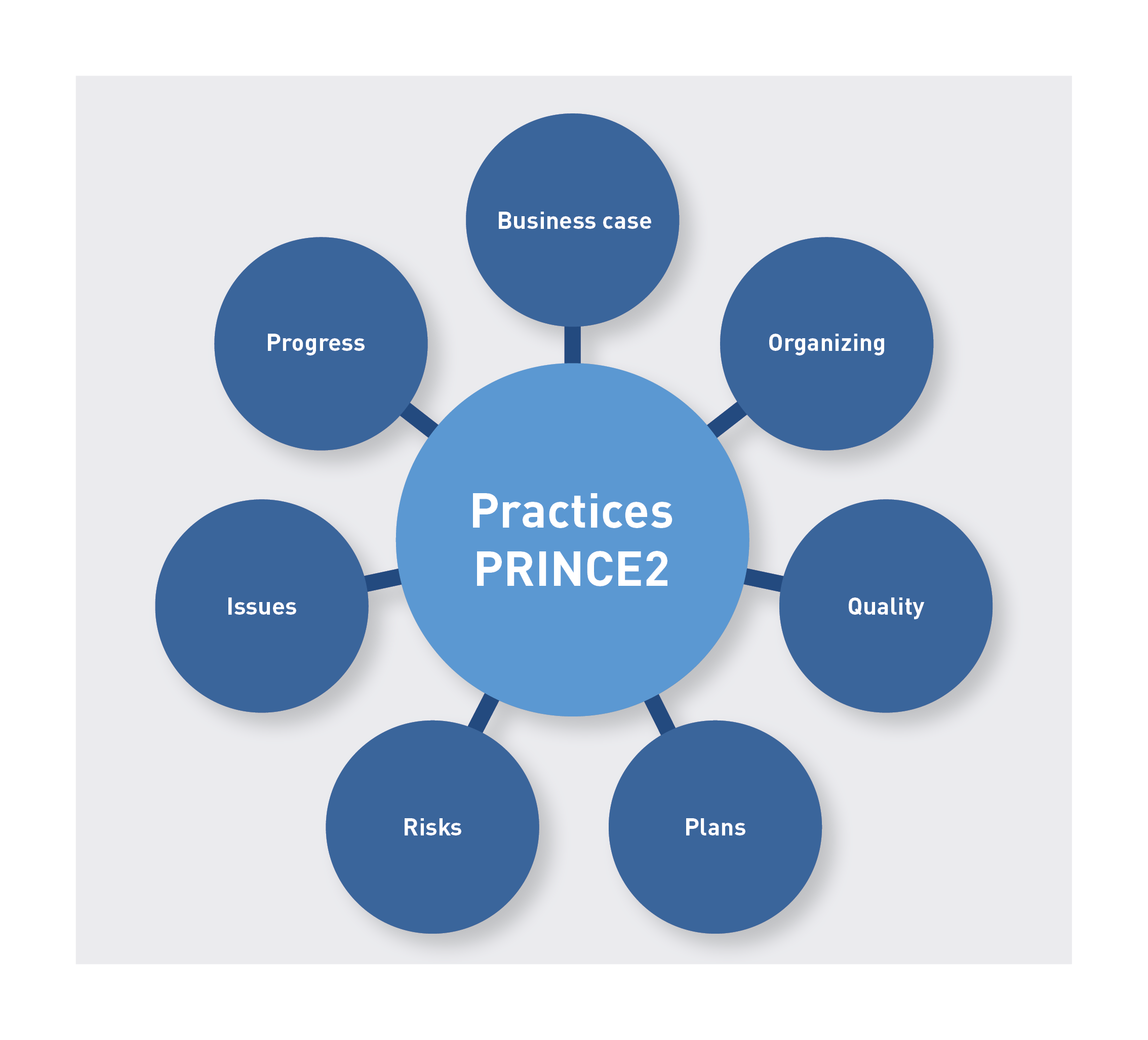
The seven practices of PRINCE2 form the basis of structured project management. They ensure that all important aspects are considered and managed from the start to the finish of a project.
While the principles provide the binding framework, the seven practices describe the information, control mechanisms, and management products required at each stage of a project. They must be continuously observed throughout the entire project and ensure that the methodological framework of PRINCE2 is consistently implemented in practice.
Practice 1: Business case – justification and profitability
The business case justifies why the project is being carried out at all. It shows the expected benefits and is regularly reviewed throughout the entire project. This is how we ensure that costs and benefits continue to be balanced even when conditions change.
Practical example
A company wants to introduce a new ERP system. The business case shows the advantages. If the basic conditions change, it is checked whether adjustments are necessary – for example, to the functional scope or the goals.
Management products which support practice 1
Business case
Benefits management approach
Sustainability management approach
Practice 2: Organizing – allocation of roles and stakeholder management
The practice of organization regulates the roles, responsibilities and decision-making processes. A clear structure and good stakeholder management avoid misunderstandings and ensure that everyone involved knows what needs to be done.
Practical example
In an international construction project, clear roles are crucial – from technology to sales. A defined project organization and regular coordination ensure smooth operations.
Management products which support practice 2
Communication management approach
Project management team structure
Role descriptions
Practice 3: Quality – Ensuring and controlling results
Quality means defining clear requirements from the outset and regularly checking whether these are actually being met. This is how products and results are created that meet expectations – both technically and in terms of content.
Practical example
A software company is developing an app. Quality standards are defined at the very beginning. Tests during development ensure that the app works and that users like it.
Management products which support practice 3
Product description
Quality management approach
Quality register
Product register
Practice 4: Plans – Structured planning and milestones
Plans structure the project. They define tasks, dates and milestones. With a good plan, we keep an overview and recognize early on if something is getting out of hand.
Practical example
When introducing a new production line, there is a clear plan for each step – from procurement to training. Delays can be quickly identified and remedied.
Management products which support practice 4
Plan (project, stage, team, exception)
Project product description
Work package description
Practice 5: Risks – Dealing with uncertainties and opportunities
Risks are part of every project. It is important to recognize and manage them at an early stage. PRINCE2 therefore requires systematic risk management that also takes opportunities into account.
Practical example
When setting up a new network, risks such as supply bottlenecks or new requirements are identified early. Contingency plans ensure that the project remains successful nonetheless.
Management products which support practice 5
Risk management approach
Risk register
Practice 6: Issues – Change management during the course of the project
Projects change. The changes practice ensures that new requirements are evaluated and implemented in a structured manner – without losing sight of the overall goal.
Practical example
A customer requests additional security features for a portal. With a clear change process, it is checked whether and how the requests can be integrated – without jeopardizing the project.
Management products which support practice 6
Issue management approach
Issue register
Issue report
Practice 7: Progress – Monitoring and controlling project progress
The practice of progress ensures that the project is always kept in view. Regular status reports, meetings and clear key figures help to identify the current status and to take countermeasures in good time.
Practical example
When a new software is introduced, progress is tracked using dashboards and milestones. If there are delays, immediate action is taken to get the project back on track.
Management products which support practice 7
Digital and data management approach
Daily log
Lessons log
Checkpoint report
Highlight report
Lessons report
Exception report
End stage report
End project report
The 7 PRINCE2 Processes
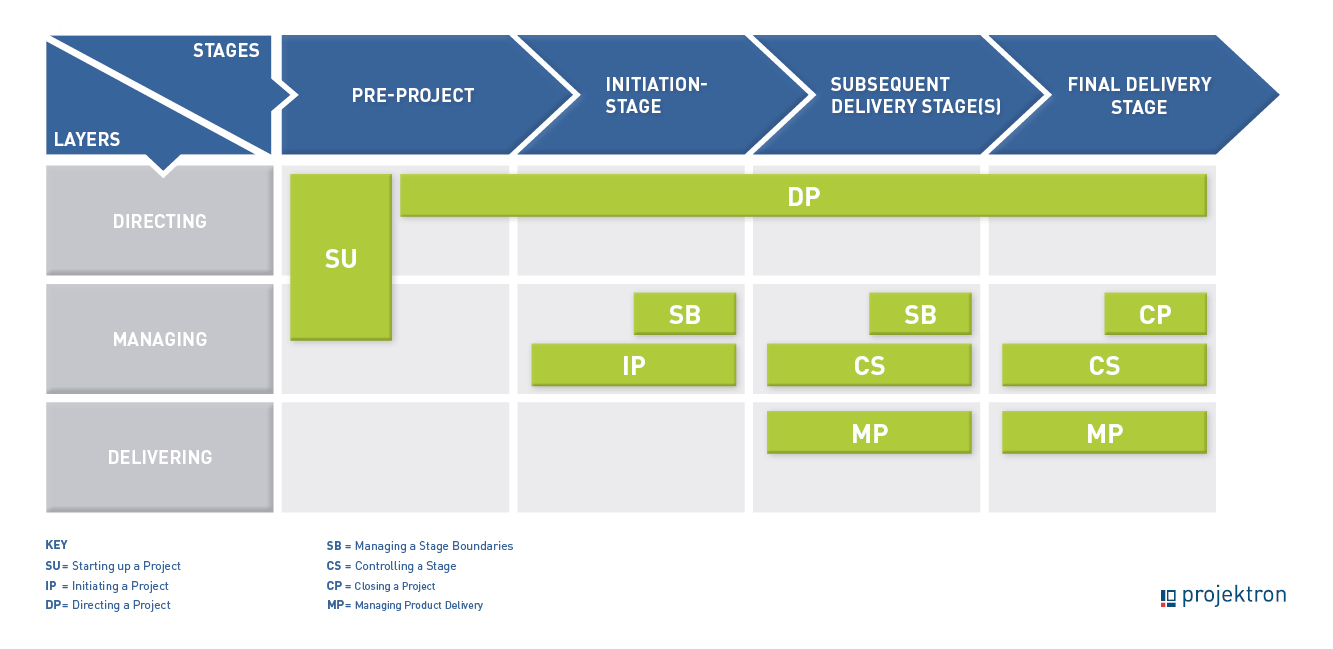
PRINCE2 structures the project lifecycle into seven clearly defined processes. These processes are logically aligned, follow an overall sequence, and can be applied iteratively. Together, they cover the entire project lifecycle—from the initial idea through the management of individual stages to the formal closure of the project.
Process 1: Starting up a Project (SU) – Initial preparation and decision readiness
The purpose of this process is to ensure that the prerequisites for initiating the project are in place. Basic information is gathered, objectives are clarified, and the project idea is critically examined. An initial assessment of risks, opportunities, and feasibility is carried out.
Key outputs of this process include the project mandate, an initial project brief, and an outline business case. These form the basis for the decision on whether the project should proceed to initiation.
Process 2: Initiating a Project (IP) – Detailed planning and approval
During initiation, the project is planned in detail. The project manager prepares the Project Initiation Documentation (PID), including the project plan and baselines for time, cost, quality, scope, risk, and benefits.
The business case is refined and serves as a key decision-making instrument. The Project Board reviews and approves the initiation documentation, thereby authorising the project to proceed.
Process 3: Directing a Project (DP) – Strategic control by the Project Board
Directing a Project is a continuous process that spans the entire project lifecycle. It focuses on strategic decision-making rather than day-to-day management.
The Project Board authorises project initiation, approves management stages, responds to escalations, and ensures that the project remains aligned with business objectives. The Board intervenes only when tolerances are exceeded and provides the necessary direction, resources, and support.
Process 4: Managing a Stage Boundary (SB) – Review and preparation of the next stage
At the end of each management stage, progress is reviewed and the next stage is prepared. The business case is reassessed, plans are updated, and lessons learned are captured.
Based on the updated information, the Project Board decides whether the project should continue and authorises the next management stage. Detailed planning for the upcoming stage is completed.
Process 5: Controlling a Stage (CS) – Day-to-day management by the project manager
Controlling a Stage covers the day-to-day management activities of the project manager within a management stage. Work packages are authorised, progress is monitored, and corrective actions are taken when necessary.
The project manager ensures that work remains within agreed tolerances, coordinates team activities, and reports regularly on progress and issues.
Process 6: Managing Product Delivery (MP) – Ensuring delivery of agreed products
This process ensures that the agreed products are created and delivered according to defined quality criteria. Teams carry out the work as specified in authorised work packages and report progress and results to the project manager.
Close coordination between teams and management ensures that products are delivered on time and meet the expectations set out in the business case.
Process 7: Closing a Project (CP) – Formal closure and lessons learned
Closing a Project ensures that the project is formally closed in a controlled manner, whether it has been completed successfully or terminated early.
Project results are evaluated, outstanding issues are addressed, and lessons learned are documented. The formal closure confirms that objectives have been met (or that closure is justified) and supports organisational learning for future projects.
What roles and responsibilities are there in PRINCE2?

Roles and responsibilities in PRINCE2 – brief overview
Roles and responsibilities in PRINCE2 – brief overview
Clear roles create transparency, responsibilities, and fast decision-making processes – a crucial success factor in complex projects.
Key roles:
Project board: Strategic decisions, approval of milestones
Project manager: Operational project management, compliance with specifications
Team Manager: Implementation of work packages and delivery of products
Project Support & Project Assurance: Administrative support and control of specifications
Change Committee: Decisions on change requests during the project
The successful implementation of a project is based not only on clearly defined processes and principles, but also on a precise assignment of roles and responsibilities. PRINCE2 attaches great importance to ensuring that each role within a project is clearly defined and assigned specific tasks. This ensures that all participants know who is responsible for which decisions and how cooperation between the various actors is organized.
Primary stakeholders according to PRINCE2®:
Clients ensure that a project generates a return on investment.
Users will use the project products, i.e., benefit directly from them.
Suppliers provide resources, knowledge, and skills and produce the project products.
These three primary stakeholder groups must be represented in the project management team and the project board. This is guaranteed by the following basic roles or positions in PRINCE2:
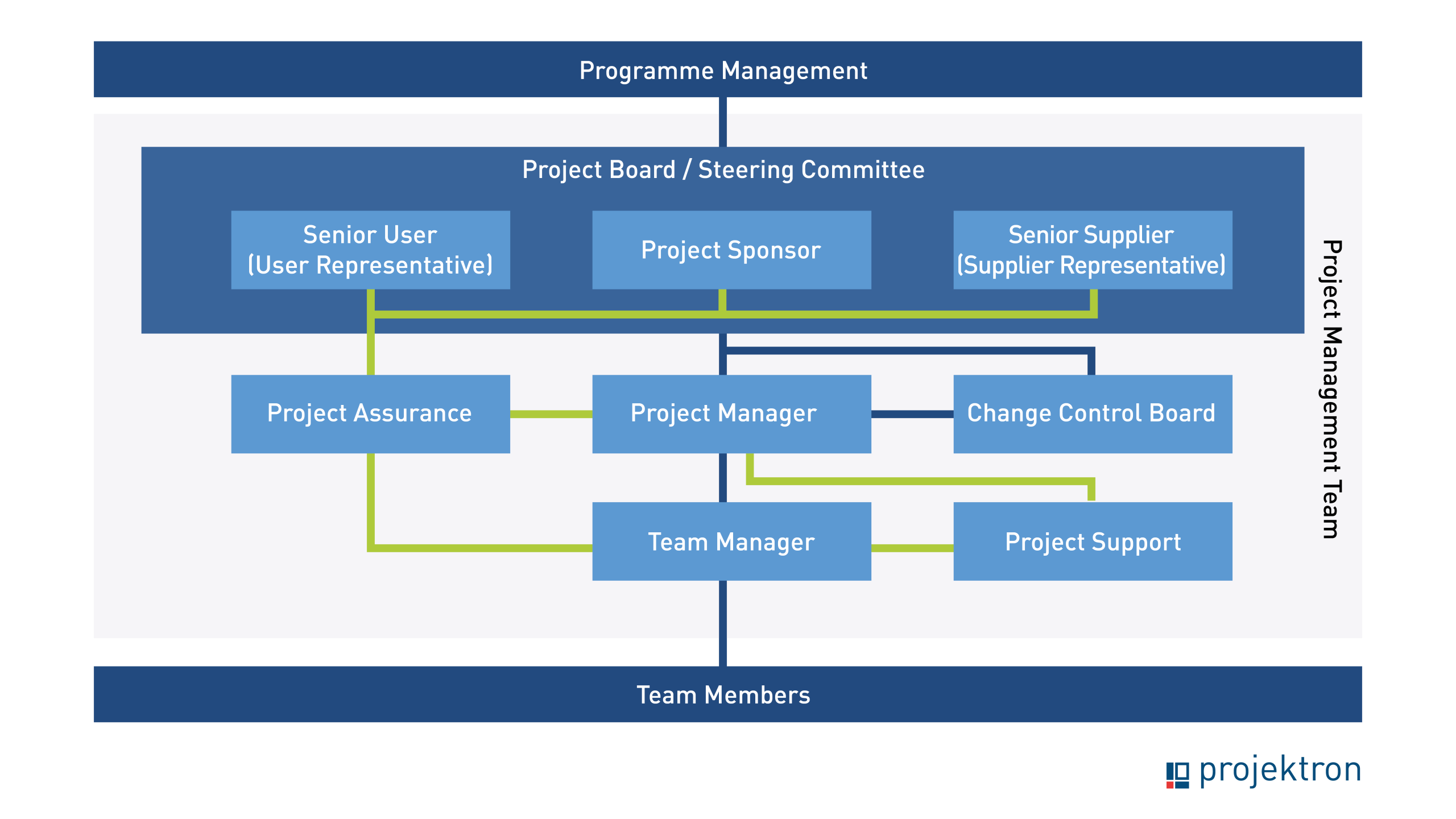
Project board (steering committee)
The project board forms the strategic management level and ensures that the project meets the business objectives. It is composed of the most important stakeholders, such as executives from finance, operations, and IT. Its tasks include approving plans, monitoring progress, and releasing resources. It makes strategic decisions, intervenes in the event of deviations, and maintains the business justification.
Senior User / Senior Supplier
These roles represent the interests of the users and suppliers. The Senior User ensures that the requirements and quality criteria of the end users are met. The Senior Supplier ensures resources, technical expertise, and implementation quality. Both work closely together to strike a balance between user needs and technical feasibility and sit on the project board together with the client.
Project Manager
The project manager manages the project operationally and is responsible for planning, coordinating, and monitoring all activities. He or she ensures that time and budget targets are met and acts as an interface to the project board, to which he or she reports regularly.
Project assistance and project assurance
The project assistant provides support with documentation, organization, and communication in the project. Project assurance independently monitors compliance with specifications and reports to the project board.
Change authority
The change authority decides on change requests that arise during the project. They review the impact on costs, time, and quality and only approve reasonable adjustments.
Team manager
The team manager leads one or more teams, plans tasks, and monitors the quality of results. They provide technical support and ensure that the objectives within the work package are achieved.
What's new in PRINCE2 7?
With the publication of PRINCE2 7 in 2023, the framework will be responding to the changing requirements of modern companies. The latest version will build on the proven principles,practices and processes of previous versions, but will integrate current insights and best practices from project management.
Major innovations in PRINCE2 7 include:
| Flexibility and scalability: PRINCE2 7 has been designed to be more adaptable to different project sizes and complexities. Organizations can customize the scope of the methodology without losing structure. | |
| Updated processes and practices: The processes and practices have been modernized to better integrate with digital work environments. This means that the documentation processes are simplified and more digitally supported. | |
| Stronger integration of agile elements: Although PRINCE2 is classically structured, PRINCE2 7 takes into account the increasing importance of agile working methods. It lays the foundation for a hybrid approach in which rigid process steps can be combined with flexible, iterative methods. | |
| Improved communication and collaboration: PRINCE2 7 supports more transparent and effective collaboration within project teams and between stakeholders with new tools and clearly defined communication channels. | |
| Focus on continuous improvement: PRINCE2 7 places even more emphasis on collecting and utilizing lessons learned in order to systematically anchor the continuous improvement process in projects. |
PRINCE2 Agile: Is the PRINCE2 method agile?
In principle, PRINCE2 can be assigned to the classical project management methods. However, in addition to the classical variant, an agile variant of PRINCE2 has now been established: PRINCE2 Agile®. Since 2015, an additional manual has described the integration of agile frameworks into the PRINCE2 process model. Agile methods such as Scrum and Kanban are characterized by their flexibility, rapid iterations and high adaptability. PRINCE2 Agile integrates these elements so that organizations can benefit from both worlds.
What is PRINCE2 Agile? PRINCE2 Agile combines the flexibility and responsiveness of AgilePM with the clearly defined overarching process control framework of PRINCE2. PRINCE2 Agile was developed for companies and individuals who use PRINCE2 and also want to benefit from the advantages of agile methods. The integration of agile approaches primarily relates to the concrete implementation. PRINCE2 Agile thus also enables agile work in complex projects and is a popular method for hybrid project management.
Strengths and advantages of the PRINCE2 method as propagated
PRINCE2 is recognized worldwide as a professional and robust project management approach and can be applied to projects of any type, size, organization, geography, and culture. The method provides a clear framework without restricting the flexibility required in everyday project work.
Focus on benefits and cost-effectiveness: A key feature of PRINCE2 is continuous business justification. Projects are only started and continued if they deliver measurable benefits. The business case is reviewed regularly, preventing resources from being invested in projects that lose their cost-effectiveness over the course of the project.
Clear processes, standards, and templates: PRINCE2 provides clearly defined processes, roles, and management products. Standardized templates and a uniform vocabulary ensure repeatability and transparency—especially in large organizations or project landscapes with many participants. Employees who are familiar with PRINCE2 quickly find their way around new projects.
Management by exception: A central control principle is management by exception. Project managers can work independently within defined tolerances, while higher management levels only need to intervene when deviations occur. This reduces the control effort and increases efficiency.
Clear roles and responsibilities: The clear distribution of roles ensures that responsibilities are regulated transparently. Decision-making processes are clearly defined, conflicts are minimized, and cooperation between clients, users, and suppliers is supported in a structured manner.
Product-based planning: PRINCE2 pursues a consistently product-oriented approach. Right from the start, the project results are clearly defined and assigned acceptance criteria. This integrated requirements analysis reduces the risk of starting projects based on false assumptions or developing them in a way that does not meet actual needs.
Flexibility through scalability: Contrary to popular belief, PRINCE2 is not a rigid approach. The method can and must be adapted to the size and complexity of the project and the organizational framework conditions – from small internal projects to complex large-scale projects.
Presumed weaknesses and disadvantages of the PRINCE2 method
Despite its numerous strengths, PRINCE2 is regularly the subject of critical discussion. However, many of these criticisms can be put into perspective or classified.
“Too much documentation”: This criticism is particularly true when PRINCE2 is not scaled appropriately. The method does not require unnecessary bureaucracy, but rather appropriate documentation. If management products are adapted to the size of the project, the documentation effort remains manageable and reasonable.
“Not agile enough”: PRINCE2 follows a clear, classic structure. However, this does not exclude agility. PRINCE2 Agile is an approach that combines agile working methods with the governance structure of PRINCE2. In practice, PRINCE2 is often successfully supplemented with agile methods.
“High complexity for beginners”: The multitude of roles, topics, and processes can seem overwhelming at first. However, this phenomenon is not specific to PRINCE2, but affects almost all established project management methods. With increasing use, routine increases—comparable to learning a foreign language.
“Limited coverage of methods and soft skills”: PRINCE2 primarily describes methodological control mechanisms. Supplementary techniques such as critical path analysis or earned value analysis, as well as leadership and communication skills, must be added depending on the project. In practice, however, this is more of a conscious distinction than a disadvantage.
Integration of PRINCE2 with other methods and frameworks
PRINCE2 is a powerful framework for managing individual projects. However, projects rarely stand alone. They are often part of larger initiatives, such as programs or portfolios. You will also regularly encounter topics such as risk management or IT-specific requirements in projects. This is precisely where PRINCE2 shows its strength: it can be flexibly combined with other recognized methods and frameworks. This allows you to create an integrated control system that is tailored to your organization and its challenges.
Portfolio and program management with MoP® and MSP®
Many organizations manage not only individual projects, but also a large number of initiatives that contribute to overarching business objectives. PRINCE2 focuses on managing the individual project – MoP® (Management of Portfolios) and MSP® (Managing Successful Programmes) are available to help manage entire project landscapes.
MoP helps you select the right projects and allocate resources effectively. It ensures that your organization implements precisely those projects that bring the greatest benefit. PRINCE2 comes into play when it comes to the actual implementation of these projects.
MSP, on the other hand, is aimed at managing programs, i.e. several interrelated projects that together implement a strategic change. PRINCE2 projects can be managed as building blocks of a larger program. By combining PRINCE2 and MSP, you create a clear framework: MSP sets the direction, PRINCE2 provides the methodology for implementation.
Risk management with M_o_R®
Risk management is part of every successful project. Although PRINCE2 has its own risk management guidelines, a deeper, more specific approach is necessary, which is where M_o_R® (Management of Risk) PRINCE2 ideally complements.
M_o_R provides a systematic framework for identifying, evaluating and managing risks in projects, programs and the entire company. While PRINCE2 keeps an eye on the risks of a project, M_o_R provides additional strategies and procedures to treat risks consistently across the company. This combination ensures consistency and security, especially for companies with many parallel projects.
IT project management and PRINCE2 in software development
Many companies also use PRINCE2 in IT and software projects. In these projects, questions often arise as to how classic project management structures can be combined with agile methods such as Scrum® or SAFe.
PRINCE2 offers PRINCE2 Agile®, a specially extended variant that combines agile working methods with the proven PRINCE2 structures. This allows you to benefit from the advantages of both worlds: the flexibility of agile development teams is maintained, while PRINCE2 provides the necessary control and transparency.
In software development, you can also combine PRINCE2 with ITIL® or DevOps. ITIL manages your service processes, while PRINCE2 ensures the structured implementation of software projects. DevOps builds the bridge to continuous integration and delivery of software (CI/CD), with PRINCE2 ensuring overarching project management and release processes.

Thilo Menges
Head of Corporate Development, Medical University of Lausitz - Carl Thiem
About 20 project managers, who are responsible for projects in the three core areas of IT, digitization & innovation and research, are actively involved in using BCS, since they partly draw on the same resources to carry out their projects. For our major projects, we use the PRINCE2 project management method, which optimally supports BCS with functionalities and corresponding assistants, as far as it suits the organization in each individual case.
Apply the PRINCE2 method: certifications and training
Anyone who wants to apply PRINCE2 successfully in projects will benefit from sound training. PRINCE2 certifications provide you with exactly this foundation. They not only prove your knowledge, but also give you a structured understanding of how to apply PRINCE2 in practice. The certifications are divided into two levels: Foundation and Practitioner.
PRINCE2 Foundation certification is aimed at those new to project management or those who want to understand the basic principles and terminology of PRINCE2. You will learn how the framework is structured, which processes and roles are available and how PRINCE2 works in a structured way. With Foundation certification, you demonstrate that you understand the method and can work in projects with PRINCE2 teams. The route to Foundation certification usually involves official training, which often lasts two to three days. At the end, you take an exam that tests your knowledge of the basics.
The PRINCE2 Practitioner certification builds on the Foundation. It is aimed at people who want to actively apply and manage PRINCE2 in projects. The aim of the Practitioner level is to use PRINCE2 flexibly and in a way that suits the situation. Here you will learn how to adapt the method to different projects, how to evaluate specific project situations and which decisions are necessary in which step. For Practitioner certification, you will usually attend an advanced training course (usually two days) that focuses on practical application. The subsequent exam is complex: in a scenario-based test, you will have to apply your knowledge in practice and show how you would deal with typical project situations.
Both exams are conducted by PeopleCert, the official PRINCE2 examining body. There are numerous PRINCE2 training providers, ranging from large training companies to specialized PRINCE2 training providers. It is important that the training is accredited and adheres to the official syllabus. To prepare successfully, it is recommended that you work through the official PRINCE2 manual intensively.
Which project management software is suitable for the PRINCE2 method?
If you are looking for a project management software that can map the PRINCE2 method in the best possible way, without you having to make concessions or even do without certain PRINCE2-specific functions, you should already pay attention to the corresponding functions when selecting the software. As our current market overview and project management software comparison show, not every popular and well-known project management software is suitable for implementing projects according to PRINCE2. Follow our 9-step plan when selecting project management software to evaluate purposefully and make the right decision in the long term.
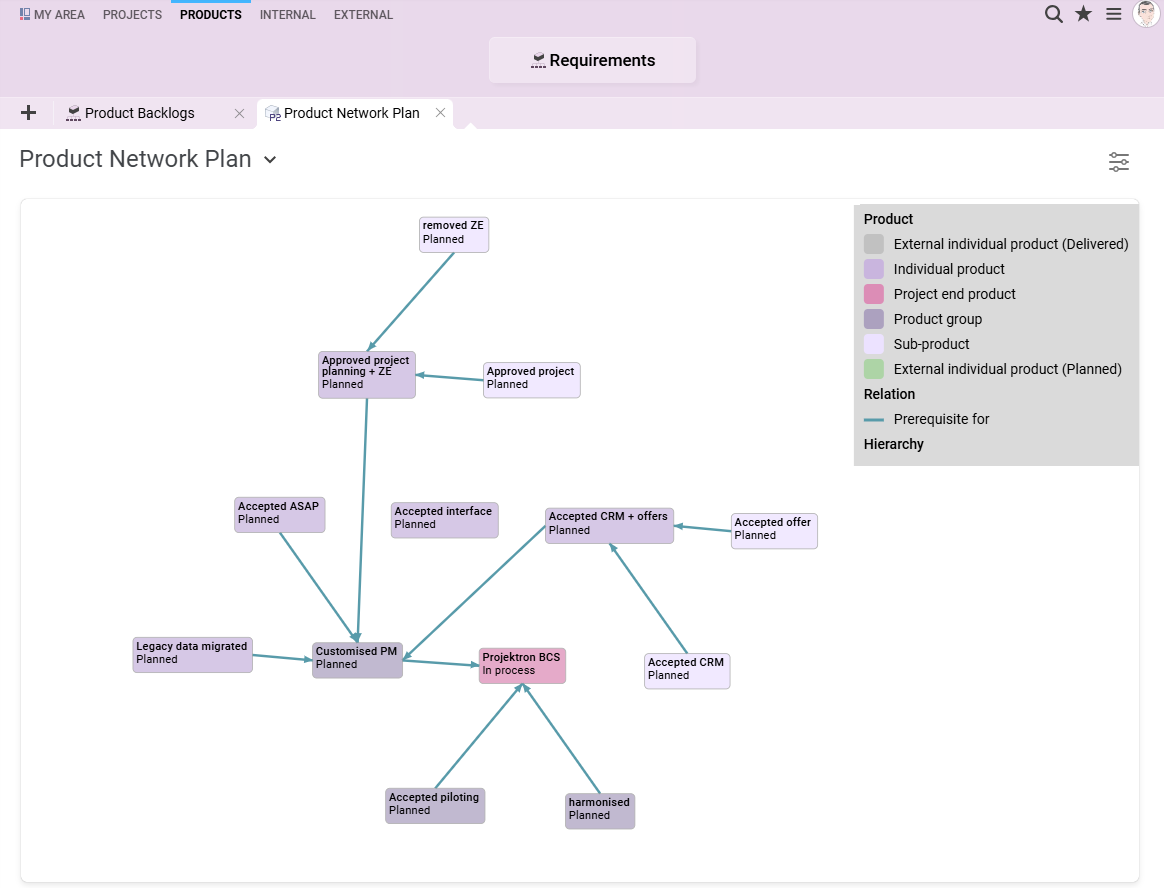
BCS not only fully supports project management using the PRINCE2 method, but also provides a suitable assistant that supports you from the very beginning when planning your projects using PRINCE2 and reliably accompanies you through to the completion of a project. The PRINCE2 functions in BCS include, among other things:
A quality register in which you define criteria for your project success.
Tolerance limits that you can store for your project values together with the steering committee.
Comprehensive planning tools for rough and detailed planning of your project phases.
Specific resource management with resource preview.
Change management for open points that the steering committee can check and accept with a single click.
Report generator, for example for your business case.
Easy assignment of project roles and display as an organizational chart.
Graphical network plan for related products with predecessor-successor relationships.
Best Practice: PRINCE2 implementation at DVZ M-V with BCS

DVZ Datenverarbeitungszentrum Mecklenburg-Vorpommern GmbH, the state's central IT service provider, has been working with the process-oriented project management method PRINCE2 since 2008. Every year, around 100 development projects and over 1,000 operational and service projects with budgets between €10,000 and €5 million are implemented. In software projects, PRINCE2 is combined with Scrum. With 17 years of experience, over 100 qualified employees and 25 PRINCE2 practitioner certifications, DVZ has a high level of maturity. A dedicated project management office (PMO) monitors quality and supports project managers.
In 2016, the company was looking for software that fully supports PRINCE2 and reduces the high level of manual work involved in day-to-day project work in order to meet the increasing demands on modern and efficient project management. In BCS from Projektron, DVZ found a solution that perfectly meets its methodological and organizational requirements.

Arne Hennes
Head of the Project Management Office (PMO) at DVZ GmbH
With BCS, we have found a software that allows us to implement PRINCE2 consistently, efficiently and in a user-friendly way. In particular, the integration of assistants, workflows and reports makes our work much easier and more structured.
BCS itself was introduced as a PRINCE2 project. To promote acceptance within the company, a multi-level training concept was developed and an internal coaching program was established that is still in place today. Supplemented by an internal trade fair, employees were able to familiarize themselves with the new solution at an early stage.
DVZ placed particular emphasis on the complete mapping of the PRINCE2 project process: with the BCS-supported assistants, the project managers are guided securely through all the phases – from initiation to completion. A graphical product structure plan always shows the current project status transparently, while standardized reports and dashboards support communication with management and the steering committees.
By introducing BCS, the number of tools used was reduced from 15 to a single solution. Manual and paper-based processes that were previously necessary are now completely eliminated. The PMO also benefits from a significant reduction in administrative effort and better control of the entire project landscape.
An additional added value: data from other systems such as SAP or the service recording can be synchronized via interfaces. This means that decision-relevant information is available in real time – a basis for successful project management and control according to PRINCE2.
In the success story of DVZ GmbH, Arne Hennes provides detailed insights into the use of BCS for implementing project management according to PRINCE2 at DVZ GmbH.
Conclusion: Why PRINCE2 is a valuable framework
PRINCE2 has proven itself over decades and is one of the world's leading standards in project management. The method offers a clear structure, defined roles, and consistent product-based planning. This creates transparency about goals, responsibilities, and progress at all times—a key prerequisite for efficient and controllable projects.
A key success factor of PRINCE2 is its consistent focus on benefits and cost-effectiveness. Projects are not only planned carefully, but also critically examined and controlled throughout their entire course. This ensures that resources are used in a targeted manner and that projects are only continued if they deliver real added value.
At the same time, PRINCE2 is not a rigid set of rules. The method can be flexibly adapted to project size, complexity, and organizational conditions and can be effectively combined with agile approaches. For example, teams can work operationally according to Scrum, while PRINCE2 provides the overarching governance and control framework. The PRINCE2 Agile extension explicitly supports this combination.
In my experience, PRINCE2 is a particularly good choice when professionalism, traceability, and reliability are required in project management—for example, in:
complex projects
regulated industries (e.g., finance, medicine, energy)
Projects with many stakeholders
Public and government projects
For organizations that want to professionalize their project management in the long term, PRINCE2 remains a powerful and future-proof framework.

About the Author
Jörg Loßmann is a PMO project manager with many years of experience in professional project management. As Senior Project Management Officer at the TWT Group, he was responsible for setting up a central, cross-company PMO and introducing BCS as group-wide project management software. Prior to that, he worked as a consultant at Projektron GmbH. One focus of his work was the implementation of PRINCE2.
FAQ – PRINCE2
What does PRINCE2 mean?
What does PRINCE2 mean?
PRINCE2 stands for "Projects in Controlled Environments." The method aims to structure projects in a clear and manageable way. It ensures that every step is planned, monitored, and controlled. Furthermore, it is based on proven processes and best practices from real-world experience, giving you confidence that your projects are well-prepared and reliably executed.
What is PRINCE2 and what is PRINCE2 Agile?
What is PRINCE2 and what is PRINCE2 Agile?
PRINCE2 is a classic project management methodology known for its process orientation and clearly defined roles. PRINCE2 Agile combines this structure with agile approaches like Scrum or Kanban, giving you the proven planning and control of PRINCE2 along with more flexibility and adaptability. This combination is ideal for dynamic projects that require frequent adjustments, allowing you to benefit from the best of both worlds.
How does PRINCE2 work?
How does PRINCE2 work?
PRINCE2 is process-oriented and structures projects into clearly defined phases. At the start, you define project objectives and benefits, then break work into manageable stages. Each phase is planned, executed, and reviewed before moving to the next. Roles and responsibilities are clearly defined so everyone knows what to do. Regular reports ensure you maintain control over progress, costs, and risks at all times.
Why should you use PRINCE2?
Why should you use PRINCE2?
PRINCE2 provides a proven, easily adaptable project management method with a clear and structured approach. It helps you plan projects better and identify risks early. Standardized terminology and processes simplify collaboration. The method is internationally recognized, benefiting certification and career development. Overall, PRINCE2 helps make your projects more transparent, efficient, and successful.
When is PRINCE2 project management applied?
When is PRINCE2 project management applied?
You use PRINCE2 when you want to manage projects in a structured way with clear processes. It is especially suitable for larger or complex projects with many participants and high requirements for structure, quality, and control. PRINCE2 is also useful when you need regular status reports and decision support. The method can be easily adapted to project size and type, making it versatile and applicable in many industries.
How difficult is PRINCE2?
How difficult is PRINCE2?
PRINCE2 is easy to understand if you approach it step by step. The method is well-structured and thoroughly documented in a manual. The Foundation certification covers the basics and process descriptions. Practitioner level is more challenging, requiring practical application. With proper preparation and some project experience, it is very achievable.
What can be adapted in PRINCE2?
What can be adapted in PRINCE2?
PRINCE2 is designed to be flexible, allowing adaptation to project size, type, and industry. You decide which processes, roles, and documents to use fully or partially. Planning detail and reporting cycles can also be customized. This scalability prevents the method from becoming overly bureaucratic and ensures PRINCE2 fits your needs precisely.
What is defined when adapting PRINCE2 to a project?
What is defined when adapting PRINCE2 to a project?
When adapting, you define which PRINCE2 processes are used and their level of implementation. You assign roles and responsibilities according to your organization. Project document content and formats are adjusted to project size, and progress and risk monitoring is defined. This creates a tailored PRINCE2 approach for your project.
What is the PRINCE2 certification?
What is the PRINCE2 certification?
PRINCE2 certification is the official recognition that you understand and can apply the methodology in projects. There are Foundation and Practitioner levels, testing your knowledge and practical skills. Certification enhances career prospects, helps you take responsibility faster in projects, and is internationally recognized and regularly updated, keeping you aligned with best practices.
What are the benefits of a PRINCE2 certification?
What are the benefits of a PRINCE2 certification?
With a PRINCE2 certification, you demonstrate mastery of project management principles according to this international standard. It enhances your career prospects and professional competence. Certification helps you manage projects more efficiently and provides proof to companies that you can professionally support their project processes, giving you a clear advantage in the job market.
What advantages does PRINCE2 have over other project management methods?
What advantages does PRINCE2 have over other project management methods?
PRINCE2 features a clear process model easily adaptable to different projects. The methodology is internationally recognized, offering global applicability. It focuses strongly on efficiency and ongoing project control. Unlike purely agile methods, PRINCE2 provides a stable framework while leaving room for flexibility, making it versatile and practical.
How is PRINCE2 applied in practice?
How is PRINCE2 applied in practice?
You apply PRINCE2 step by step by running through its seven processes sequentially. Each project is planned deliberately, executed in controlled phases, and regularly reviewed for progress and quality. Clear roles and defined reporting structures improve communication and decision-making. PRINCE2 also helps manage risks and use resources efficiently, ensuring project goals are reliably achieved.
More interesting articles on the Projektron blog

Hybrid PM
Classic or agile? If the decision between these two approaches is difficult, a combination of two or more project management methods is probably the right way to go. Find out everything you need to know about hybrid project management in this article.
Scrum in software development
When it comes to agile software development methods, there is one term you cannot avoid: Scrum. But what exactly is Scrum and how does it develop its strengths in software development?
Project management software comparison
Get an up-to-date overview: We compare 15 of the most popular and best project management software solutions. Start here, discover the market and compare for yourself!
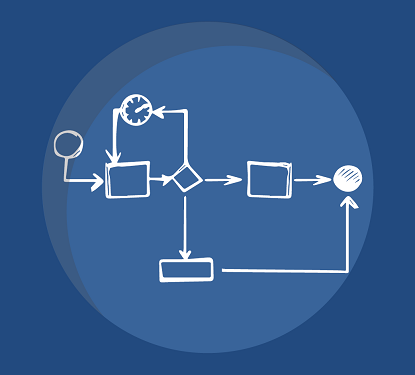
Process modeling with BPMN
BPMN - the standard for process modeling. BPMN stands for Business Process Model and Notation and is an international modeling language for business processes. You can find out everything about BPMN and how you can use it here.
The PRINCE2 logo: symbol of the internationally recognized project management method