11/20/2025 - Articles
Project management with PMI and PMBOK Guide – a proven standard in transition
The PMI's PMBOK Guide is considered one of the most important standards in project management and has undergone fundamental development with its seventh and now eighth editions. While earlier versions took a process-oriented approach, PMI now focuses more on flexible principles and results-oriented performance domains. This change enables companies to apply the PMBOK Guide not only to traditional projects, but also to agile and hybrid projects. But how can the PMBOK Guide be optimally implemented in practice? This article provides an in-depth look at the twelve principles, eight performance domains, and key certifications. We also show you how to work in accordance with the PMBOK Guide using Projektron BCS – from planning and risk assessment to reporting.
Contents:
- What are PMI and the PMBOK Guide?
- What is the PMBOK Guide used for?
- The ten knowledge areas at a glance (up to Edition 6)
- The 8 performance domains according to PMBOK Guide (since edition 7)
- The five process groups and their significance
- The 47 processes according to PMBOK Guide
- The 12 universal principles according to PMBOK Guide (since edition 7)
- Agile and hybrid methods in the current PMBOK Guide
- How does a project according to PMBOK Guide work?
- What are the benefits and challenges of PMBOK Guide?
- How does PMBOK Guide differ from other project management approaches?
- Hybrid approaches: combining PMBOK Guide and agile frameworks
- PMI certifications and learning paths
- Which software for PMBOK Guide-compliant project management?
- What does the future hold for PMI and PMBOK Guide?
What are PMI and the PMBOK Guide?
The Project Management Institute (PMI) was founded in the United States in 1969 to establish project management as an independent discipline and to professionalize it. At a time when structured project management methods had not yet been standardized in many industries, PMI recognized the need for a common understanding of best practices.
The founding idea was based on the following objectives:
Promoting a unified approach to project management
Providing training and certification
Developing an international network for the exchange of knowledge
Milestones in PMI history
Year | Event |
|---|---|
1969 | PMI founded in Pennsylvania, USA |
1984 | First version of the PMBOK Guide published |
1991 | Introduction of the Project Management Professional (PMP) certification |
1996 | Official recognition of PMBOK Guide as a standard by the American National Standards Institute (ANSI) |
2017 | Integration of agile methods into the PMBOK Guide (6th edition) |
2021 | Release of the 7th edition with a stronger focus on principles rather than rigid processes |
2025 | 8th edition of the PMBOK Guide with section on AI and return of processes |
With over 700,000 members and more than one million certified professionals worldwide, PMI is now the leading organization in the field of project management.
The current 8th edition of the PMBOK Guide
Publisher: Project Management Institute (PMI)
Publication Date: November 2025
Key Updates
- Six Core Principles: Guidelines for effective project management
- Seven Performance Domains: Governance, Scope, Schedule, Finance, Stakeholders, Resources, Risk
- Modernized Process Guidance: Reintroduced, flexible, and non-prescriptive
- Expanded Topics: Artificial Intelligence (AI), PMOs, Procurement
- Focus: Value delivery, adaptability, accountability
Core Message
The 8th Edition combines principles, performance domains, and modern process guidance into a flexible, practical framework. It supports traditional, agile, and hybrid projects alike, providing clarity, value focus, and adaptability in dynamic project environments.
The development of the PMBOK Guide – from its beginnings to the current edition
The PMBOK Guide (Project Management Body of Knowledge) is PMI's most important reference work. It defines methods, processes, and best practices that are considered the standard for professional project management.
In the 1980s, the PMI collected proven methods from practice to create a uniform project management methodology. This resulted in the first version of the PMBOK Guide in 1984, which served as a guide for professional project managers.
Edition | Year of publication | Key innovations |
|---|---|---|
1st edition | 1987 | First standardized definition of processes in project management |
2nd edition | 1996 | Introduction of the five process groups and nine knowledge areas |
3rd edition | 2004 | Expansion to include stakeholder and risk management |
4th edition | 2009 | Simplification and improved structuring of processes |
5th edition | 2013 | Introduction of the knowledge area “Stakeholder Management” |
6th edition | 2017 | Integration of agile methods |
7th edition | 2021 | Transition from process to principle orientation |
8th edition | 2025 | Section on opportunities, risks, and practical application of AI, return of processes |

Current focus of the PMBOK Guide: from process to principles and back?
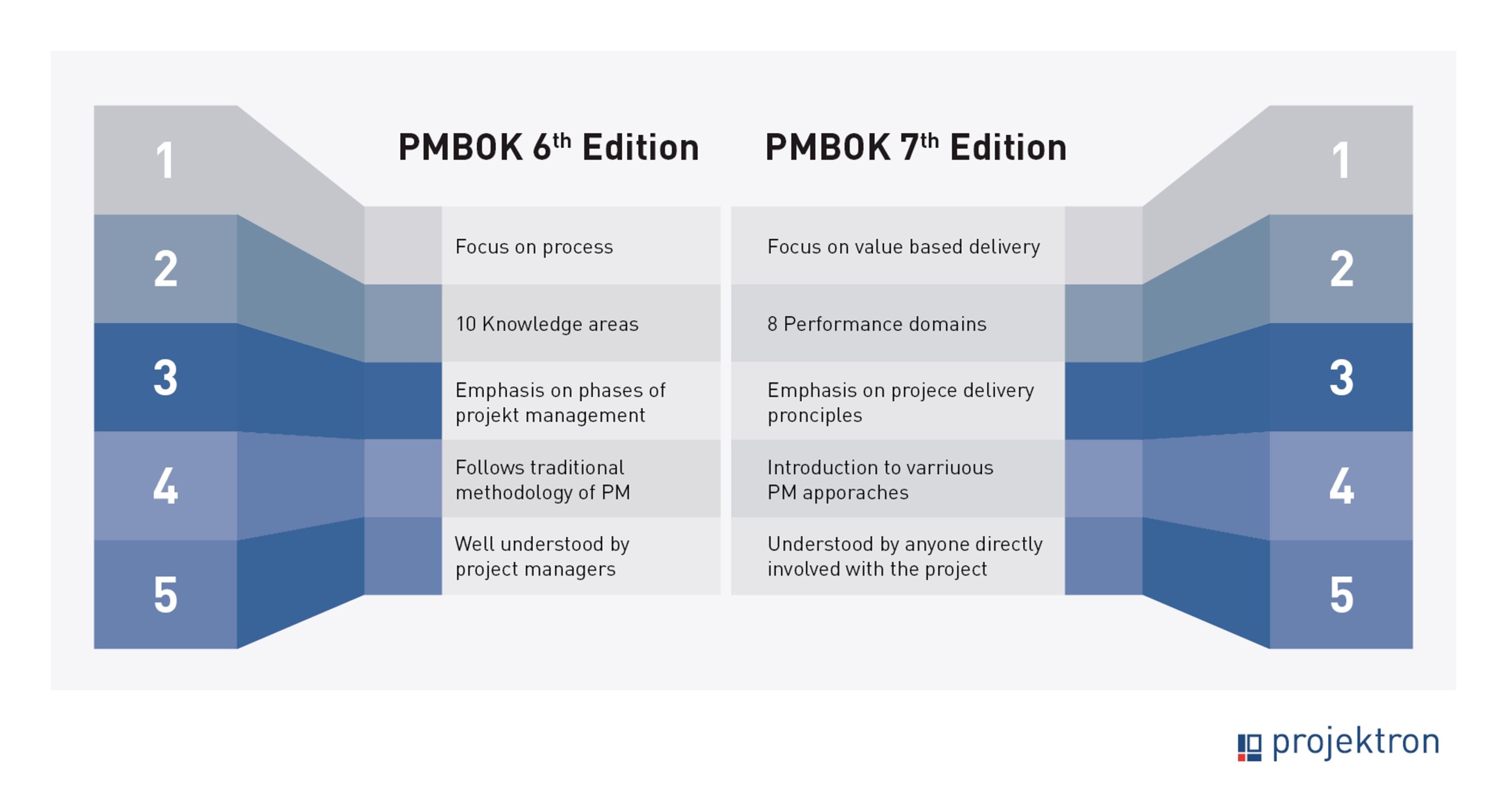
The 7th edition of the PMBOK Guide broke with previous versions by focusing less on rigid processes and more on twelve universal principles and eight performance domains. This was intended to allow for greater flexibility and adaptability for different industries. The 8th edition builds on the 7th edition, retaining its structure (principles + domains), but making it simpler, clearer, and more action-oriented. Processes are reintroduced in edition 8, but not in a prescriptive manner; instead, they are more flexible, with a greater focus on guidance rather than rules.
Project management has evolved significantly, particularly through agile and hybrid approaches. The new structure is less focused on strict processes and is designed to offer more adaptability for different types of projects. This allows project managers to tailor methods to their specific requirements. The latest Edition 8 of the PMBOK Guide is also much more focused on practice, outcome, environment, and accountability.
Why is the PMBOK Guide one of the most important standards in project management?
PMBOK Guide has established itself as the global standard because it:
Can be applied across industries: Whether construction, IT or healthcare – the principles apply universally.
Summarizes best practices: The guide is based on the experiences of thousands of project managers.
Creates a common language: Terms and methods are internationally recognized and facilitate communication in teams.
The basis for certification: The PMI certifications, which are in demand worldwide, are based on the PMBOK Guide.
Hybrid methods are supported: Since the 6th edition, agile and classic approaches can be combined.
What is the PMBOK Guide used for?
Project management is a complex discipline influenced by numerous factors: time, costs, resources, risks and much more. The PMBOK Guide (Project Management Body of Knowledge) was developed to ensure a structured approach. It is a kind of “toolbox” for project managers and offers a proven methodology for the successful implementation of projects. PMBOK is used in almost every industry, including:
- IT and software development – structured planning of complex IT projects
- Construction and engineering – project management for large-scale projects
- Healthcare – clinical trial management and digitalization
- Automotive and manufacturing – process optimization and product development
- Finance – risk management in banks and insurance companies
PMBOK Guide's universal applicability enables a structured approach to projects regardless of size, industry, or complexity. But how exactly is this guide structured?
Overview of the ten knowledge areas (up to edition 6)
Until the sixth edition, the PMBOK Guide divided project management into ten knowledge areas. Each of these areas covered a specific aspect essential to the success of a project. They were intended to help divide the complexity of project management into clearly defined topics.
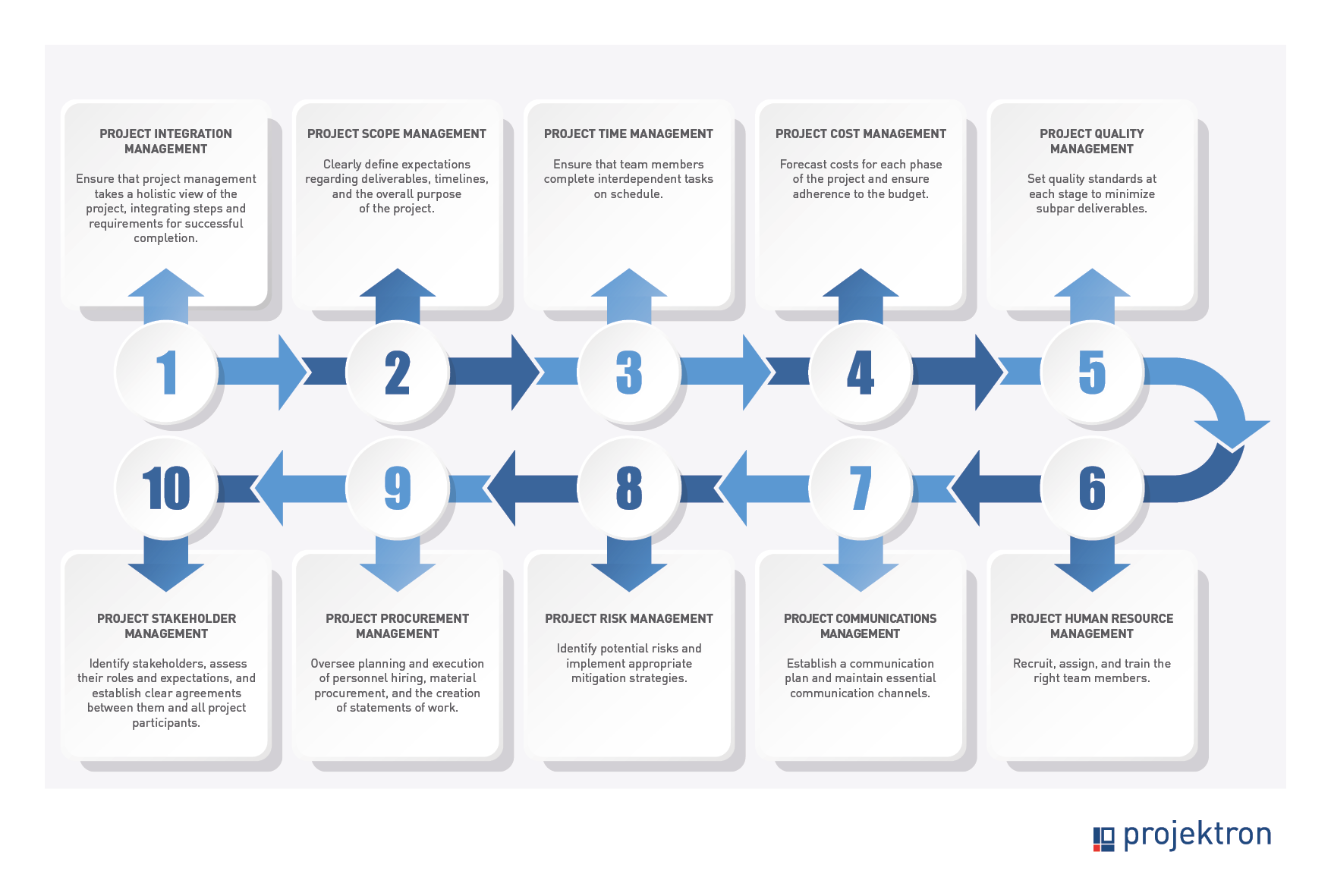
Knowledge Area | Included aspects |
|---|---|
| 1. Integration Management | The core of project management. This is where all processes and activities are coordinated to ensure that the project works as a whole. From the start of the project to its completion, this area of knowledge ensures that all components are smoothly interlinked. |
| 2. Scope Management | Where does the project begin and where does it end? Defining and controlling the project scope ensures that new requirements are not constantly being added and the project gets out of hand (keyword: “scope creep”). |
| 3. Schedule Management | No successful project without a schedule. Planning, managing and controlling the project time ensures that milestones are met. |
| 4. Cost Management | A good budget is the basis for every project. Estimates, calculations and ongoing cost control help to avoid unpleasant surprises. |
| 5. Quality Management | What use is a project that is completed on time if the result is not convincing? This field of knowledge ensures that project performance meets expectations. |
| 6. Resource Management | People, machines, material – this field of knowledge ensures that all the required resources are in the right place at the right time. |
| 7. Communications Management | Clear communication is crucial. Who needs to receive what information and when? A communication management plan prevents misunderstandings and information gaps. |
| 8. Risk Management | There are risks in every project. The trick is to recognize them early, evaluate them and take steps to minimize them. |
| 9. Procurement Management | External service providers or materials often have to be procured. Contracts and supplier management fall within this area. |
| 10. Stakeholder Management | Every project involves various stakeholders. Managing their expectations and gaining their support is a key success factor. |
With the seventh edition of the PMBOK Guide, the ten knowledge areas from previous versions were officially supplemented by a principle-based approach, or rather, this approach was introduced to replace the previous structure. This means that instead of detailed processes and knowledge areas, the focus is now on the twelve universal principles and eight so-called performance domains.

Knowledge areas remain relevant
The knowledge areas have not been completely discarded, but are included in a more flexible form in the new performance domains and in the PMBOK Guide – Seventh Edition. Even with the eighth edition, they did not return to the spotlight. Companies can continue to work with the knowledge areas, especially if they prefer a process-based structure. The sixth edition of the PMBOK Guide remains a relevant reference for classic project management methods.
The 8 performance domains according to PMBOK Guide (since Edition 7)
In the seventh edition of the PMBOK Guide, eight performance domains play an important role alongside the ten knowledge areas. These form a holistic framework for project management and are not to be understood as isolated areas, but rather work dynamically together.
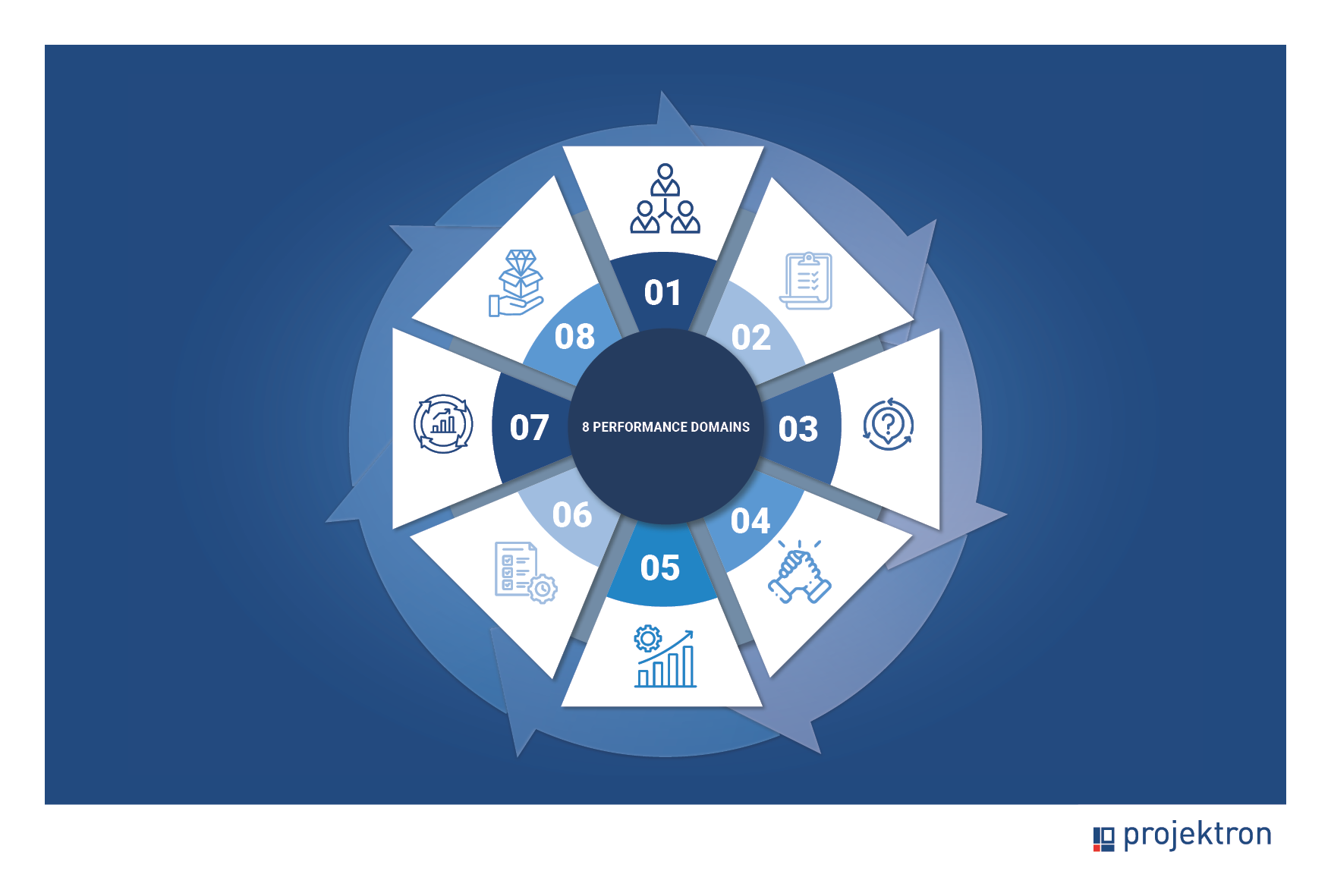
Performance Domain | Included Performances |
|---|---|
| 1. Stakeholder |
|
| 2. Planning |
|
| 3. Navigating Uncertainty and Ambiguity |
|
| 4. Team |
|
| 5. Measurement |
|
| 6. Delivery |
|
| 7. Development Apporach and Life Cycle |
|
| 8. Project Work |
|
The five process groups according to PMBOK Guide and their significance
In addition to the knowledge areas, the PMBOK Guide divides the project process into five process groups based on the Deming Cycle. They describe the phases that every project – regardless of industry or size – goes through.
Process Group | Included Tasks |
|---|---|
| 1. Conception & Initiation | Every project begins with an idea. In this phase, the project mandate and rough objectives are defined. Who are the stakeholders? What should the project achieve? |
| 2. Definition & Planning | The detailed planning begins. Timelines, cost calculations, risk assessments – everything is defined as precisely as possible in advance to avoid problems later on. |
| 3. Launch or Execution | Now it's time to get to work. The project team implements the plan, completes tasks and advances the project step by step. |
| 4. Performance & Control | Is everything going according to plan? If not, adjustments need to be made. Progress, costs and risks are constantly monitored here. |
| 5. Closure | After successful implementation, the project is officially closed. A final evaluation ensures that experiences are documented for future projects. |
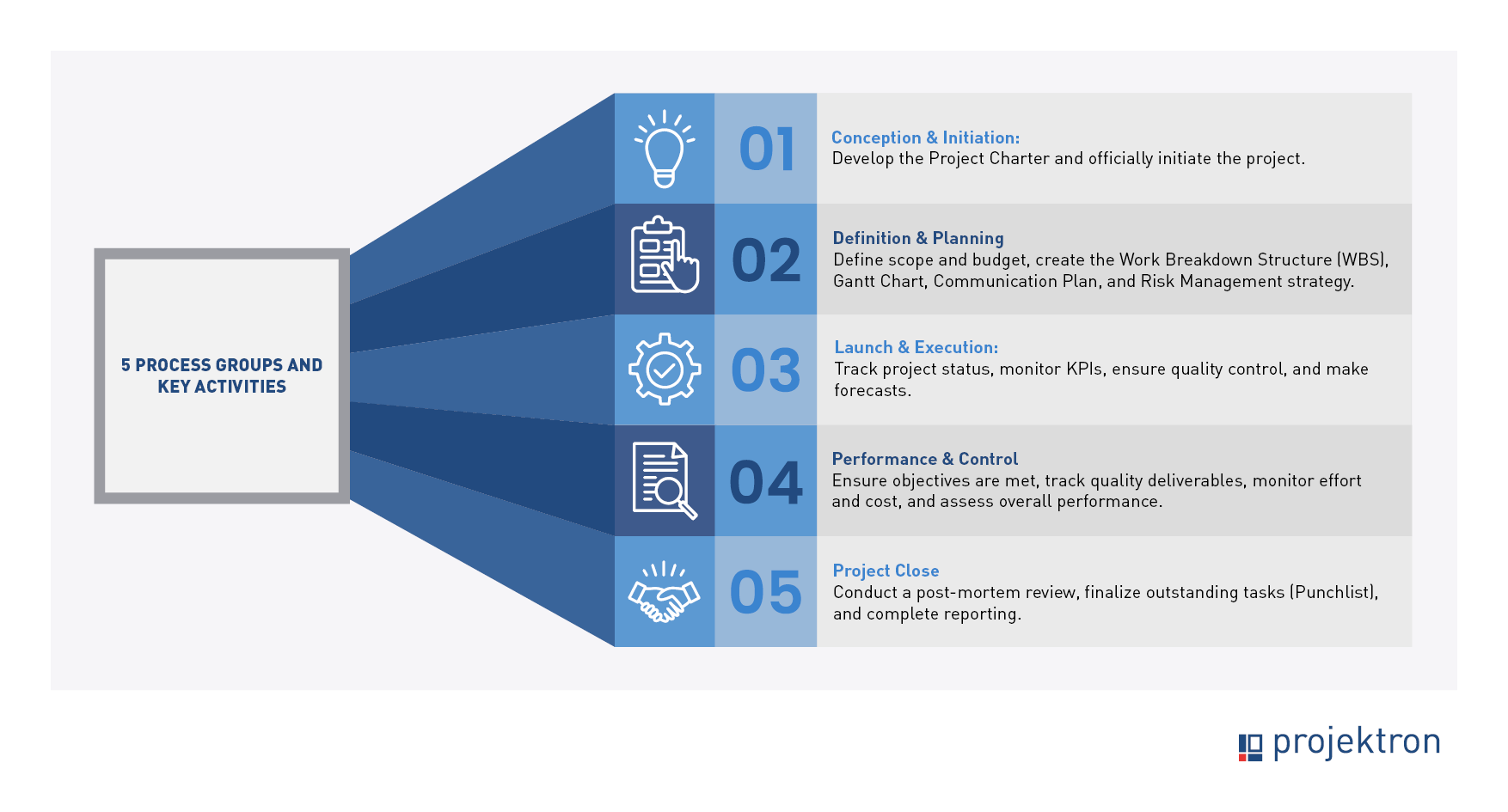

Decline in the importance of process groups with PMBOK Guide 7th Edition and return in Edition 8
In the 7th edition of the PMBOK Guide, the traditional process groups were not completely replaced, but their role was changed and they were no longer emphasized in the same structural way as in previous editions. The 7th edition focuses on the 8 performance domains and 12 principles of project management, rather than categorizing project management processes into the familiar process groups.
The process groups are still relevant in the 7th edition, but the focus is more on the results and values of the project. Instead of a detailed process structure, the emphasis is now on a more flexible, agile approach that is geared to the specific needs of a project rather than rigid, predefined phases.
The 8th edition (2025) brings the processes back in full, but:
- not as a rigid framework as in the 6th edition,
- but as modern, flexible process guidance that once again offers more practicality and orientation in everyday life.
It thus combines the best of editions 6 and 7:
structure + flexibility, processes + principles, practice + adaptability.
The 47 processes according to PMBOK Guide
The PMBOK Guide (up to the 6th edition) structured project management based on the five process groups and ten knowledge areas. These were linked by a total of 47 processes. This structure formed a kind of matrix in which each process was assigned to a specific process group and, at the same time, to a knowledge area. The five groups represent the chronological sequence of a project, while the ten knowledge areas represent the various specialist areas in project management. Each of the 47 processes was assigned to a process group and a knowledge area. For example, the process “Identify Risks” belongs to the process group “Planning” and the knowledge area “Risk Management”.
The overview of the assignment of processes to process groups shows that the PMBOK Guide clearly emphasizes the process group “Planning”.
Initiation | Planning | Execution | Control | Closure | |
|---|---|---|---|---|---|
| Integration Management | Develop Project Charter | Develop Project Management Plan | Direct and Manage Project Knowledge | Monitor and Control Project Work | Close Project or Phase |
Manage Project Knowledge | Perform Integrated Change Control | ||||
| Scope Management |
| Plan Scope Management |
| Validate Scope | |
Collect Requirements | |||||
Define Scope | Control Scope | ||||
Crate Work Breakdown Structure | |||||
| Schedule Management |
| Plan Schedule Management |
| Control Schedule | |
Define Activities | |||||
Sequence Activities | |||||
Estimate Sctivity Durations | |||||
Develop Schedule | |||||
| Cost Management |
| Plan Cost Management |
| Control Cost | |
Estimate Costs | |||||
Determine Budget | |||||
| Quality Management |
| Plan Quality Management | Manage Quality | Control Quality | |
| Resource Management |
| Plan Ressource Managment | Acquire Resources | Control Resources | |
Develop Team | |||||
Estimate Activity Resources | Manage Team | ||||
| Communications Management |
| Plan Communications Management | Manage Communications | Monitor Communications | |
| Stakeholder Management | Identify Stakeholders | Plan Stakeholder Engagement | Manage Stakeholder Engagement | Monitor Stakeholder Engagement | |
Risk Management |
| Plan Risk Management | Implement Risk Responses | Monitor Risks | |
Identify Risks | |||||
Perform Quantitative Risk Analysis | |||||
Perform Quantiative Risk Analysis | |||||
Plan Risk Response | |||||
Procurement Management |
| Plan Procurement Management | Conduct Procurements | Control Procurements |
The following was defined for each process:
input variables (inputs, e.g. project objectives, requirements)
methods and tools (e.g. risk analysis, Gantt charts)
output values (outputs, e.g. risk register, reports)
The 12 principles according to PMBOK Guide (since edition 7)
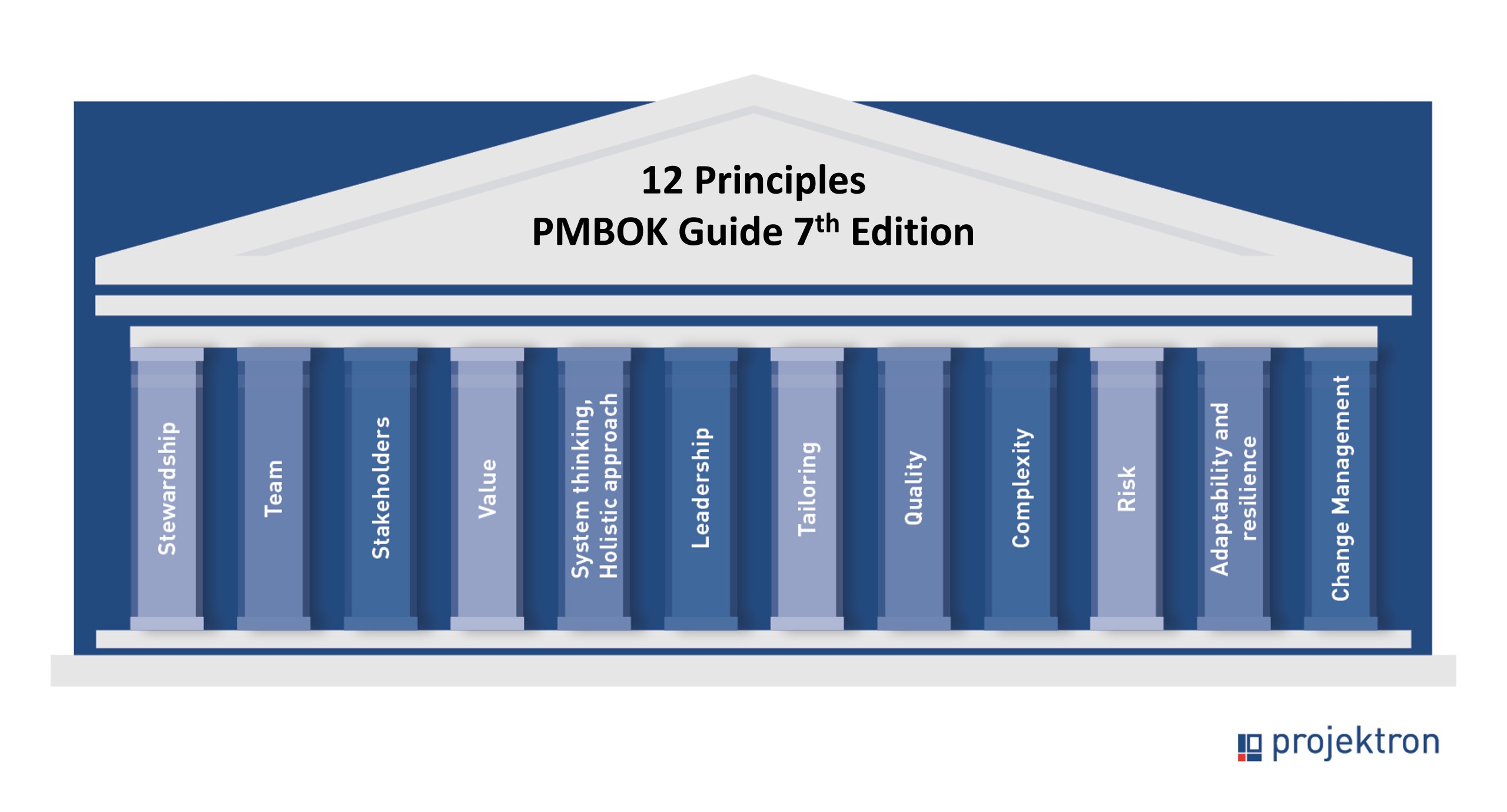
The twelve universal principles of project management were introduced with the seventh edition of the PMBOK Guide (2021). They replace the previous process-based structure with a more principle-oriented approach to allow more flexibility for different project environments. These principles apply to all projects, regardless of industry, size or methodology. They are aligned with the Code of Ethics of the PMI and define the what and why of project management.
Principle | Meaning |
|---|---|
| 1. Stewardship | Take responsibility for the project and its impact, make sustainable decisions and act ethically. |
| 2. Team | Build an effective team, promote collaboration and create a positive work culture. |
| 3. Stakeholders | Identify relevant stakeholders at an early stage, actively involve them and manage their expectations. |
| 4. Value | Manage projects in a way that continuously generates value for customers and organizations. |
| 5. System thinking, holistic approach | Understand projects as part of a larger environment and take systemic interactions into account. |
| 6. Leadership | Enable leadership at all levels, delegate responsibility and encourage team members to take initiative. |
| 7. Tailoring | Adapt approaches and tools to the specific project and its requirements. |
| 8. Quality | Continuously review and improve processes and results to achieve the desired standards. |
| 9. Complexity | Actively manage uncertainties and dynamic changes and flexibly adapt solutions. |
| 10. Risk | Systematically identify and evaluate risks and develop strategies to take advantage of opportunities and minimize threats. |
| 11. Adaptability and Resilience | Design projects so that they can respond to changes without losing sight of the overall goal. |
| 12. Change Management | Document and share knowledge and experiences and make them available for future projects. |
These principles provide a flexible framework for modern project management that integrates both traditional and agile methods. They help project organizations to manage their projects efficiently and achieve successful results in the long term. It is no coincidence that there are 12 principles:
Both the Agile Manifesto with its 12 principles and the PMBOK Guide (7th Edition) with its universal principles focus on fundamental values that can be applied independently of specific methods or frameworks. With the seventh edition, PMI deliberately built a bridge between classic and agile project management by shifting the focus from detailed processes to timeless principles. This orientation was consistently developed and refined in the eighth edition.
While earlier versions of the PMBOK Guide focused heavily on processes, ITTOs, and clearly defined best practices, the 7th edition worked with principles and performance domains to enable greater flexibility and context sensitivity. The eighth edition retains this principle-oriented approach, but reintroduces modernized, non-prescriptive process guidance. It thus combines the best of both worlds: clear guidance for practice without losing adaptive openness. This development follows the general trend in project management: away from rigid process models and toward adaptable principles and situation-appropriate processes that meet the different requirements of classic, agile, and hybrid ways of working.
The continued integration of agile and hybrid thinking in the 8th edition also shows that PMI has recognized the change in practice. Today, companies rarely work in a purely classic or purely agile manner, but instead use hybrid approaches that combine stability and flexibility.
Agile and hybrid methods in the current PMBOK Guide
Agile, hybrid, and lean-oriented approaches play a central role in the current version of the PMBOK Guide. The 8th edition expands on the agile content, integrates modern topics such as AI, PMOs, and procurement, and links them to a more clearly structured process framework.
Agile project management: Agile methods rely on iterative development, short feedback cycles, and continuous adaptation. Instead of creating a complete project plan in advance, work is done in sprints or increments, which enable rapid learning and quick value delivery. This is particularly advantageous in dynamic environments such as software development or innovation projects.
Hybrid methods: Hybrid approaches combine classic planning and control with agile elements such as iterations, reviews, and adaptive decisions. The 8th edition shows more clearly than before how this combination can be implemented in practice and how processes can be flexibly adapted to different environments.
Lean approaches: Lean focuses on efficiency, flow, and continuous improvement. The reduction of unnecessary work steps, fast throughput times, and a focus on value create the basis for higher speed and better quality. The 8th edition integrates Lean more clearly into the process landscape and shows how Lean practices can be applied in classic and agile projects.
Together, these methods help to better address the complex and dynamic challenges of modern projects. The 8th edition makes it clear that successful project work today lies in the ability to combine a structured approach, flexibility, value orientation, and continuous learning.
How is a project carried out according to the PMBOK Guide?
The PMBOK Guide is not just a theoretical model – it also provides a clear structure for practical application. According to PMBOK Guide, a project typically runs in several phases, even though the seventh edition is de-emphasizing this approach.
1. Initiation: From the project charter to the stakeholder analysis
The foundation for the entire project is laid in the initiation phase. The aim here is to define the project idea, evaluate the benefits and define the initial framework conditions. The central component of this phase is the project charter, which includes all relevant key data, objectives and stakeholders.
Important steps in this phase:
Formulate project charter: The project charter is the central document that describes the purpose of the project, the rough planning and the resources.
Conduct a stakeholder analysis: Who has an interest in the project? What are the expectations of the parties involved? These questions are answered in a detailed stakeholder analysis.
Conduct a cost-effectiveness review: Does the project make financial and strategic sense? It may be necessary to conduct feasibility studies or cost-benefit analyses at this stage.
A well-structured start reduces the risk of misunderstandings and creates a solid basis for the next phase: detailed planning.
2. Planning: managing time, costs, risks and quality
Initiation is followed by the extensive planning phase. This is where the necessary measures are defined to achieve the project goal. This phase is particularly important because it lays the foundation for the subsequent implementation.
Important aspects of the planning phase:
Time management: creating a realistic project schedule with milestones.
Cost management: calculating the budget and defining the cost structure.
Risk management: identifying, analyzing and assessing possible risks.
Quality management: setting standards to ensure high-quality project results.
Resource planning: Allocation of personnel, materials and other necessary resources.
Planning is an iterative process. Depending on the progress of the project, adjustments may be necessary to respond to new circumstances.
3. Implementation: The actual project work begins
Now the actual work on the project begins. In this phase, the planned tasks are carried out and the necessary resources are deployed to achieve the project goals.
Important aspects:
Team coordination: Project managers must ensure that all team members understand their tasks and work together efficiently.
Communication: Regular meetings, status reports and feedback loops help keep the project on track.
Change management: If unforeseen problems arise, adjustments must be made.
The success of the project depends largely on how well the implementation is organized and how flexibly the team reacts to challenges.
4. Monitoring and control: Continuous control of the project
Monitoring and control takes place in parallel with implementation. The goal is to continuously measure the progress of the project and ensure that it remains on schedule and within budget.
The focus of this phase is on
Progress monitoring: Are we on schedule? Are we achieving our goals?
Quality assurance: Do the results meet the defined standards?
Risk management: Have new risks emerged, and how can they be minimized?
Stakeholder management: Communication with key players to manage expectations.
This phase ensures that the project does not get out of hand and that problems can be addressed early on.
5. Closure: Bringing the project to a successful conclusion
The final stage of the project is the closing phase. The aim here is to officially end the project, document the results and carry out a review.
Important steps:
Evaluating the results: Have the objectives been achieved?
Final report: Documenting lessons learned for future projects.
Transferring the results to the customer or users.
A clean finish ensures better utilization of lessons learned and improves future projects.
What advantages and challenges does PMBOK bring?
The 8th edition of the PMBOK Guide offers companies numerous advantages, particularly through the combination of clear principles, practical performance domains, and the reintroduced, modernized process guidance. This mix creates a framework that is internationally compatible while remaining flexible enough to be applied in traditional, agile, and hybrid environments.
A key advantage lies in the continued standardization of project management terminology and basic logic. Despite moving away from the old, strictly process-oriented model, the 8th edition creates a common understanding of how projects can be professionally initiated, managed, and completed. This facilitates the collaboration of international teams and provides a reliable foundation for organizations of all sizes.
In addition, the 8th edition builds on a broad base of best practices, empirical data, and real-world experience. It integrates insights from classic projects as well as from agile, hybrid, and lean-oriented environments. The new process guidance is deliberately not prescriptive, but rather offers orientation on what concrete work steps might look like without imposing rigid requirements.
Another advantage is the high scalability of the framework: whether it's a small software project, a complex transformation initiative, or a global infrastructure program , the 8th edition is designed to be adaptable to a wide range of situations. Companies can flexibly combine principles, domains, and processes to align them with the size, risk, dynamics, and maturity of the organization. The 8th edition offers valuable guidance and structure, especially in environments with many stakeholders or in highly dynamic industries.
Advantages of project management according to PMBOK Guide 8th edition | Disadvantages of project management according to PMBOK Guide 8th edition |
|---|---|
|
|
Despite these challenges, the 8th edition offers a mature and contemporary approach. It overcomes the rigidity of earlier versions without losing its practical orientation and ensures that modern projects – whether classic, agile, or hybrid – can be managed in a structured, value-oriented, and sustainable manner.
When is project management according to the PMBOK Guide the right choice?
The PMBOK Guide is particularly suitable for companies that rely on a standardized, traceable, and professionally structured approach to project management – and at the same time want to take advantage of the flexibility of the 8th edition, which combines principles, domains, and modern process guidance.
It is the right choice if:
Projects are highly complex and require a clear yet adaptable framework to efficiently manage risks, dependencies, and stakeholders.
Companies operate in regulated industries where structured planning, traceability, and extensive documentation are essential (e.g., pharmaceuticals, aviation, finance, public administration). The 8th edition continues to support this, but at the same time offers more flexibility in the design of processes.
Organizations operate internationally and need a common, globally understandable project management language. The 8th edition provides clarity here through standardized terms, principles, and cross-domain orientation.
Scalability and long-term optimization of processes are crucial: The combination of principles (strategic framework), domains (operational orientation), and flexible process guidance (practical implementation) makes the 8th edition particularly suitable for mature, project-intensive organizations or PMOs.
Companies that work predominantly in an agile manner or prefer very fast, iterative development cycles should consider whether the PMBOK Guide is combined in a hybrid manner in the spirit of the 8th edition – e.g., by combining classic planning logic with agile working methods such as Scrum or Kanban. The 8th edition explicitly supports hybrid approaches and shows how principles and processes can be applied in a context-sensitive manner.
How does PMBOK differ from other project management process models?
PMBOK Guide vs. classic waterfall methods
PMBOK and classic waterfall methods share many similarities, but differ in their level of detail and application. Both rely on a sequential approach with clearly defined phases, but PMBOK offers a more comprehensive collection of processes and best practices.
Similarities between PMBOK and waterfall methods
Linear structure: Both PMBOK and classic waterfall methods are based on a sequential series of phases that build on each other. Changes during implementation are often difficult to implement.
Detailed planning: Both approaches rely on a thorough planning phase with comprehensive specifications before the actual implementation begins.
Documentation-driven: Documentation is highly important – both PMBOK and waterfall methods place a great deal of emphasis on requirements, plans, reports and evidence.
Differences between PMBOK and waterfall methods
| PMBOK | Waterfall |
|---|---|---|
| Flexibility | Provides processes for adaptation and optimization | Rigid process, changes are difficult to implement |
| Focus | Methodical framework with best practices | Fixed phases (requirements analysis → design → implementation → test → maintenance) |
| Scope | Universal for different industries | Often in software development and engineering |
While waterfall methods are suitable for clearly defined projects with stable requirements, PMBOK offers a more adaptable structure that allows for broader application.
PMBOK Guide vs. PRINCE2: Differences in structure and application
PMBOK Guide and PRINCE2® are among the best-known project management methods, but they differ in their structure and application. While PMBOK Guide takes a process-based approach and describes best practices for project management processes, PRINCE2 is a methodical approach with clearly defined roles, processes and documents.
PRINCE2 places a strong focus on controlling the entire project life cycle and provides a stringent structure for decision-making processes. PMBOK Guide, on the other hand, is more flexible and allows companies freedom in implementing the recommended practices. Companies with clear hierarchies and highly regulated projects often tend to favor PRINCE2, while PMBOK Guide is better suited for organizations with individual process requirements.
| PMBOK Guide | PRINCE2 |
|---|---|---|
| Approach | Collection of best practices and processes | Predefined framework with defined roles |
| Flexibility | High, as there is no rigid methodology | More rigid structure, less flexible |
| Focus | Processes, inputs, outputs, tools | Governance, responsibilities and business case |
| Area of application | Universal for all industries | Frequently used in the UK and by public authorities |
PRINCE2 project management method: principles, strengths and weaknesses
As standardized approaches, project management methods provide guidance for the planning, execution and controlling of projects. PRINCE2 is a process-oriented method that can be scaled and puts the benefits of a project at the center of project management. Our technical article offers an introduction to the basic idea, strengths and weaknesses of the PRINCE2 method.
PMBOK Guide vs. IPMA: Competence-based vs. process-based approaches
A fundamental difference between PMBOK Guide and the IPMA® (International Project Management Association) lies in the methodological approach. PMBOK focuses on processes and best practices, while the IPMA's Individual Competence Baseline (ICB) model takes a competency-based approach.
The IPMA ICB not only considers processes, but also the individual abilities and soft skills of project managers. The method places particular emphasis on leadership, strategic thinking and social skills. Companies that want to develop their employees in project management in the long term often benefit from IPMA certification. PMBOK Guide, on the other hand, is more suitable for organizations that want to establish process-oriented structures.
PMBOK Guide | IPMA | |
|---|---|---|
| Focus | Processes and Methods | Personal and organizational skills |
| Certification | PMP (process-based) | IPMA Level A–D (competency-based) |
| Flexibility | Structured Best Practices | Adaptation to the individual strengths of the project managers |
PMBOK Guide vs. Agile Methods (Scrum, SAFe, Kanban): Predictability vs. Flexibility
While PMBOK Guide takes a planning-oriented approach, agile methods such as Scrum, SAFe and Kanban rely on flexibility and iterative development. The biggest difference is that PMBOK Guide prescribes a detailed project structure with defined phases, while agile methods rely on continuous adaptation and incremental development.
Scrum is particularly suitable for software development teams that work in short sprints. SAFe enables the scaling of agile principles in large companies. Kanban, on the other hand, optimizes workflows and minimizes bottlenecks by visually displaying tasks.
Companies that require a high degree of planning or are subject to regulatory requirements benefit from PMBOK Guide. Agile methods, on the other hand, are ideal for dynamic environments where rapid adjustments are required.
PMBOK Guide | Agile | |
|---|---|---|
| Focus | Structured planning | Iterative development |
| Flexibility | Relatively low | High |
| Documentation | Detailed documentation required | Minimal documentation |
| Area of application | Large, complex projects | Dynamic, fast-changing projects |
Scrum in software development: agile and structured
When it comes to agile software development methods, there is one term you can't avoid: Scrum. But what exactly is Scrum and how does it develop its strengths in software development? What roles and activities are there in Scrum? What are the advantages and disadvantages of this agile framework? You will learn all of this in this article. In addition, we will provide you with an insight into our agile Scrum variant, which we successfully use to develop Projektron BCS. We use BCS as Scrum software for this.
When is which process model the best choice?
Selecting the right project management approach depends on the individual requirements of a company. The following overview provides some guidance:
Process model | Advantages | Suitable for |
|---|---|---|
| PMBOK Guide | Structured processes, scalability | intensive regulation industries, large companies |
| PRINCE2 | Clear distribution of roles, strict control | authorities, companies with fixed project structures |
| IPMA (ICB) | Focus on personal skills | companies with long-term personnel development |
| Scrum | Rapid iterations, highly adaptable | software development, innovative industries |
| SAFe | Scaling of agile methods | software development, innovative industries |
| Kanban | Increased efficiency, visual transparency | companies with variable workloads |
In practice, many companies rely on hybrid approaches. A combination of PMBOK and agile methods, for example, can help to combine structured planning with flexibility. It is crucial that the process model fits with the corporate culture, the project requirements and the long-term goals.

Hybrid project management: combining traditional and agile methods for greater effectiveness and efficiency
Classic or agile? If you find it difficult to decide between these two approaches, a combination of classic and agile project management methods is probably the right way forward. Hybrid project management is the approach that seeks to combine the best of both worlds. In this article, you will learn how the hybrid approach works, when it is suitable, what advantages and disadvantages the approach has for organizations, and how you too can benefit from hybrid project management.
Hybrid approaches: the combination of PMBOK Guide and agile frameworks
Agile methods such as Scrum seem to contradict the detailed process structure of the PMBOK Guide. However, agile principles can be successfully integrated into the PMBOK framework to benefit from the advantages of both approaches.
Iterative planning: PMBOK Guide allows iterative planning approaches within individual process groups. Teams can, for example, work in short cycles (sprints) while still using the overarching PMBOK Guide processes.
Flexibility in execution: While PMBOK Guide provides a structured framework, agile methods can help to react quickly to changing requirements.
Role customization: Classic project roles from PMBOK Guide (project manager) can be combined with agile roles (scrum master, product owner).
Combining PMBOK and agile methods can be useful if a company needs structured processes but also wants to benefit from the advantages of agile flexibility.
When are hybrid approaches useful?
In large organizations: While management often relies on structured processes and reporting, teams benefit from agile methods in implementation.
In regulated industries: PMBOK Guide provides the necessary framework for compliance and documentation, while agile methods enable innovation and rapid adjustments.
For complex projects with uncertain requirements: A combination of detailed planning and agile flexibility makes it easier to deal with uncertainties.
Typical hybrid models
Agile development within a PMBOK Guide project management: The overall project is managed according to PMBOK Guide, but individual sub-projects or teams work in an agile manner.
Agile methods with PMBOK Guide-controlled governance: Management uses PMBOK Guide for controlling and reporting, while teams use agile frameworks.
Phase-based approach (“waterfall agile”): The planning phase follows PMBOK Guide, while the implementation is agile.
Possible agile additions to the PMBOK Guide structure
PMBOK Guide process group | Possible agile additions |
|---|---|
1. Initiating | Produktvisionierung, Stakeholder-Mapping |
2. Planning | Release Planning, Roadmaps, User Stories |
3. Execution | Scrum, Kanban, Daily Stand-ups |
4. Control | Sprint Reviews, Burndown Charts |
5. Closure | Retrospektives, Lessons Learned |
PMI certifications and learning paths for PMBOK Guide
A PMP certification is considered a seal of quality for professional project managers and significantly increases career opportunities. PMI offers various certifications for different levels of experience and specializations in project management:
Project Management Professional (PMP)®: The most well-known certification for experienced project managers with extensive knowledge of PMBOK Guide.
Certified Associate in Project Management (CAPM)®: entry-level certification for junior project managers and career changers.
PMI Agile Certified Practitioner (PMI-ACP)®: For project managers who use agile methods such as Scrum, Extreme Programming, Lean Management, Kanban.
Program Management Professional (PgMP)®: Specifically for managing multiple projects within a program.
Further certifications such as PMI-RMP (risk management) or PfMP (portfolio management) offer specializations for specific roles.
All certificates must be recertified after three years.
PMBOK Guide can be learned through training, online courses, specialist literature, practical application and exchange in specialist groups. Official training and flexible e-learning options impart theoretical knowledge, while practical projects and networks deepen its application.
Which software for PMBOK Guide project management?
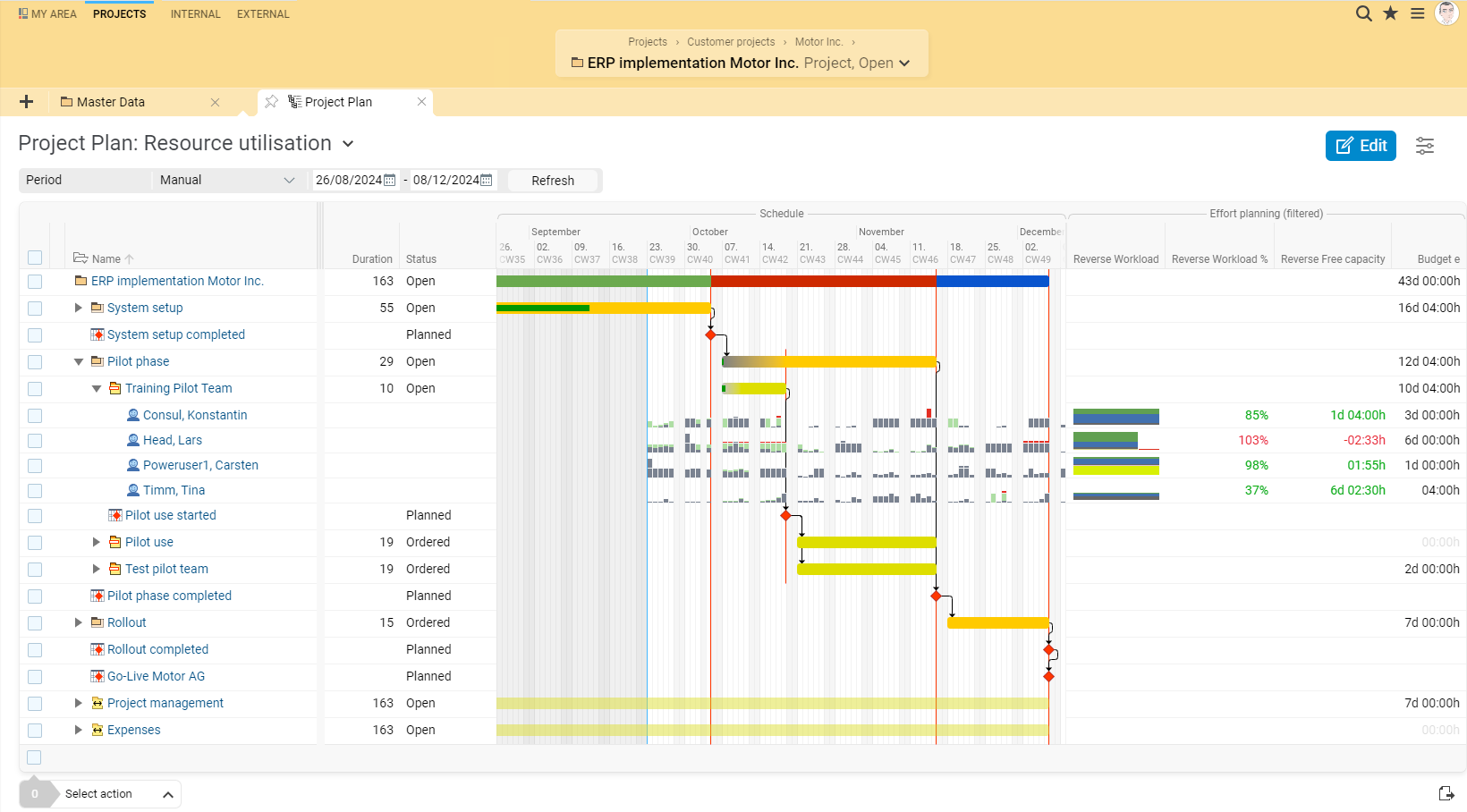
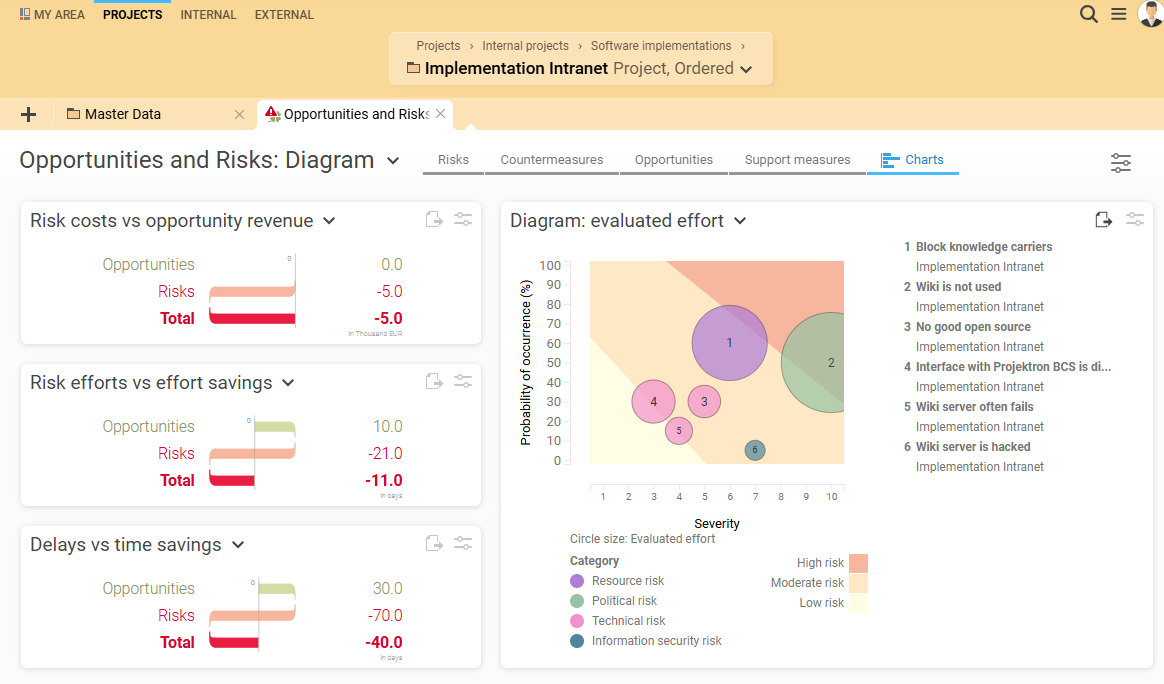
Sound project management according to PMBOK Guide requires powerful software that maps all relevant processes and at the same time flexibly addresses company requirements. Projektron BCS offers a comprehensive solution for this: from structured planning to risk management to the optional integration of agile methods.
Projektron BCS supports all ten knowledge areas and five process groups of the PMBOK Guide framework and offers useful tools for all eight performance domains in project management. Project managers can define work packages in detail, create schedules and control dependencies. In addition, the software enables standardized documentation that creates transparency and facilitates collaboration.
A central component of PMBOK Guide is risk management. In Projektron BCS, risks can be systematically recorded, evaluated and assigned to measures. Integrated resource planning helps teams keep track of capacities and availabilities. Detailed reports and dashboards provide real-time information on progress, budgets and bottlenecks – essential for data-based decisions.
Numerous companies successfully use Projektron BCS for their project management according to PMBOK Guide. Projektron BCS makes it easier to standardize processes while also offering customization options.
On our method page for BCS for project management according to PMBOK Guide, you will find detailed information and practical examples. Would you like to see the software in action? Arrange a free online presentation to see for yourself the advantages for your company.

Natalia Sergeeva, Senior IT Consultant Planning & Governance, Panasonic Europe B.V.
“We are certified according to ISO 27001 (information security), ISO 27017 (cloud security) and carry out projects according to the PMI framework. Projektron BCS seemed very flexible and adaptable at first glance. We were also convinced by the costs: Projektron BCS is much cheaper to run than our previous solution. The decision in favor of BCS was therefore quickly made and, for us, switching to Projektron BCS meant, above all, greater flexibility and an extended range of functions.”
What does the future hold for PMI and PMBOK Guide?
The PMBOK Guide remains a proven framework for professional project management that enables standardization, orientation, and scalability. With the eighth edition, PMI has further modernized this approach: In addition to universal principles and performance domains, the new version once again offers flexible, practical process guidance that gives teams more orientation without falling back into rigid structures. The 8th edition thus combines the strengths of earlier versions with the adaptability of the seventh edition.
While older editions were strongly process-oriented and the seventh edition focused on principles, the eighth edition takes an integrated approach: it combines why (principles), what (performance domains), and how (modern processes) into a coherent, adaptable framework. This further development takes into account the reality of modern projects, in which companies are increasingly working in a hybrid, agile, and value-oriented manner.
The eighth edition also breaks new ground in terms of content: topics such as artificial intelligence, automation, procurement, modern PMOs, and data-driven decision-making are covered in much greater depth. This is PMI's response to the growing importance of digital tools and changing work models. The PMBOK Guide is expected to continue developing in this direction – towards an even more data-driven, adaptive, and technology-open understanding of project management.
Projektron BCS offers companies the flexibility they need to efficiently manage PMBOK Guide-compliant projects. The software combines powerful features for resource management, reporting, and process automation features with the ability to use agile methods such as Scrum and Kanban. This not only allows companies to implement the PMBOK Guide, but also to adapt it to their specific requirements.

About the author
Kai Sulkowski is an editor in the marketing department at Projektron and an expert in project management topics. With his many years of experience in analyzing and processing complex technical content, he imparts in-depth knowledge of best practices, methods and trends in project management. His focus is on providing practical content that helps companies manage their projects efficiently.
More interesting articles on the Projektron blog

Project communication
One of the main reasons for project failure is a lack of project communication - according to a PMI study, communication management in a project is just as important as an accurate cost estimate, a clear definition of project goals and a thorough risk analysis. 3 practical tips for your project communication!

Project flowchart
A project flow chart is an important part of the project plan and the basis for many other plans. Here you can find out everything you need to know about the project flow chart, get a template and examples of the project flow chart as a list, network plan and Gantt chart.

Resource planning
Resource planning is a strategically important step in project management. What is a resource plan? What information does it contain? What are the benefits of resource planning in project management? Here's resource planning from A to Z.
Project structure planning
It is considered the plan of plans or the mother of all plans in classic project management: the work breakdown structure (WBS). Find out how you should proceed when creating a work breakdown structure here.
Symbolic image for the connection between PMI and PMBOK Guide: the organization and its guide fit together like two puzzle pieces and together form the foundation for professional project management.