05/27/2026 - Network
Too Many Projects, Too Little Control: Why Multiproject Management Is Becoming Critical in Public Administration
Digitalization in public administration rarely fails because of individual projects, but rather because of a lack of control across the entire project portfolio. In the latest post on the Administration of the Future (VdZ) blog, Kai Sulkowski and Jan Wallisser explain why multiproject management is becoming a key success factor for modern administrative organizations and what role integrated business coordination software plays in this context.
When the problem isn't the project, but the portfolio
Many public administrations are familiar with the situation: Individual projects appear to be well organized, status reports remain green, and yet implementation is noticeably slowing down. Decisions take longer, resources are missing in several areas at the same time, and priorities keep shifting.
In their article, Kai Sulkowski and Jan Wallisser describe a pattern that can be observed in many public sector organizations: It is usually not the individual project that first gets out of control, but the overall landscape of parallel initiatives. This is where complexity emerges through
- competing priorities,
- shared resources, and
- limited transparency regarding dependencies.
The article’s central message: Successful digital transformation requires more than strong project management. It also depends on effective multi-project management and portfolio management.
Why traditional project management is often no longer sufficient
Especially in public administration, digital transformation initiatives, regulatory requirements, and organizational change are closely interconnected. Departments, IT teams, and governance units often work in parallel on different initiatives while relying on the same critical resources.
This creates a challenge that many organizations underestimate: Even when individual projects are carefully planned, the overall portfolio can quickly become unrealistic.
The authors identify three common symptoms:
Projects formally remain “on track,” even though operational delays are already emerging
Priorities shift at short notice between committees and departments
Resource bottlenecks only become visible once critical situations have already occurred
One particularly important insight is that information alone does not create effective governance. Many organizations already have extensive reporting and status data available — but without a shared governance logic.
This is exactly where multi-project management with BCS supports an organization-wide perspective on priorities, resources, and strategic dependencies.
Multi-project management as a strategic management level
Multi-project management is not an additional administrative layer. It is the prerequisite for keeping complex project landscapes manageable and governable in the first place. This includes, in particular:
Transparency across ongoing initiatives
Visibility into resources and dependencies
Comparability between projects
Reliable prioritization
Alignment between strategic and operational levels
This is exactly where the multi-project management functionality of Projektron BCS comes in. The software combines project portfolio management, resource planning, and operational project governance within one integrated system.
Resource management is becoming a bottleneck
One particularly important aspect of the VdZ article is the role of resource planning. Many organizations still plan projects based on implicit assumptions about resource availability, without organization-wide transparency.
This creates a well-known paradox: All projects appear to be prioritized, but not all of them can realistically be executed at the same time.
The article clearly demonstrates that prioritization only becomes effective when organizations can see:
which initiatives are dependent on one another
which key personnel are assigned to multiple initiatives simultaneously
which capacities are actually available
The Projektron article on resource planning in project management explains how modern resource management can support this process. Also relevant in this context is the recent expert article on project prioritization under resource constraints, which describes why many portfolios become overloaded over time.
Why software alone is not the solution
Increasingly, the public sector is recognizing that modern software alone does not solve organizational challenges. Especially in complex administrative environments, governance issues rarely arise because of missing tools. More often, they result from unclear priorities, inconsistent processes, or a lack of transparency regarding responsibilities and resources.
The authors therefore emphasize that effective governance always depends on the interaction of several factors:
clear priorities,
defined roles and responsibilities,
shared governance frameworks,
as well as appropriate technical support.
Particularly in public administrations managing numerous parallel digital transformation and organizational change initiatives, it becomes clear how important a shared view of projects, resources, and dependencies really is. Only when strategic objectives, operational planning, and actual capacities are connected can organizations establish a reliable foundation for prioritization and governance.
This is precisely why integrated solutions such as Business Coordination Software are becoming increasingly important. Systems like BCS combine project management, resource planning, process management, and project portfolio management within a single platform. This enables organizations to consolidate information consistently across departments, improve transparency regarding dependencies, and make more informed decisions — especially within complex project environments in public administration.
Conclusion: Modernizing public administration requires manageable project portfolios
The article by Kai Sulkowski and Jan Wallisser on the Verwaltung der Zukunft blog describes a development that many public administrations are currently experiencing: The challenge no longer lies solely in managing individual projects, but in the ability to govern complex project landscapes as a whole.
Organizations that want to implement digital transformation sustainably therefore need:
transparency across the entire portfolio
realistic resource governance
reliable prioritization
integrated systems for multi-project, portfolio, and process management
This is exactly where the true operational capability of modern organizations is created.
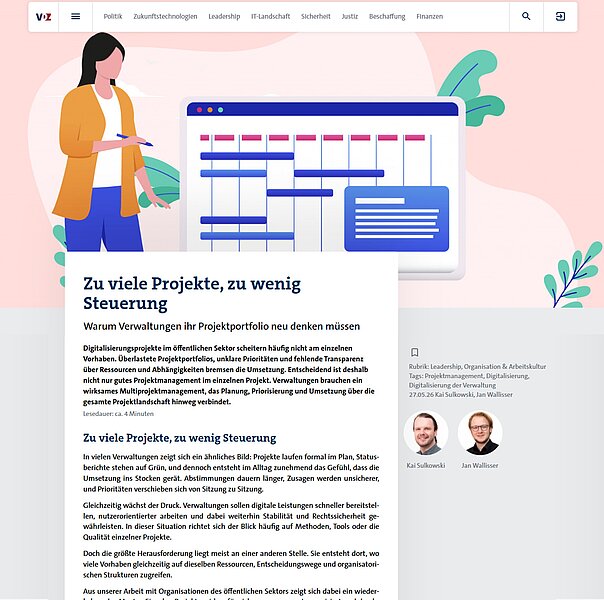
Screenshot of the post “Too Many Projects, Too Little Oversight – Why Government Agencies Need to Rethink Their Project Portfolios” by Kai Sulkowski and Jan Wallisser on the blog “Verwaltung der Zukunft” (VdZ): https://www.vdz.org/leadership-organisation-arbeitskultur/zu-viele-projekte-zu-wenig-steuerung (last accessed on May 27, 2026)