05/04/2026 - Network
Project prioritization under resource constraints: Projektron expert article on the GPM blog
Projektron editor Kai Sulkowski has published a guest article on the blog of GPM Deutsche Gesellschaft für Projektmanagement. In it, he analyzes why many project portfolios fail. As a common cause, he identifies not flawed strategy, but overload and a lack of prioritization based on real resource conditions. We summarize the key insights.
Our experience: The real problem isn’t strategy
In conversations with organizations, we repeatedly see the same pattern: strategies are clearly defined, roadmaps are aligned, and projects are reasonably prioritized. On paper, everything appears consistent.
However, in day-to-day execution, a different reality emerges. Portfolios continue to grow: new requirements are added, existing programs are expanded, and additional projects are launched. Rarely is there an active decision to not pursue something.
The result is a portfolio that is expected to deliver more than is realistically possible.
This observation also aligns with our experience from customer projects and user reports. Organizations often implement project management software to address a lack of transparency around resources and workload, and to identify bottlenecks early on. When multiple projects are planned in parallel using the same key resources—without systematically managing these dependencies—delays occur because projects are waiting on the same bottlenecks, such as IT approvals or expert availability.
For us, this makes one thing clear: the core challenge is not selecting the “right” projects, but limiting how many are executed at the same time.
The real bottleneck: simultaneity
The article makes it clear that the issue is not the number of projects, but their simultaneity.
A project portfolio cannot scale indefinitely. Certain roles—such as experienced project managers, subject matter experts, or IT architects—are inherently limited. These bottleneck resources determine the actual flow of work through the system.
When multiple projects draw on the same resources at the same time, typical effects occur:
- delays due to waiting times
- increased coordination effort
- growing dependencies
- fragmented progress
This becomes particularly critical when bottlenecks are not visible early enough. Projects are then started even though the required capacity is not actually available.
Why overload often goes unnoticed for too long
A key argument of the article is that overload develops gradually. Projects start as planned but lose momentum over time. Decisions are delayed, teams frequently switch between tasks, and priorities are adjusted on short notice.
At the same time, a misleading perception of productivity emerges. High utilization is interpreted as efficiency. In reality, however, the adaptability of the entire portfolio declines. From our perspective, this is one of the biggest challenges in multi-project management: as simultaneity increases, complexity grows disproportionately—while actual output decreases.

The lock effect: where congestion builds up
In this situation, a project portfolio behaves like a lock. Many ships can gather in front of it, but only a limited number can pass through—and only one after another. The key is not how many initiatives are planned, but how well their passage is managed.
Rethinking prioritization: from evaluation to steering
Many organizations prioritize their projects—but often without consistently linking prioritization to actual capacity.
This is where the article draws a clear line. Under resource constraints, prioritization means more than evaluation. It requires active decisions:
- What do we start now?
- What do we deliberately postpone?
- What do we choose not to implement (for now)?
This step is challenging because it requires trade-offs. Projects come with stakeholders, budgets, and expectations. Yet making these trade-offs is exactly what enables real impact.
From our perspective, this marks a key maturity step in project portfolio management: prioritization evolves from an analytical exercise into a true steering decision.
Capacity realism as a foundation
Another core concept of the article is what can be called capacity realism: decisions must be based on a realistic view of available resources.
This goes beyond project planning alone. It must include:
operational (line) work
absences
ongoing commitments
Our experience shows that this is often where the biggest gaps exist. Without an integrated view of projects and resources, systemic overload occurs—even when individual projects are reasonable on their own.
From project list to managed portfolio
An important distinction highlighted in the article: many organizations manage projects, but do not truly manage a portfolio.
A project list shows what exists. A managed portfolio answers a different question: which projects can realistically be executed at the same time?
To answer that, three perspectives must be combined:
strategic relevance
actual feasibility
dependencies between initiatives
Only this combination enables well-founded decisions about sequencing and timing.
The role of software: enabling transparency and decisions
As a provider of project management software, we see every day how important transparency is for sound decision-making.
Modern solutions like our Business Coordination Software (BCS) make it possible to see:
how resources are utilized
where bottlenecks arise
what dependencies exist
which scenarios are realistically feasible
At the same time, transparency alone is not enough. It is the prerequisite for effective steering—but it does not replace it.
Only clear decision rules and consistent prioritization turn transparency into real impact and measurable value.
Conclusion: Optimize flow, not utilization
The GPM article highlights a key insight that we can confirm from many real-world projects: successful portfolios do not maximize the number of parallel initiatives—they optimize flow.
In practice, this means:
consciously limiting parallel work
actively managing bottleneck resources
sequencing projects effectively
Organizations that follow this approach improve not only their efficiency, but more importantly their ability to execute.
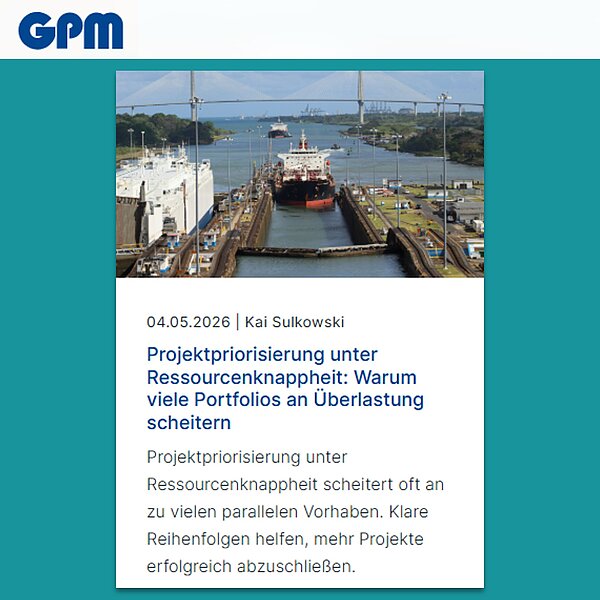
Screenshot of the GPM blog article teaser “Project Prioritization Under Resource Constraints: Why Many Portfolios Fail Due to Overload,” published on https://www.gpm-ipma.de/ueber-die-gpm/blog, accessed on May 4, 2026.