02/16/2026 - Articles
BCS put to the test: Strengths and weaknesses of Projektron's business coordination software in the Le Bihan assessment
BCS is Projektron's business coordination software for project, team, and portfolio management. In an independent software assessment conducted by Le Bihan in cooperation with Projekt Magazin, BCS 2026 was reevaluated in the project management software category. The result speaks for itself: an overall rating of 93%. Compared to the previous assessment in 2024 (92%), this is a visible step forward, especially in the disciplines that have the greatest leverage in many organizations: program and portfolio management. We classify the results, highlight the strengths and weaknesses of BCS, explain what the figures mean in practice, and why BCS is now much more than just project management software for many companies.

What is the Le Bihan assessment in Projekt Magazin and why is it relevant?
The software marketplace of Projekt Magazin offers a comparable market overview of project management and PPM tools. The solutions listed there are evaluated and verified by Le Bihan as part of an expert assessment. This is based on a multi-level, standardized evaluation system that is regularly updated.
The evaluation logic is central to this:
The range of functions shows which topics a software program covers.
The rating independently assesses the quality of the implementation.
This means that even solutions with a focused range of functions can achieve a very high quality rating.
This is particularly helpful for readers because the assessment not only compares lists of functions, but also structurally classifies how well a software program meets specific requirements, and does so in the context of a marketplace that evaluates all tools according to the same system.
Le Bihan Consulting has been supporting companies in the selection, design, and implementation of project and portfolio management solutions for over 30 years. This consulting experience shapes the depth and practical relevance of the assessment.

BCS offers comprehensive, scalable functions for planning, controlling, and evaluating agile and traditional project and team work.
Collaboration between Le Bihan and Projekt Magazin
Le Bihan Consulting is an independent consultancy that conducts standardized expert assessments of project management software. Projekt Magazin publishes these assessments in its software marketplace, making them accessible and comparable for readers. Le Bihan is responsible for the technical testing and evaluation, while Projekt Magazin provides the platform and editorial classification. The two companies work together but remain organizationally independent.
Results overview: BCS improves to 93%
BCS achieved an overall rating of 93% (previously 92%) in the latest update. The improvement is not evenly distributed across all areas, but is concentrated in areas where many organizations are currently investing: program and portfolio management.
| Rating Category | 2024 | 2026 | Δ |
|---|---|---|---|
| General Features & Administration |
|
| +4 |
| Initiating Projects |
|
| +2 |
| Planning Projects |
|
| +1 |
| Executing Projects |
|
| +2 |
| Agile Project Management |
|
| ±0 |
| Program & Portfolio Management |
|
| +5 |
The key message: BCS remains stable at a very high level in traditional PM disciplines and is making significant gains in areas where management across multiple projects is challenging.
Strengths of BCS in assessment
The results of the assessment clearly show where BCS sets its strategic priorities. The software is particularly strong in areas where structured control, transparency, and integrated planning are crucial. The following evaluation areas illustrate that BCS not only optimizes individual functions, but also focuses on a consistent overall model of project, program, and portfolio management.
Strong foundation: Administration, general features, and noticeably improved usability
The increase to 99% in “General Features & Administration” is more than just a cosmetic improvement. In practice, this area is crucial when BCS is introduced company-wide: clear role and rights structures, consistent standards, and clean administration across organizational units.
The improved usability is particularly positive. It often determines whether software is accepted in everyday use or whether processes take place outside the system.
Initiating projects: Idea management and pre-project phase as a quality feature
Many PM landscapes have a problem long before the actual planning stage: too many ideas, too little transparency, prioritization based on gut feeling. This is where BCS scores highly in the assessment, primarily through stronger idea management (jump from 85% to 95%) and a very well-rated pre-project phase.
This is relevant for PMOs and division managers who not only want to handle projects, but also actively control the project funnel: Which projects fit the strategy? Which ones have the best business case? Which ones block resources without sufficient benefit?
Planning projects: top-level structure, workflow, and resources
BCS bleibt in der Planung in den zentralen Kategorien auf Top-Niveau: Aufgabenmanagement, Projektstruktur- und Ablaufplanung sind mit 100 % bewertet, und Ressourcenplanung/-management liegt ebenfalls sehr hoch.
Das ist genau das Profil, das Unternehmen benötigen, wenn Projekte nicht nur „irgendwie“ organisiert, sondern verlässlich geplant und steuerbar gemacht werden müssen, inklusive Abhängigkeiten, Auslastung, Engpässen und Prioritäten.
Auffällig ist außerdem der Sprung im Risikomanagement auf 98 %. Das passt zur Realität in vielen Organisationen: Risiken sind kein „Extra“, sondern werden bei Portfolioentscheidungen immer häufiger zum Steuerungsparameter.
Projekte durchführen: deutlicher Fortschritt bei Change Requests
Im Durchführungsblock fällt besonders eine Verbesserung ins Auge: Projektnachträge/Change Requests steigen von 75 % auf 88 %.
Das ist in der Praxis ein großer Hebel, insbesondere bei Kundenprojekten oder in Umgebungen mit formaler Änderungslogik. Change Requests sind häufig der Ort, an dem Projekte „ausfransen“: unklare Auswirkungen auf Budget, Termine und Ressourcen, fehlende Nachvollziehbarkeit, Schattenkommunikation. Wenn eine Software hier sauber unterstützt, verbessert sich nicht nur die Projektdisziplin, sondern auch die Steuerungsfähigkeit im Management.

With integrated tools, e.g., for detailed resource management, administration of personnel and customer data, and cost planning and control, the software enables comprehensive project control.
Program and portfolio management: here comes the most important leap
The biggest change is in portfolio management: the evaluation block increases from 78% to 83%, and the breakdown shows why:
| Rating Category | 2024 | 2026 | Δ |
|---|---|---|---|
| Portfolio Scenarios & Simulations |
|
| +80 |
| Program Management |
|
| +88 |
| Portfolio Planning & Control |
|
| +7 |
This is precisely the part that is crucial for many organizations if portfolio work is to be more than just reporting: scenarios answer the real questions, such as:
What happens if we bring forward a strategic project?
Which projects do we have to stop if we lack capacity?
Which combination delivers the best contribution to our goals at an acceptable level of risk?
Integrated process management with BPMN as a strategic advantage
The Le Bihan assessment primarily evaluates project-related functions. Nevertheless, BCS benefits from its integrated BPMN approach in many categories: Standardized workflows ensure consistent processes, reduce sources of error, and increase transparency across projects and portfolios. This combination of project management and process automation is a clear competitive advantage, especially for growing organizations.
Particularly noteworthy is BPMN (Business Process Model and Notation), which allows every type of process in the company to be individually mapped and automated.
Weaknesses and limitations of BCS
Even high-performance systems show differences in an assessment. However, the following ratings do not indicate classic functional deficits, but rather reflect deliberately set product priorities and strategic positioning. The decisive factor is therefore not so much the isolated percentage figure as the question of the organizational context in which BCS is used.
Scaled agility remains at 75%: deliberately not a focus of BCS
In the area of “agile project management,” the rating remains stable, with scaled agility still at 75%. This is not an indication of functional deficits in agile working itself, but rather an expression of clear product positioning. BCS provides comprehensive support for agile methods such as Scrum and Kanban at the team and project level, but is not primarily designed as a framework-specific tool for SAFe,LeSS, or comparable scaling models.
Instead, BCS pursues an integrated approach: agile teams work flexibly at the operational level, while control, prioritization, resource management, and portfolio logic remain consistent across the board. In organizations with very large, highly standardized agile setups, such as those with fixed PI cycles, ART structures, and framework logic, this may mean that additional methodological conventions must be established outside of the tool.
The assessment thus realistically reflects the fact that scaled agility is less a question of individual features and more a function of organizational design, role understanding, and governance. It is logical that BCS is evaluated differently here: The software focuses on hybrid control capabilities rather than the complete mapping of a single agile scaling framework.
Budget planning and time reporting: solid, but critical depending on the business model
The ratings of 79% for budget planning and 75% for time reporting indicate areas that are highly dependent on the respective business model. BCS offers comprehensive functions for cost planning, control, and evaluation as well as time recording, but positions these not as isolated individual modules, but as part of an integrated control system.
In product-oriented companies, budget planning is often embedded in central controlling or ERP systems. In this context, BCS is primarily used as a planning and control platform, while detailed financial processes are handled externally. For these scenarios, the rating is more than sufficient.
In service-driven organizations, on the other hand, time and budget control are directly critical to margins. Here, detailed questions come to the fore: approval processes, time maintenance, mobile use, correction logic, evaluation granularity, and integration with invoicing and finance. BCS supports these requirements, but requires a clean process design to be fully effective.
The assessment thus makes it clear that budget planning and time reporting in BCS are powerful, but their added value is only fully realized when they are consistently integrated into the overall processes of the company. This is an approach that fits with the positioning of BCS as holistic business coordination software.
No functional weaknesses, but rather deliberate priorities
The areas that received lower ratings in the assessment are less classic “weaknesses” and more indications of deliberate product decisions. BCS focuses on integration, consistency, and controllability across projects, resources, processes, and organizational units, but not on the complete mapping of individual specialized methodological worlds.
This classification is particularly advantageous for companies with a hybrid reality, a growing portfolio, and a high need for control. As with any professional software, it is worth taking a close look at your own requirements for highly specialized scenarios.
Who BCS appeals to and why BCS can do more than just project management
BCS is particularly effective when projects are not run in isolation but are managed as a system: resources, priorities, risks, governance, standards, and transparency across departments.
And more importantly, BCS has long been more than just project management software in many setups. With additional functions such as resource management, master data (personnel/customers), cost planning, invoicing, CRM, and control logic, BCS has developed in practice toward ERP for service providers: Many service organizations not only map projects, but also use BCS as a framework for operational control, from planning and service recording to project control.
This also explains why the rating in classic PM domains is so high and why portfolio development is so relevant: those who manage services do not manage “projects,” but rather utilization, margins, delivery capability, and priorities.
The biggest winners:
PMOs that need to secure portfolio decisions with scenarios
Service providers with resource-driven businesses (utilization, forecasting, control)
Organizations that work in both classic and agile modes in parallel (hybrid reality)
Companies that need governance and standardization across many teams
FAQs about the BCS Assessment
Where Are the Assessment Results Published?
Where Are the Assessment Results Published?
The results are available in the software marketplace of Projekt Magazin under the respective software listings.
Who Conducts the Assessment?
Who Conducts the Assessment?
The expert assessment is conducted by Le Bihan and published in cooperation with Projekt Magazin.
How Does the Assessment Evaluate the Software?
How Does the Assessment Evaluate the Software?
The feature set is evaluated separately from the quality assessment to ensure comparability.
How Often Is the Assessment Updated?
How Often Is the Assessment Updated?
The assessments are regularly revised and updated to reflect new software versions.
Why Is the Increase from 92% to 93% Relevant?
Why Is the Increase from 92% to 93% Relevant?
At already very high ratings, additional points require concrete functional improvements.
What Role Does BPMN Play in the Evaluation?
What Role Does BPMN Play in the Evaluation?
BPMN functions as a cross-functional capability across multiple categories but is not evaluated separately.
Is BCS Suitable for Service Providers?
Is BCS Suitable for Service Providers?
Yes. Resource-driven and project-based service providers in particular benefit from the integrated control logic.
Is Projektron Planning Further Assessments?
Is Projektron Planning Further Assessments?
Yes. Projektron commissions the assessment for BCS at regular intervals. BCS is continuously developed to systematically expand its functionality, quality, and usability and to fully realize its long-term evaluation potential.

About the author
Kai Sulkowski is an editor in the marketing department at Projektron and specializes in analyzing and classifying project management software, market comparisons, and assessments. He breaks down complex evaluation systems in an easy-to-understand way and translates key figures, ratings, and function blocks into concrete statements for practical use. His focus is on providing guidance to decision-makers and PMOs: What are the strengths of a solution in everyday use, where are the deliberate focal points—and what does this mean for organizations that want to reliably manage projects, programs, and portfolios?
Further interesting articles on the Projektron blog
How good is BCS?
How is BCS evaluated independently? The latest software review in projektmagazin provides an expert assessment of its strengths and positioning. Discover how BCS brings together multiproject management, resource planning, and ERP-related processes – and why the Business Coordination approach matters.

Comparison: ERP for Service Providers
For service providers, choosing the right ERP solution determines efficiency, transparency, and revenue. Our comparison highlights the 10 best systems, explains which features truly matter, and provides valuable tips for making the right choice. Discover the ERP that will really drive your business forward!

Project management software comparison
Get an up-to-date overview: We compare 15 of the most popular and best project management software solutions. Start here, discover the market and compare for yourself!
Choosing PM software
If your SME or company is about to choose project management software, you probably don't know where to start looking for the right PM tool for you. This guide will guide you through the PM software market and lead you to the right decision in 9 steps.

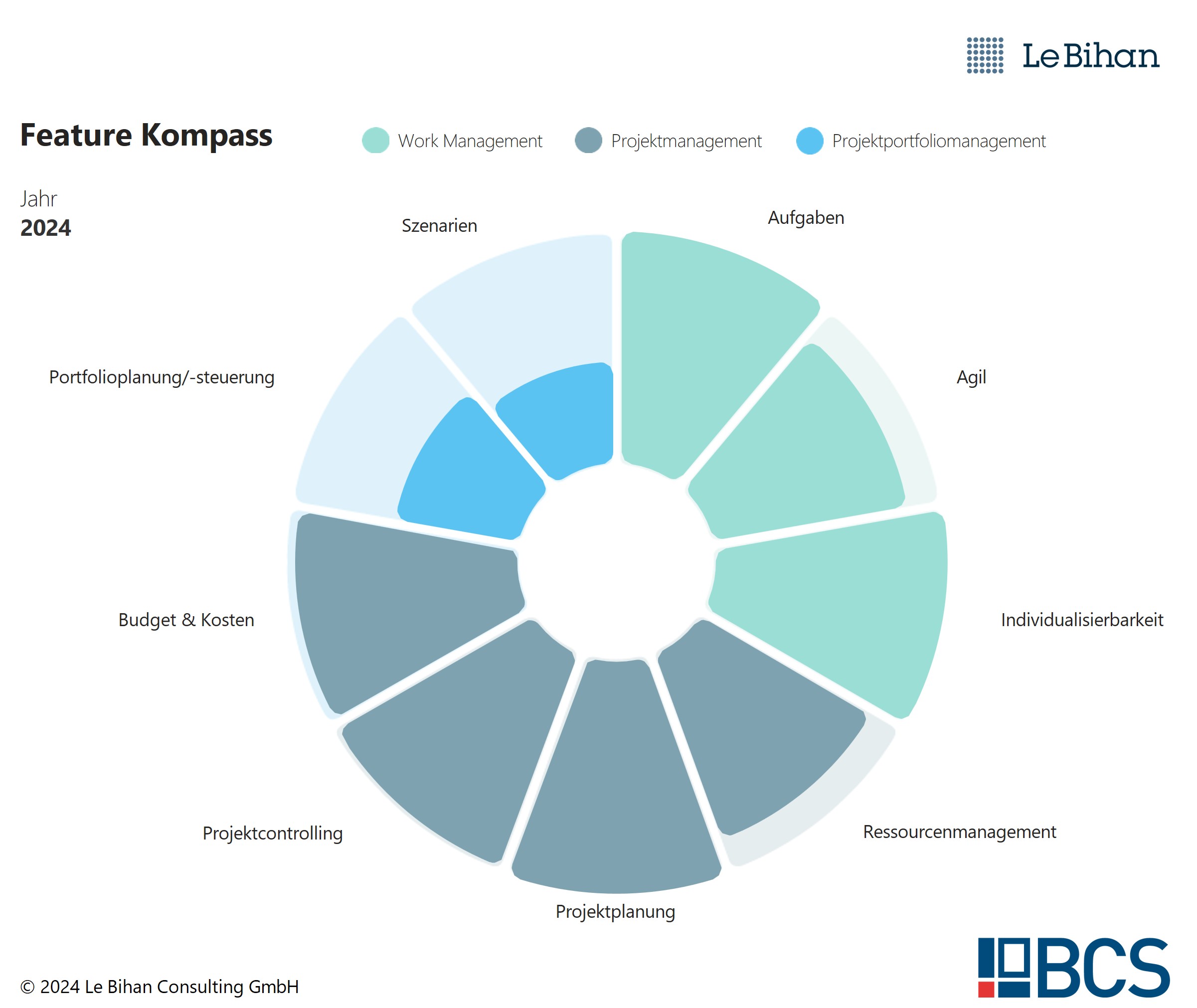
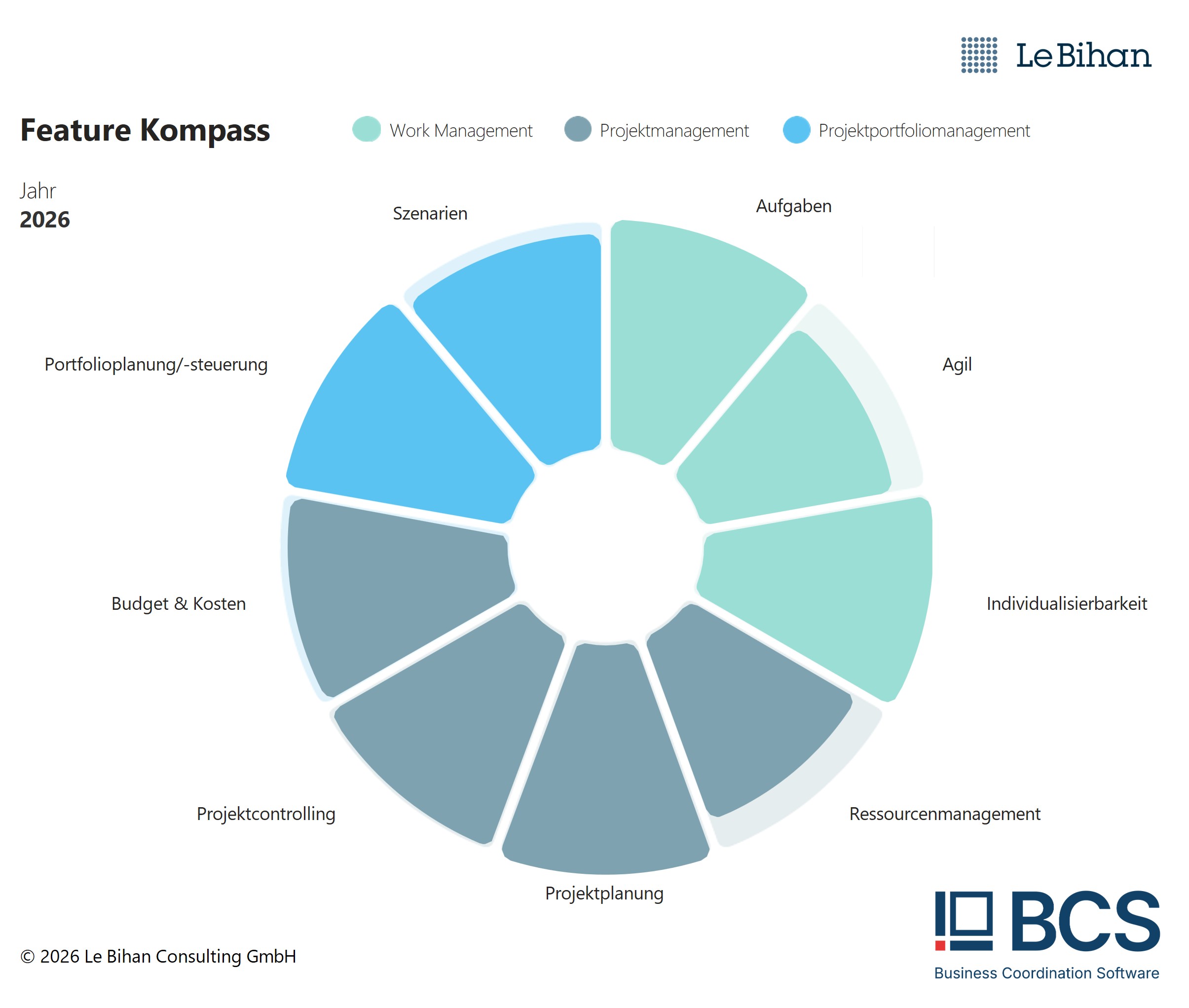
The independent Le-Bihan expert assessment rates BCS 2026 at 93%. The Feature Compass visualizes the functional range and quality characteristics of the business coordination software in comparison to the market.