03/31/2026 - Articles
How good is BCS 26.1? The review in projektmagazin
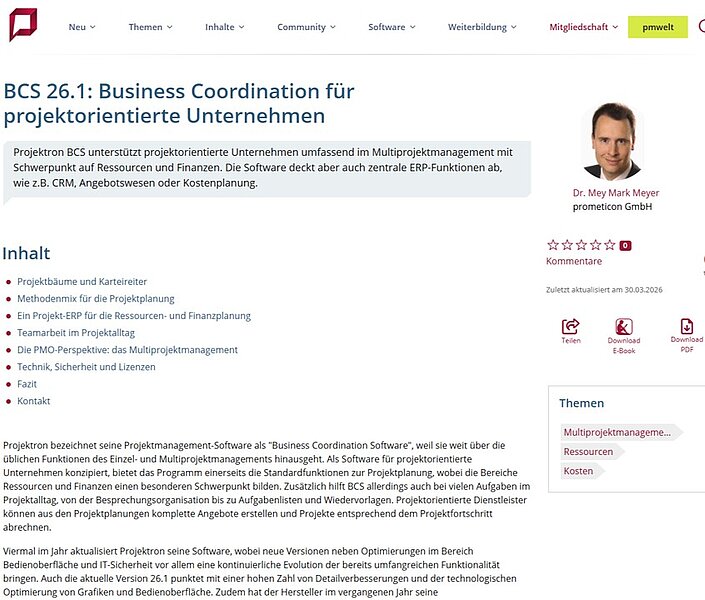
What remains of BCS when marketing claims are set aside and an experienced technical writer evaluates the software? The latest software review in projektmagazin provides a well-founded answer to exactly that question. In “BCS 26.1: Business Coordination for Project-Oriented Companies,” published on March 30, 2026, Dr. Mey Mark Meyer describes BCS as a solution for multi-project management with a focus on resources, finances, and related ERP functions.
BCS 26.1 in Projektmagazin: How Dr. Mey Classifies Business Coordination for Project-Oriented Companies
The article isn’t just a list of features. It answers a much more interesting question: What does business coordination mean in practice? Meyer views BCS not merely as project management software, but as a system that brings project-oriented companies together across several key management dimensions. This is precisely what makes the article compelling for readers who are interested not only in schedules but also in the interplay of projects, teams, budgets, proposals, services, and portfolio decisions.
The fact that the article is being published right now also aligns with product development: In the article, Meyer highlights that Projektron updates its software four times a year and that version 26.1 stands out primarily for its many detail improvements, user interface optimizations, and technical advancements. He also notes that the manufacturer restructured its development organization last year and expanded its development capacity.
Context of the Software Review
The article in projektmagazin is not intended as a mere overview of features. Rather, it aims to place BCS within the broader context of project-oriented companies.
The focus is particularly on three dimensions:
managing multiple projects simultaneously
dealing with scarce resources
linking project work with business processes
This perspective is crucial, because this is precisely where many traditional project management tools reach their limits.
The Author: Consultant, Practitioner, Software Expert
Dr. Mey Mark Meyer is the Managing Director of prometicon GmbH and an experienced consultant in the field of project management. He assists companies in establishing, optimizing, and strategically developing project management structures, particularly with a focus on project-oriented organizations. His professional background combines practical experience and academic expertise: As a graduate engineer, he earned his doctorate in project management and innovation and has spent many years intensively exploring the question of how methods, processes, and software interact optimally in project management. A particular focus of his work is on the selection, implementation, and evaluation of project management software.
His assessment of BCS is therefore based not only on theory, but on many years of consulting experience in real-world project environments.
Business Coordination: The Core Concept
A central theme of the article is the concept of business coordination. This refers to the ability to plan and manage projects not in isolation, but to closely integrate them with resources, costs, and organizational processes. The analysis shows that BCS addresses precisely this need. In addition to the familiar project planning functions, the software supports numerous tasks in day-to-day project work and extends these with business-oriented functions such as quoting, billing, and CRM.
This creates a system that not only manages projects but also actively contributes to the management of the company.
Flexibility in Project Methodology
Another focus of the discussion is methodological openness. In many organizations today, different project approaches coexist: classic planning, agile development, and hybrid forms.
BCS addresses this by bringing together different methods within a single system. Classic schedules with Gantt charts are available, as are agile elements based on tickets, backlogs, and sprints. At the same time, both worlds can be combined, allowing hybrid project structures to be mapped as well.
This offers a major advantage, particularly for companies with heterogeneous project landscapes: they do not have to commit to a single method but can work flexibly depending on project requirements.
Resource Management as the Key to Control
The strength of BCS is particularly evident in the area of resource management. In many project-oriented organizations, personnel capacity is the decisive bottleneck and, at the same time, one of the most challenging factors in planning.
The presentation demonstrates how BCS combines different planning levels here. In early project phases, placeholders can be used to estimate long-term demand. As the project progresses, these are replaced by specific team members, with workflows supporting coordination between project management and functional departments.
This is supplemented by analyses that visualize capacities and help identify overloads early on. Skills and qualifications also play a role, so that resources can be planned not only based on availability but also on competencies.
This makes it clear: Resource planning in BCS is not a byproduct, but a central management tool.
From Planning to Billing: Projects as a Single Economic Unit
Another key aspect of the analysis is the close integration of project planning and financial processes.
BCS enables users to generate quotes directly from planned workloads and defined roles. During project execution, work performed is tracked and can subsequently be billed—including additional costs such as travel, materials, or third-party services.
This end-to-end integration is a decisive advantage for many organizations. It reduces data silos, increases transparency, and ensures that financial considerations are incorporated into project planning from the very beginning.
The discussion makes it clear that BCS thus goes beyond the traditional role of project management software and takes on key functions of a project ERP system.
Support in Day-to-Day Project Work
In addition to strategic and planning functions, the article also highlights daily collaboration within projects.
BCS supports teams in organizing tasks, exchanging information, and documenting processes in a traceable manner. Tickets play a central role here: They serve not only as a task list but also as a structured communication channel through which work steps, comments, and decisions can be recorded.
The organization of meetings is also supported end-to-end, from agenda creation and execution to minute-taking and follow-up.
These functions demonstrate that business coordination does not occur solely at the management level but is reflected in the teams’ day-to-day work.
Technology, AI, and Security
The discussion also addresses the technological advancement of BCS. Modern web technologies ensure a contemporary user interface and interactive operation.
Furthermore, AI features help capture information more quickly, for example through automatic summaries or context-sensitive help. It is particularly relevant that these features can also be used in data-sensitive environments.
This is complemented by comprehensive security mechanisms and flexible operating models, ranging from installation on-premises to use as a cloud solution.
Perspectives for PMOs and Multi-Project Management
From the perspective of PMOs, the strength of BCS is particularly evident in its cross-functional management capabilities. Projects can be analyzed not only individually but also within the context of programs and portfolios.
Dashboards and reports provide transparency regarding progress, resources, and financial metrics. At the same time, features for evaluating and selecting projects help ensure well-informed strategic decisions.
This makes BCS a tool that bridges operational project work and strategic management.
Conclusion: An integrated approach for project-oriented companies
The software review in projektmagazin paints a clear picture: BCS is specifically designed for organizations where projects play a central role and are closely linked to resources and financial considerations.
The combination of project management, resource planning, financial control, and functions that support day-to-day operations makes BCS a solution that goes beyond traditional PM tools.
This creates added value, particularly in multi-project environments, which is reflected not only in better-planned projects but also in an overall improvement in management capabilities.
More interesting articles on the Projektron blog

Le-Bihan Assessment: 93% for BCS
How strong is BCS in practice? The independent Le Bihan assessment 2026 delivers a clear answer: 93% overall rating. This article breaks down the results, highlights strengths and limitations, and explains what the numbers really mean for portfolio management, resource control, and complex project environments.

Comparison: ERP for Service Providers
For service providers, choosing the right ERP solution determines efficiency, transparency, and revenue. Our comparison highlights the 10 best systems, explains which features truly matter, and provides valuable tips for making the right choice. Discover the ERP that will really drive your business forward!

Project management software comparison
Get an up-to-date overview: We compare 15 of the most popular and best project management software solutions. Start here, discover the market and compare for yourself!

Choosing PM software
If your SME or company is about to choose project management software, you probably don't know where to start looking for the right PM tool for you. This guide will guide you through the PM software market and lead you to the right decision in 9 steps.
Screenshot der Softwarebesprechung „BCS 26.1: Business Coordination für projektorientierte Unternehmen“ im projektmagazin (Quelle: projektmagazin.de, abgerufen am 30.03.2026)