02/11/2026 - Network
Strategic PMO in the age of AI: Projectron expert article on the GPM blog
Projektron-Redakteur Kai Sulkowski hat einen Fachbeitrag auf dem Blog der GPM Deutsche Gesellschaft für Projektmanagement veröffentlicht. Darin beleuchtet er die Transformation des Project Management Office im Kontext von Digitalisierung und Künstlicher Intelligenz. Der Artikel zeigt, warum PMOs heute strategischer agieren müssen und welche Rolle datenbasierte Transparenz dabei spielt. Wir geben einen Überblick über die Kernaussagen und verlinken zum vollständigen Beitrag.
Projektron expertise on the GPM blog
Our marketing editor Kai Sulkowski is featured as an author on the blog of GPM Deutsche Gesellschaft für Projektmanagement e. V. (German Association for Project Management) with his article “Strategic PMO in the AI age: transparency, prioritization, impact.”
GPM is one of the most important professional associations for project management in German-speaking countries. We are therefore delighted that Projektron is able to contribute its perspective on the further development of PMO structures in this environment.
The article focuses on the transformation of the Project Management Office – away from being a pure method administrator to becoming a strategic driving force. Or, to put it another way: from a timekeeper to the conductor of an increasingly complex project portfolio.
The PMO as conductor of modern project landscapes
Today's organizations resemble a large orchestra: numerous projects run in parallel, different methods are used, resources are limited, and strategic goals set the direction.
In this environment, a modern PMO takes on the role of conductor. It ensures transparency, coordinates dependencies, prioritizes tasks, and ensures that all participants work toward a common goal without restricting the technical independence of the teams.
Artificial intelligence acts as an analytical co-conductor. It analyzes project data, recognizes patterns, predicts bottlenecks, and provides a basis for decision-making, which the PMO can use to steer the project in a targeted manner.

Starting point: The classic PMO is reaching its limits
Traditionally, PMOs take on tasks such as:
Providing methods and templates
Consolidating status reports
Quality assurance and formal reviews
Monitoring standards
This model worked well in stable project environments. However, modern organizations are characterized by:
Parallel projects and programs
Short-term changes in requirements
Hybrid and agile working methods
Rising expectations for decision-making quality
A PMO that focuses primarily on control and reporting is losing acceptance and strategic relevance in this environment.
Drivers of transformation: complexity, digitalization, resource management
The article makes it clear that several factors are driving the realignment of the PMO:
1. Growing complexity of the project landscape
Dependencies between projects, programs, and line organizations are increasing. Transparency is becoming a key prerequisite for control.
2. Digitalization and intelligent analysis tools
Modern systems enable the automated consolidation of large amounts of data, recognize patterns, and support forecasts. Predictive analytics helps to identify risks and bottlenecks at an early stage.
3. Scarce resources
Capacities must be planned realistically and scenarios evaluated on the basis of data. Portfolio decisions require a solid foundation.
Digital tools and AI do not replace the expertise of the PMO, but rather expand it. Routine activities are automated, while strategic tasks gain in importance.
From operational support to strategic impact
A key argument of the article: The PMO must position itself as an active partner of management.
The focus in the future will be on:
Portfolio transparency and prioritization
Decision support based on valid data
Early identification of risks
Promotion of learning ability and methodological competence
Data is no longer just documented, but used specifically for control purposes. Dashboards will replace isolated status reports. Scenario analyses will enable informed portfolio decisions.
The PMO will thus become the connecting link between strategy and operational implementation.
Harmonizing methodological diversity
Modern organizations rarely work exclusively in a classic or agile manner. Rather, different process models exist side by side.
A modern PMO does not attempt to standardize this diversity, but rather creates comparability and transparency. The goal is harmonization rather than uniformity.
Intelligent analyses can help to highlight best practices, identify deviations, and leverage learning potential between teams.
Change management as a success factor
The further development of the PMO is not purely a structural project. It requires:
Clear role models
New competency profiles
Data and analysis expertise
Active change management
When using AI-supported tools in particular, organizations must proceed step by step, create transparency, and ensure acceptance.
The PMO itself plays a key role as a driver and companion of change.
Conclusion: The PMO as a conductor in the age of AI
The article paints a picture of a PMO that no longer acts as a “beat counter” but as the conductor of a complex project portfolio. It provides orientation, prioritization, and strategic impact, supported by intelligent analysis tools.
Organizations that actively shape this development not only strengthen their project landscape, but also their competitiveness.
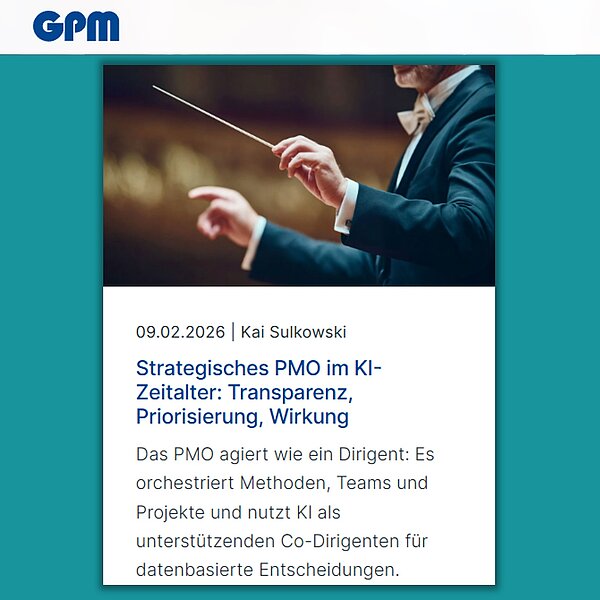
Screenshot of the GPM blog article teaser “Strategic PMO in the AI age: transparency, prioritization, impact,” published on https://www.gpm-ipma.de/ueber-die-gpm/blog, accessed on February 11, 2026.